Showing posts with label Mario. Show all posts

Wednesday, December 27, 2023

Mario & Luigi: Paper Jam

Mario & Luigi: Paper Jam
Developer: AlphaDream
Publisher: Nintendo
Original System: 3DS
System Played On: 3DS
Rating: 4 stars

On November 15, 2023, I defeated Bowser and Paper Bowser, thus finishing Mario & Luigi: Paper Jam on the Nintendo 3DS! During my playthrough, I leveled up Mario & Luigi & Paper Mario to level 38, and I rescued all the Paper Toads, and I did it all in 35 1/4 gameplay hours over a span of 2 1/2 months.

To quote the Simpsons & Family Guy crossover: "Yay! A crossover always brings out the best in each show! It certainly doesn't smack of desperation, the priorities are always creative, and not driven by marketing..." This sarcasm accurately portrays how crossovers seem like a good idea, but too often they rely on the marketing of the crossover itself than actual good writing. I am glad to report that Mario & Luigi: Paper Jam does not fall under this category. Mario & Luigi: Paper Jam truly wants to explore the idea of what would happen if the characters of Mushroom Kingdom would meet their paper equivalent. The writing was on point. More on that later.

The most notable thing that a Mario & Luigi and Paper Mario crossover brings to the table is a third member to the party - Paper Mario. Mario & Luigi: Bowser's Insider Story had Bowser as a third playable character, but Bowser play was asynchronous with Mario & Luigi play. Mario & Luigi: Dream had a team of Luigis playing with Mario in Dream World, but it was more like the Luigis were powering up Mario than actual playing alongside him. The last game to really have more than 2 playable characters was Mario & Luigi: Partners in Time, which included Baby Mario & Baby Luigi. With 2 games between Partners in Time and Paper Jam, more party members felt fresh. Paper Mario wasn't just another member of the party, though. He had some unique properties. He can make up to 6 copies of himself, which get destroyed before Paper Mario loses health. Naturally, to balance things out, Paper Mario has less HP. Of course, feeding Paper Mario enough heart beans can get Paper Mario caught up. Just in case gamers struggle with Paper Mario having fewer hit points, Paper Mario has flutter jump to dodge enemy attacks. Naturally, the developers accounted for this, but it's still an advantage, nonetheless. Paper Mario copies also come in handy for the attack. Instead of the usual double jump Mario & Luigi can do with a timed jump attack, Paper Mario can do a jump for each copy, up to 6. Of course, the developers accounted for this, making Paper Mario's individual jumps less powerful, but again, enough pow beans and equipment can bump that up quite a bit. Paper Mario's hammer attack also comes with a benefit. With up to 6 paper copies, Paper Mario's hammer can attack up to 6 enemies at once. It's nice to have a basic attack that can attack multiple enemies. He even comes with his own special attacks called Trio Attacks. As the name hints, it requires all 3 party members to execute. All these characteristics of Paper Mario play into his paper attributes, characteristics and personality well. The only one thing I don't get about Paper Mario's RPG battles is that his input color is yellow! I think it would have made more sense to make his color blue. Not only because of R-G-B, but because they all blue overalls!

The one paper aspect that I don't get was the papercrafts. The papercrafts replace the Bowser battles from Bowser's Inside Story and the giant Dreamy Luigi battles from Dream Team. To some extent, I get the Bowser battles and the giant Dream Luigi battles. They show off the hardware capabilities of the 3DS: the vertical 3DS gameplay, the touch screen and the microphone. The papercrafts use none of these. The gamer holds the 3DS horizontally, not vertically. The player puts his inputs with the buttons, not with the touch screen or the microphone. Therefore, I don't understand why this is in the game. Perhaps its intention is to give the gamer a break from the RPG gameplay, but I came here to play an RPG! Maybe the developers needed a break from designing an RPG to design some other game play. Whatever the reason, I just don't understand it. This is the bad, if not the worst part of the Paper Mario series (or at least the latter part of the series)- distracting from the RPG with different gameplay.

Another gameplay mechanic that distracts from the RPG gameplay is making the papercrafts in the first place. In order to make the papercraft, Mario & Luigi & Paper Mario have to rescue Paper Toads. Sometimes rescuing Paper Toads means chasing and catching them, when other times rescuing Paper Toads means finding them hidden in an area. Sometimes the Paper Toads rescues requiring avoid enemies, and if you get attacked, you have to start from the beginning, while others have time limits. Some have both, while others have neither. Some are required to advance the game, while others are optional, but the optional have some good payoffs, like a Bros. attack. I rescued all the Paper Toads for these benefits, and I would recommend it, too.

I won't spoil the plot, but I will say it's not a McGuffin search. I can always appreciate it. The problem with McGuffin searches is that the plot ends once all the McGuffins are found. Without a McGuffin search, the plot always have the player guessing if the plot is resolving sooner than later.

I will spoil, however, the final boss. [SPOILER ALERT!] Ok, this isn't really too much of a spoiler because it's easy to guess. The final boss is Bowser and Paper Bowser. I will allow this because of the dynamic of Bowser and Paper Bowser teaming up for double the trouble. Something less expected is that, halfway through the battle, Paper Bowser turns into armor for Bowser. Again, the combination works, so I will allow it. Still, it on the easier end of boss battles. I only failed once before succeeding, and my one and only failure came during the Paper-armored Bowser, which they were kind enough to reset me to the beginning of the Paper-armor Bowser halfway point. This is a little disappointing, considering a lot of the other boss battles did take a few rounds to learn. On the other hand, the easiness of the battle made the battle feel very fair at all times [/END SPOILERS].

And with that, I have played and finished all 5 Mario & Luigi games, thus ending the Year of Mario & Luigi. Here's my ranking of the games within the series, from favorite to least favorite-

  1. Mario & Luigi: Partners in Time
  2. Mario & Luigi: Paper Jam
  3. Mario & Luigi: Bowser's Inside Story
  4. Mario & Luigi: Dream Team
  5. Mario & Luigi Superstar Saga

I will still say, however, that the best Mario RPG is Super Mario RPG: Legend of the Seven Stars. Good thing it's received a remake, so that future generations can enjoy it with easier access to it!

Tuesday, December 26, 2023

Mario & Luigi: Dream Team


Mario & Luigi: Dream Team
Developer: AlphaDream
Publisher: Nintendo
Original System: 3DS
System Played On: 3DS
Rating: 2 stars 


On August 21, 2023, I beat Antasma and defeated Dreamy Bowser, thus finishing Mario & Luigi: Dream Team for the Nintendo 3DS! In my playthrough, I leveled up Mario & Luigi both to level 37, I recovered 100% of the Pi'ilo, and I recovered 86% of the blocks. And I did it all in 43 1/3 gameplay hours spanning over about 1 3/4 months (average 1 1/2 hours per gameplay session).

What sets Mario & Luigi: Dream Team apart from the rest of the series, as the subtitle hints, is that Mario can enter Luigi's dreams. Therefore, the player plays in 2 different worlds: Pi'ilo Island and Dream World. This isn't just a change in setting, though. It's also a change in gameplay. Pi'ilo Island has Mario & Luigi exploring on a 3D plane, while Dream World has Mario & Luigi (Dreamy Luigi in the Dream World) explore on a 2D plane. This transition is so seamless that they gamer may not even tell unless they are actively paying attention to it. The change in worlds also denotes a change in battle. While exploring Pi'ilo Island, Mario & Luigi fight side-by-side, with their own attacks and stats, as with the tradition in other games in the series. When in Dream World, however, Mario and Luigi merge into one, giving Mario a stat boost, but reducing Luigi to a supporting role. Naturally you would expect this to mean 2 types of boss battles, but actually, it results in 3 types of boss encounters. Boss battles in Pi'ilo Island are just like traditional Mario & Luigi boss battles. Boss fights in Dream World can take on the same format, but they can also become giant battles, similar to the Bowser battles of Bowser's Inside Story.

Listen, I wasn't a fan of the giant battles in Bowser's Inside Story. To me, they were glorified quick time events with a little strategy thrown into them. Still, it did make a little sense to contrast big and brawly Bowser to Mario & Luigi. In Dream Team, giant boss battles make even less sense. Yes, I get they take place in Luigi's Dreams, so Luigi can make himself whatever he wants, but that leaves the question on why he doesn't make himself a giant whenever he approaches any enemy of any kind, especially ALL the boss battles (not just some). I think even the game knows this because after enough failures, the game asks if you rather just skip them. No, I did not skip them. After enough attempts of learning patterns, they make sense and can easily be learned.

Remember how, regarding Bowser's Inside Story, I complained about how it relied too much on DS features, as opposed to Partners in Time, which minimalized utilizing the DS hardware? Well, it's about to get worse with Dream Team. As the first Mario & Luigi meant for the 3DS, it wants to use all the 3DS features, including touch screen, gyroscope, and holding the 3DS vertically. This doesn't just infiltrate certain areas of the game; this molds the entire game as a whole. You'll find touchscreen controls, gyroscope and holding the 3DS vertically in exploration, puzzle solving, battles, quick time events, minigames, and the list goes on and on. It's sometimes a little jarring when the gamer constantly has to move the 3DS from vertical to horizontal, when the player has to keep taking the stylus out and putting it back in, and when the gamer has mentally switch over from controlling Mario & Luigi with the circle pad to controlling them with the gyroscope. I know developers receive more support from publisher Nintendo with the more hardware features they incorporate. Still, with this constant switching, it almost feels like AlphaDream did not know what direct they wanted to take Dream Team.

As the first Mario & Luigi game designed with the 3DS in mind, however, one positive does come from it. This is the first Mario & Luigi game that can actually be played in 3D. AlphaDream designed some pretty cool features with it, too. Previously, countering or dodging an attack from a foe came down to jumping over the attack or swinging your hammer in tandem. In Dream Team, dodging can also include moving up and down to move out of the way of the trajectory of the shot. Sometimes, countering a move requires moving up or down to line up with the shot. Furthermore, sometimes enemies will surround Mario & Luigi, and the gamer has to tell Mario & Luigi which way to look in order to counter or dodge. Sometimes, the game will add an extra enemy in the background, which the player can choose to engage with a taunt, which gives the potential of greater reward at the cost a more challenging opponent. To top things off, the 3D in this game is never too straining on the eyes. I may have only played and finish 16 3DS games, but this game is one of the better uses of 3D.

[SPOILER ALERT!] So since there is 3 types of boss battles in this game, the end game has to be all 3 boss battles in a row. The first one is a giant boss battle, the second one is traditional boss encounter but in Dream World, the third one is a traditional boss fight in a traditional Mario & Luigi fashion. Fortunately, and smart on their part, they did put save points in between the boss battles, so you can put it down if too frustrated and pick it back up later. Probably my least favorite was the giant boss battle with Bowser. It's already bad enough that I didn't get enough boss battle experiences because it's part of the tertiary gameplay loop, Bowser has got some attacks and counter never experienced in a giant boss battle before. This was the closest I was tempted to go into easy mode for any kind of boss battle. There is very little difference between the boss encounter with Antasma in Dream World and Dreamy Bowser on Pi'ilo Island. Both are allowed to bring minions in battle, both are allowed way too many attacks before Mario & Luigi can get off 1 attack, and both can way too easily heal themselves (yes, I know it's technically unfair that I brought in 40 1-Up Deluxe Mushrooms and 30 Max Mushrooms for healing, but the computer doesn't have feelings!). I will say, though, that this is the first final boss battle in a Mario & Luigi game that didn't feel like a huge difficulty spike. Yes, they still took an hour each to vanquish, but it never felt like it was because I was too weak. Heck, I think I could have done it with Mario & Luigi at level 35 or even level 30! Again, it came down to simply learning the patterns of their attack, and then either countering or dodging appropriately. [/END SPOILERS]

Just a few other things I will quickly note. I was a bit annoyed that they removed a control for both Mario & Luigi to jump at the same time. Typically, that was assigned to the Y button, but not anymore. Now the X button acts as a second A button, and the Y button acts as a second B button. I don't see why the gamer needs a second A button or B button, but I can see why the player needs a simultaneous jump button. More often, the gamer wants Mario & Luigi to jump at the same time, and less often, the player wants Mario & Luigi to jump differently. Heck, I can even see a better reason to have a simultaneous hammer button than a second A and B button. Speaking of controls, instead of the L and R buttons functioning as a sort of move wheel, with the R button rotating clockwise and L button rotating counterclockwise, the R button does indeed rotate clockwise, but the L button merely resets it back to the beginning. The former is intuitive; the latter is not intuitive. I can definitely attest to this, as halfway through my gameplay, my R button decided not to work too well. One last final minor gripe: why did they bring Starlow back? Starlow had a purpose in Bowser's Inside Story. He was the information dump, the tutorial coach and the hint guide. In Dream Team, Prince Dreambert acts as the information dump, the tutorial coach and the hint guide. So why is Starlow there then?! I can imagine some people say he's there to interact with real Luigi to change the environment in Dream World, but why couldn't Luigi just move in his sleep? One companion is enough. There is no need for 2 companions, and Starlow is the weaker companion here, so he should have went.

While I definitely like Dream Team better than Superstar Saga, I think it falls in comparison to the rest of the games in the series. It seems to fall back to the vanilla version of the series, except it utilizes the 3DS hardware to the fullest extent, perhaps even too much.

Tuesday, December 19, 2023

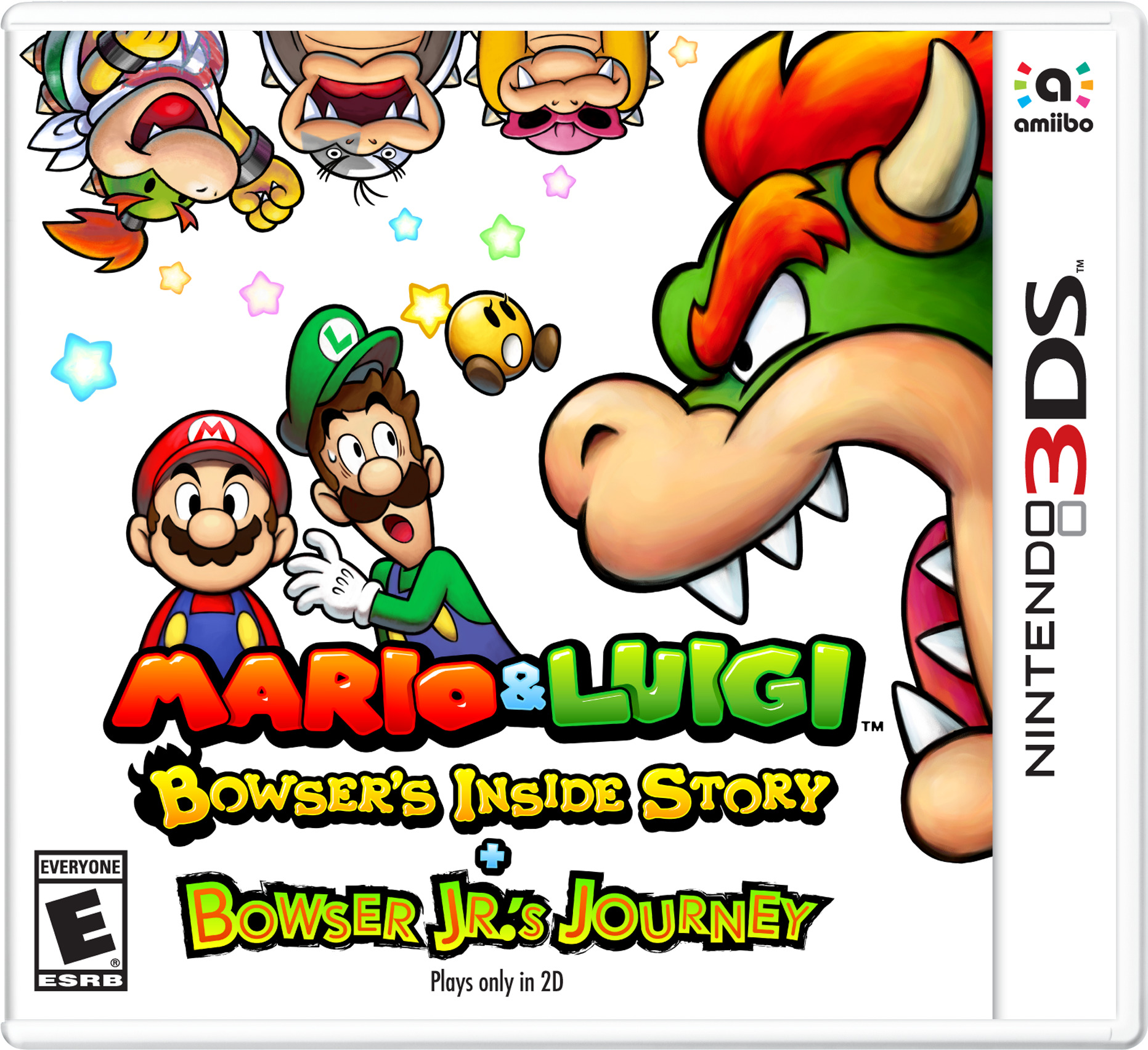
Mario & Luigi: Bowser's Inside Story + Bowser Jr.'s Journey


Mario & Luigi: Bowser's Inside Story + Bowser Jr.'s Journey

Developer: AlphaDream
Publisher: Nintendo
Original System: DS for Bowser's Inside Story, 3DS for Bowser's Inside Story + Bowser Jr.'s Journey
System Played On: 3DS
Rating: 3 stars 

On June 30, 2023, I defeated Dark Bowser and Dark Fawful (both products of the Dark Star), thus finishing Mario & Luigi: Bowser's Inside Story + Bowser Jr.'s Journey for the Nintendo 3DS. In my playthrough of the Bowser's Inside Story part, I leveled up Mario & Luigi to level 34, which is rainbow rank (the highest rank), and I leveled up Bowser to level 31, which is master boss rank (the second-highest rank). I also found 76% of the blocks, 54% of the beans, and 89% of the music. In my playthrough of the Bowser Jr.'s Journey section, I discovered 94% allies, 100% of the enemies, 66% challenges and 18% formations. I also cleared all 89 quests, thanks to getting my squad level 57. My playthrough for Bowser's Inside Story took 31 2/5 gameplay hours, and my playthrough of Bowser Jr.'s Journey took 18 1/4 hours, for a grand total of 49 2/3 gameplay hours over a 2-month span. [WARNING: SPOILERS ALERT AHEAD!]

Mario & Luigi: Bowser's Inside Story realized that 4 party members for 4 face buttons, like done for Partners in Time, was a bit too much, yet they didn't want to reduce it down to just 2 like in Superstar Saga. Therefore, the middle-ground was to have 3 playable characters. For this game, the 3rd playable character was Bowser. It only makes sense that a character as big as Bowser would take up the remainder face buttons. Yes, while Mario is the traditional A button, and Luigi is the typical B button, Bowser takes up X & Y. Bowser taking up 2 face buttons originally sounds helpful but ends up hurting. In regard to Mario and Luigi, when needing an action command, Mario is always A, and Luigi is always B. Regarding Bowser, however, when needing to do a quick time event, it could be X, or it could be Y. When you have to make quick-thinking reaction, it's easy to confuse the buttons, and that could be costly.

The 3 party members, however, do not play synchronous. Bowser plays separately from Mario and Luigi. This is the Inside Story of Bowser's Inside Story. At the beginning of the story, Fawful tricks Bowser into eating a vacuum shroom, which makes Bowser eat Mario & Luigi, as well as some Toads. Mario & Luigi spend a majority, if not most, of the game exploring Bowser's body. Bowser is the one exploring the outside world between Peach's castle and his castle. Therefore, the RPG battles will take place with either Bowser or both Mario & Luigi. Again, in regard to Mario & Luigi battles, the gamer merely has to tell which party member the attack is directed to, and then use the corresponding character's button. Regarding Bowser, however, the player has to figure which Bowser command counters the attack, which isn't always obvious. The kicker is that, in the 2nd half of the game, near the end, Mario & Luigi found a pipe in Bowser that leads to the outside world, allowing Mario & Luigi to traverse in between inside Bowser and the outside world. To quote CinemaSins, "WHAT ARE THE RULES?!" Did Bowser always have this pipe in him, or did he suck it up when sucking up everybody else? Did it always function in the sense it led to the outside world? How does it power itself? I don't get the point of this. I would have preferred the whole Mario & Luigi part of the game take inside Bowser, and leave Bowser alone the sole adventurer in the outside world. To me, the game should have ended when Mario & Luigi escaped Boswer's body.

Going back to RPG battles, Mario & Luigi have their traditional jump and hammer. Their special attacks, called Bros attacks, seem to be a combination of Superstar and Partners in Time. A lot of the attacks either come right from or are inspired by Partners in Time. The Bros attack are powered by Bros points, like in Superstar Saga, and not by items, like in Partners in Time. I like this best of both world approach. I liked the Partners in Time Bros attack better than the ones in Superstar Saga, but I like the single points system from Superstar Saga. The only problem, however, is to acquire these Bros. attacks, the gamer has to find puzzle pieces in a certain area. While well guided, they can still be missed. Bowser's regular attacks contain punching and fire-breathing, which fits Bowser. As a kind of sort of third attack, Bowser has inhale, which sucks up enemies for Mario & Luigi to deal with inside Bowser's body. I like this inclusion, as this is one of the ways to incorporate all 3 characters at the same time. Bowser has his own special attacks, known as Brawl attacks. When Bowser finds his minions in his exploration, he adds them to his party in the sense that he uses them for his special attacks. Whereas Mario & Luigi use their action buttons for their Bros attacks, Bowser uses the touch screen and stylus for his Brawl attacks. Ugh, why!?! It's somewhere between jarring and annoying that I have to take out my stylus to perform the Brawl attack, and then put it away for the rest of the battle. Half the time I just kept it out in my had while pressing the buttons.  Again, I ask why, just why. Speaking of which...

Well, way to go, everybody! Nintendo heard everybody mention how Partners in Time had so little touch screen input, so they stuffed it full of touch screen inputs for Bowser's Inside Story. In order for Mario & Luigi to activate parts of Bowser's body, it usually comes down to a minigame with touchscreen controls. The most famous (infamous) example is in the enzyme minigame for eating the carrot, but I didn't have too many struggles with it. As more touch screen minigames were added to gameplay, however, it became hard to keep track of which minigames requires which touch actions. It feels especially jarring when switching between button controls of the RPG battles and the touch screen minigames. Mario & Luigi has gone from not enough touch screen input to too much touch screen input.

Another added feature is when Bowser grows to kazu size to fight a building or a fortification. This too is based in touch screen. For these battles, the 3DS needs to be held vertical. While this is supposed to look cool, it does not feel cool. To start, the hinges of the 3DS gets in the way, unintentionally splitting a single image. On top of that, what's meant to be cool comes across as an inconvenience. The gamer has to turn the 3DS on its side when it begins, and then turn it back to normal when done. The player has to go to mashing buttons to furiously scribbling and tapping on the touchscreen. It almost feels like Alpha Dream or Nintendo had this gameplay mechanic in mind, but neither could think of a whole game of it, so they throw it into a Mario & Luigi game. This feels so out place. It does not need to be here.

Once again, Alpha Dream has a problem of escalating the final boss battle too much. On my final day of play, I did the battles between Fawful, Dark Star, Peach's Castles, and Dark Bowser/Dark Fawful. Those 4 battles alone took me 3 hours. Yes, each battle took about the same amount of time, so each battle took 45 minutes. Not only did the battle itself escalate, but the attacks within the battle escalate. One minute the enemies' attacks do 50 points of damage, and the next minute the foes' attacks do 150 damage! This makes it extremely hard to predict when to use items, and when you waste time to use items, you miss the window of opportunity to attack. I can't count the number of times that either a battle was elongated or I had to redo a battle because I miscalculated an escalated attack. Furthermore, Alpha Dream's final bosses once again gets an unfair amount of attacks. I can't count the number of turns when one of the bosses mentioned above got to use his entire arsenal of attacks before the player could even get off 1. Again, that turn is wasted if the gamer has to spend it using a healing item, only for the next turn to have the boss's whole arsenal of attacks to widdle down HP again. Once again, this feels unfair and unnecessary.

Just to briefly cover Bowser Jr.'s Journey. You'll notice Bowser Jr.'s Journey took longer than Bowser's Minion on Superstar Saga, 18 1/4 hours to 1 1/2 hours respectively. That's because Alpha Dream added more layers and gave it more depth. Bowser Jr.'s Journey adds "first mates," which gives Bowser Jr. extra leadership commands, which makes things more complicated. The 9 in your squad can form certain formations, which gives statistical advantages, as another layer of complexity. Whereas Bowser's Minions on Superstar Saga only had 1 extra challenge, a "true ending," Bowser Jr.'s Journey on Bowser's Insider Story has a whole after game, giving even more challenge. On top of that, Bowser Jr.'s Journey has a bigger and more complex story, especially considering it adds 3 brand-new antagonists. All these extra layers of complexity are good. I enjoyed them. My only complaint is that I got stuck in the middle and the end, which required grinding to advance. Still, I had to grind more often in Bowser's Minions, so Bowser Jr.'s Journey must have found a way to reduce it.

While not as exciting as the 4 party members of Partners in Time, the 3 party members of Bowser's Inside Story mixes up the formula from the 2 members of Superstar Saga. If the gamer is still wary about 3 party members, Bowser's Inside Story has the 3 party members play asynchronously, which still mixes up the formula plenty, considering both past and future games in the series. Bowser's Inside Story goes back to formatting of the Bros. Attacks from Superstar Saga, yet it keeps the style of the Bros. Items from Partners in Time, another example of the best of both worlds from the previous games in the franchise. Bowser's Inside Story utilizes the dual screens and the touch screen more than Partners in Time on the DS, for better or for worse. Bowser Jr's Journey fleshes out Bowser's Minions more, in both quality and quantity, making Bowser Jr.'s Journey worth playing more that Bowser's Minions. For all these reasons, I give Mario & Luigi: Bowser's Inside Story + Bowser Jr.'s Journey a 3-star rating out 5 stars. In comparison to the rest of the games in the Mario & Luigi series, Mario & Luigi: Bowser's Inside Story + Bowser Jr.'s Journey falls somewhere between average and mediocre. I would just play it, whether that be for an hour or until the player gets bored, but by no means feel obligated to either finish it or complete it.

Wednesday, December 6, 2023

Mario & Luigi: Superstar Saga + Bowser's Minions


Mario & Luigi: Superstar Saga + Bowser's Minions
Developer: AlphaDream
Publisher: Nintendo
Original System: Game Boy Advance for Superstar Saga, 3DS for Superstar Saga + Bowser's Minions
System Played On: 3DS
Rating: 1 star


On March 11, 2023, I finished Mario & Luigi: Superstar Saga + Bowser's Minions on the Nintendo 3DS, thus finishing my first Mario & Luigi game! For the record, I played both Superstar Saga and Bowser's Minions (because with the Kirby games I normally avoided the side/mini games). In regard to Superstar Saga, I beat Cackletta, leveled up both Mario & Luigi to level 36, and I also found 55% of the beans, 78% of the blocks and 88% of the music. Regarding Bowser's Minions, I beat Fawful, recruited 90% of the allies, saw 75% of the allies, learned 30% of the skills, and I did 63% of the challenges. It took me 46 hours to finish Superstar Saga, plus it took me another 1 1/2 hours to finish Bowser's Minions, equaling a grand total of 47 1/2 gameplay hours. And I did it all in a span of 2 1/3 months. Now I will review Superstar Saga and Bowser's Minions separately.

SUPERSTAR SAGA:

Nintendo has been on an ever so long quest to match or succeed the expectations set by Super Mario RPG: Legend of Seven Stars. This quest has produced both great hits and worst duds. Superstar Saga falls on the good half of the spectrum. Of course, this far exceeds Paper Mario games like Sticker Star and Color Splash, but even next to the original Paper Mario for the Nintendo 64 and The Thousand Year Door on the GameCube, Superstar Saga holds its ground. I expect nothing less AlphaDream, a video game development company made up of former Square employees. Since Super Mario RPG was a joint effort between Square and Nintendo, Superstar Saga feels more like a spiritual successor to Super Mario RPG than the original Paper Mario on the Nintendo 64 does. So many features of this game gave me nostalgic flashbacks of playing Super Mario RPG: the options of weak regular attacks or strong special attacks (they're called "Bros Attacks" in Superstar Saga), items including mushrooms to heal HP and syrups to regain Bros points, timed actions to give more damage or receive less damage, a well-balanced mix of turned-based RPG elements and platforming through a connected world (if anything, Superstar Saga feels more connected than Super Mario RPG), and minigame puzzles to solves, which were both connected to the main game and side games for bonuses. This is what I come to expect in an RPG game with Mario in it, thanks to Super Mario RPG: Legend of the Seven Stars, and I found it all in Superstar Saga.

What may be Superstar Saga's greatest hits may be also its worst duds. First, let's start with the difference between regular attacks and Bros. attacks, which is the special attacks. In Super Mario RPG: Legend of the Seven Stars, normal attacks all go in one menu and special attacks go in another. In Superstar Saga, while all the Bros. attacks go in 1 menu, jump attacks, hammer attacks and hand attacks (the common denominator category for Mario's fire attacks and Luigi's ice attacks), each have their own option on the battle screen. While I clearly remember the game pointing out hammer attacks upon getting the hammer, I don't recall a distinct point in which the game explained that fire/thunder can be used in battle. I didn't realize it until I saw my Bros. attacks now incorporated fire and thunder, so I figured the hand on the battle menu must be a simple fire or thunder attack. Speaking off difference between jump, hammer and hand attacks, the game really didn't do a good job of teaching these attacks had advantages and disadvantages. I knew from playing the Paper Mario series to not jump on spiny enemies or that hammers don't reach flying enemies, but the only way to learn this in Superstar Saga is to read through the in-game guides. I know the game encourages you to do so, but it does so in way that makes you feel like you're stupid for consulting the guide, and no game should do that. Make it evident in your gameplay. This gets worse with the hand attacks. Some enemies are weak to Mario's fire or Luigi's thunder. Some bosses can't even be defeated without using Mario's fire or Luigi's thunder! Does the game clearly tell you this? No. I guess I should have assumed that the boss that looks like a Christmas tree should be weak to fire, but I have played games that don't always play by those "common sense" rules (after all, in Mario's platforming games, you can shoot fireballs under water). To me, this is borderline sharing the same video game sin as Paper Mario entries Sticker Star and Color Splash committed. Unlike them, it's not as bad as requiring you to enter a battle with a specific item in mind to win. Like them, it's so bad that a game requires you to use certain attacks to defeat an enemy, especially a boss. I don't ever remember Super Mario RPG doing that to you. You just needed to widdle down the enemy's health, with either attacks or specials, and at worse, the enemy would disable one or the other. Superstar Saga takes away that freedom, and I don't like it at all.

Another shared feature between Super Mario RPG and Superstar Saga is the timed actions. Timed actions take the RPG formula up a step. No longer can gamers make a choice, set it and forget it. If the player taps the correct button when Mario's/Luigi's attack makes contact, the attack gives more damage. If the gamer taps the right button when Mario/Luigi is about to get hit, Mario/Luigi receives less damage. The only timed action not shared between Super Mario RPG and Superstar Saga is that Super Mario RPG had timed action for items. Timed actions have both advantages and disadvantages. As a disadvantage, if the gamer wants to indeed play an RPG that one can "set it and forget it" (like Pokémon), the gamer has to eliminate this game as an option. As an advantage, if the player gets just choosing commands and watching them play out, this kind of RPG keeps them busy. The problem with Superstar Saga's timed actions is that they seem to be a requirement. Forgive me if my childhood memories deceive me, but Super Mario RPG never required the gamer to use timed actions. Any enemy, including bosses, could be beaten without using timed actions. Timed actions merely gave an advantage by giving a bonus. Here in Superstar Saga, timed actions are a requirement. Some enemies, especially bosses, can one-hit KO you if you don't perform a timed action. If they don't one-hit KO you, they will two-hit KO you if you don't heal. This only gets worse as the game progresses. This is most evident playing defense, but it can also become apparently playing offense. Without timed attacks, if an opponent has a defense high enough, your attack will not damage the opponent. Even if it does land damage, quite possibly, your opponent will heal faster than you can damage. Anyone playing this game will quickly learn that the longer fights drag out, the less likely Mario & Luigi will win. Timed actions, whether attacking or defending, should not work this way. They should merely give the gamer something to do and merely give extra bonuses, not become a requirement for winning. I can't count the number of times I could only win by perfecting timed actions throughout the entire battle.

Both Super Mario RPG: Legend of the Seven Stars and Superstar Saga have platforming outside the RPG battles. Superstar Saga takes the platforming up quite a few notches. On top of jumping, Mario & Luigi have to high jump, spin, crawl low to the ground, crawl underground, dash and strafe. As a positive, this movement creates interesting puzzles. As a negative, since this game originally existed on the Game Boy Advance, and since A is Mario's action button and B is Luigi's action button, the L and R buttons become a scroll bar for scrolling through these actions. Now the 3DS remake makes this more feasible by making these movements accessible on the touchscreen, but since the touchscreen also has the map, I found more feasible to keep the map on the touchscreen and scroll through the movements with the L and R buttons. Now remember that a single room or environment might require several of these movements, and on top of scrolling through them to find the right one, you may have enemies attempting to attack you. Oh, and I forgot to mention that if Mario & Luigi attack the enemy, Mario & Luigi have an advantage, but if the enemy attacks Mario & Luigi, Mario & Luigi have the disadvantage. Sometimes it makes the most sense to clear the room of enemies before trying to solve the platforming puzzle, which maybe the developers intended, but I doubt it because sometimes an opponent will just wait at the end of the platforming puzzle, and that's not the gamer's fault.

[SPOILER ALERT!] That last dungeon of Bowser's castle is just ridiculous. Some of most basic and most simple minions can one-hit or two-hit KO you. It requires the gamer to constantly go back to the last heart box to heal, which slows down any feelings of progression. Then, all of a sudden, out of nowhere, Koopalings! Each Koopaling has his own gimmick, which I felt was never introduced previously in the game. So much for the final dungeon being a test of all skills learned throughout the game. It gets worse with the later Koopalings, in which, for some reason, need to be beaten in 8 turns. Why, game, why? Do you think I'm purposely drawing out my battles? To make matters even worse, the 3DS remake for someone reason makes Mario & Luigi defeat the last Koopaling in 5 turns! This is one of the shining examples of needing to do the timed actions perfectly in order to win, as I barely won that battle with 1 turn to spare. Then the final boss battle with Cackletta is more of an endurance run. In order to do that endurance run, however, make sure you're stocked up health restoring items (I would recommend at least 10 of each), and again, make sure you practiced your timed actions to perfection. Even then, some of Cackletta's attacks really don't give any hints on how to prepare for the attacks. [/END SPOILERS]

Just in case my length rants of the negatives portray me as not liking the game, let me throw in a few more positives to prove I enjoyed the game. I do like the fact that each Mario Bros. has his own button, with Mario's action button being A and Luigi's action button being B. It adds to the feeling that the gamer is truly controlling both Mario Bros. at the same time. I can appreciate that the first Mario & Luigi game, unlike the first Paper Mario game, did not resort to making Bowser the final boss and his traditional minions the typical enemies. It was nice to have a new setting, new NPCs and new enemies, especially including a new final boss (even if Bowletta did feel like Bowser battle in disguise). I also liked that the game did not resort to a McGuffin fetch quest. Honestly, I was expecting the premise and plot of the game to fetching a certain amount of McGuffins. After all, that's what Super Mario RPG and the first Paper Mario did (ironically, both were 7 stars). While there is technically a McGuffin search, it doesn't happen until near the end of the game, and one of the main NPCs actually aids in collecting the pieces. A very pleasant surprise. Lastly, I'm glad Nintendo decided to do a graphical remake, not just an enhanced port. The Game Boy Advance has the hardware power of a Super Nintendo, but the 3DS is somewhere between the Nintendo 64 and GameCube, so it had the power to look prettier, and Nintendo utilized that. I compared screenshots, and let me tell you, I preferred the 3DS look every time. I would highly advise playing the 3DS version, even if it's free with your Switch Online subscription, especially if you want to play Bowser's Minions. Speaking of which...

BOWSER'S MINIONS:

Bowser's Minions pretty much falls under the RTS genre. The gamer picks out minions to fight in a battle against other minions, based off their stats, and then the player proceeds to watch it play out, hoping to win. Just like with Superstar Saga, Bowser's Minions does provide timed actions to prevent the gamer from getting bored waiting for the outcome. As the captain, the player has such action as denying the enemy's timed action, giving a stat boost, doing a sneak attack, calling for extra help, challenging the opposing captain head on, etc. Of course, these have costs, which the player will have to weigh out during gameplay. Even when all the captain points have been spent, the gamer can assist the NPC teammates with random action commands, assuring the player will never get bored. Some levels will have 2 or 3 battles, while other levels with have 6 or 8 battles. While teammates heal between battles on every level, if your team struggles on the first battle, your team will less likely make it all the way until the end.

Believe it or not, the grinding is fairly low. Usually, when I lost a battle, it was less likely due to under-leveled fighters and more likely due to choosing the wrong team. All I had to do was simply edit the team, and I was good to go. It wasn't until the last world that I actually had to grind to level the fighters up to a level in which they could handle the upcoming level.

This side/mini game only took me 1 1/2 hours, although I will admit that sometimes it felt longer than that. That 1 1/2 hours is just about right for this kind of game. Any longer, and I would have gotten bored, but any shorter, I would have asked myself why I played in the first place (or why the developers took their time out developing the main game for this side/mini game). Now in all honesty, I played up to the false ending. I did not get the opportunity to play the true ending. I thought the true ending required me to first beat Superstar Saga. I found that the true ending required me to fully complete Bowser's Minions up to defeating Fawful, which I did not do. This brings me to my biggest and only complaint about this side/mini game.

Bowser's Minions has optional levels called captain's challenges. In these captain's challenges, the gamer must learn to master the captain's special skill to pass. In order to make sure the player has truly mastered the captain's special skill, the game puts in place extra barriers. First, the captain goes in alone, without any minions. Second, the opponent is way over leveled. With the early captain's challenges, this is a small barrier. Simply activate the captain's special skill ability, and winner winner chicken dinner. With the later captain's challenges, however, this is a big barrier. The captain has to be a certain level, the captain's special skill needs to be activated at exactly the right time, and still even then the challenge still feels like it was coming down to luck. In my opinion, it's not worth it, and if I were you, don't waste your time on fully completing Bowser's Minions to get the true ending. Just finish it with the false ending.

Friday, December 31, 2021

2021: The Year of Paper Mario

 After The Year of Super Mario in 2020, after playing 21 platforming games in 2020 (22 if counting Super Mario 35), I wanted a changed in video game genre. I considered changing over to the RPG (role playing game) genre. I had not played an RPG since my Pokémon days, and I thought it would be nice to get back into them. My only hesitation is that I know RPGs can be an investment in time, and going through both an adoption and a dissertation, I could not afford a game which required an investment in time. I looked for a light RPG, and I assumed that Paper Mario looked like a lighter RPG. I also found myself interested about the recent conversation about the Paper Mario series. It seems like the Paper Mario series has gone from RPG to RPG Light to RPG elements. With the recent Paper Mario games, you either love them or hate them; there is no middle ground. As somebody not blinded by nostalgia glasses, I wanted to see if these games held up by themselves, with or without embracing the RPG genre, and if one can just like Paper Mario games. Therefore, I declared 2021 the Year of Paper Mario! For the year of 2021, I aimed to finish all 6 Paper Mario games. Naturally, it only made sense to begin with the original that started it all, and then play in order of release.


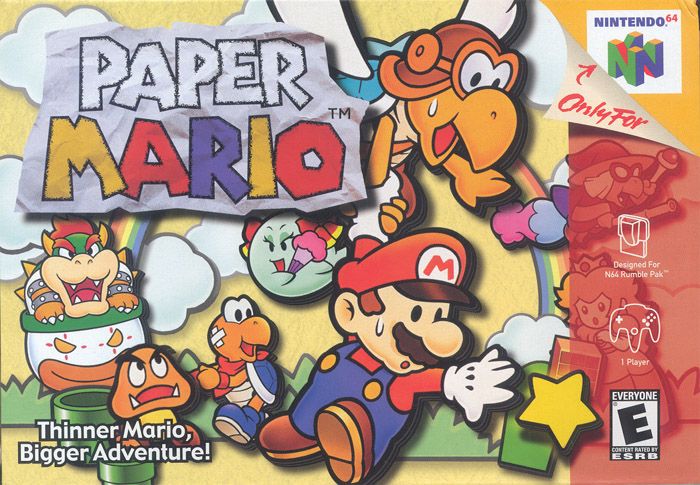
On February 27, 2 months in 2021, I saved all 7 star spirits and defeated Bowser (twice!), thus finishing Paper Mario for the Nintendo 64 (via the Wii U Virtual Console)! In my playthrough, I collected 33 star pieces and 28 badges. I leveled up Mario to level 23, giving up 55 HP (maxed out), 55 FP (maxed out) and 18 badge points. I also leveled up all 8 party members to super level and 5 party members to ultra level. And I did it all in a matter of 21 hours. If familiar with the back story of Paper Mario, this game was originally supposed to be a sequel to Super Mario RPG: Legend of the Seven Stars. While Nintendo went a different direction early in development, some of the gameplay still felt reminiscent of Super Mario RPG. For example, the quick time events give the gamer something to do, besides selecting attacks and waiting. At the same time, however, the gameplay feels watered down compared to Super Mario RPG. Mario only has 1 partner to help in battle, as opposed to 2, although these partners can switch out. Only Mario can use items and the special star moves, whereas each character in Super Mario RPG can use attacks, special attacks, items and a defense stance. The level up system rewards increasing HP first and then FP, whereas Super Mario RPG rewards equally improving the characters. I think I prefer the gameplay of Super Mario RPG over Paper Mario. Nintendo had a good attempt at an RPG, but Nintendo should have left RPGs to Square (Enix), the king of RPGs. Similarly, the story of Paper Mario resonates with Super Mario RPG: Legend of the Seven Stars. Again, Mario has to collect 7 stars, but this time, the stars are alive (that is, personified), and these stars give you power (which gives the stars more importance than the McGuffin status in Super Mario RPG). The only problem is that big bad boss is Bowser again, instead of an original character like Smithy. Yes, I know Shigeru Miyamoto does not like his original property messed with, and yes, I know it will get worse, but Mario versus Bowser just feels like another Mario game. It's just that now the combat is RPG instead of platforming. And why does Mario have to face off against Bowser? To save Princess Peach, of course! Again, this feels like another Mario game. Just substitute platforming with RPG.


About 2 months later, on May 1, I defeated the Shadow Queen, thus finishing Paper Mario: The Thousand Year Door for the Nintendo GameCube (via the backwards compatibility on the Nintendo Wii). During my playthrough, not only did I collect the 7 crystal stars, I collected 73 star pieces, 48 of 85 badges (that's a majority of them!), all 42 shine sprites (thus fully upgrading all partners but the optional partner Ms. Mouz), and I also journaled 95 of 124 tattles. And I did it in 36 1/2 hours. And I have a hot take: the original Paper Mario is better than The Thousand Year Door. I felt the game had both positives and negatives. Let me get the positives worth complimenting out of the way first. Paper Mario: The Thousand Year Door has more RPG elements. I like how now Mario's health and the partner's health are separate. I also like how the quick time events give something to do as turns play out, not just a set it and forget it. I like story, for the most part. I appreciate how it wasn't Bowser trying to steal the Mushroom Kingdom from Princess Peach. As a matter of fact, both Bowser and Peach have their own subplots, which the gamer can play. My favorite were the Bowser parts, as many of them re-enacted famous levels from the first Super Mario Bros. In some regards, Paper Mario: Thousand Year Door is more of the original Super Paper Mario, with some fine tuning. Now let's get to negative. Somebody should really discipline the game developers, for at sometimes I do not think they understand good game development. It seemed like every chapter involved backtracking with no good reason. I sometimes even thought the developers included so much backtracking to pad time, which it really didn't need. The worst infringement was near the end (semi-spoiler, I guess) when the game has the player travel the entire world map to look for a character, only to find out he was at the starting point! Yes, I know that was the joke, but without any real instant quick travel, it was annoying! The puzzle segments were not always self-explanatory. I got the official Nintendo Power walkthrough packaged with my game, and without it, I would never have solved the puzzles. True to Mario, sometimes the game required platforming, and the platforming felt off. I would press A and Mario would not jump. Mario would fall short to a jump he should have made. Yes, ultimately it is a RPG, so jumping is not supposed to spot on as a platformer, but it should be manageable and not frustrating. Then came final showdown, which was like an Elite Three because it had 3 boss fights in a row, only allowing healing and saving between the second and third. I only survived the first two because I figured out a way to level up between the first and second, thus healing me. But I legitimately got stuck on the final boss. The only way I could get through was through grinding. Those past 2 sentences I should never have to say in a casual RPG, like Paper Mario. Since Mario maxes out at level 30, once the player reaches level 25, leveling up becomes grinding to its fullest definition. No matter who are Mario's opponents, Mario only gains 1 star point (Paper Mario's experience points) per battle. If you do the math, then yes, leveling up Mario to level 30 would take 500 star points or 500 random battles. I managed to get to level 27, but from then, I focused on upgrading my partners. While Thousand Year Door had fine-tuned RPG gameplay and a fresh story, it also had dully repetitious backtracking, puzzles more confusing than intriguing, off platforming and bosses requiring grinding to the right level. Nevertheless, after playing through the entire series, I looked back at this game and decied the positives outweighed the negatives. Paper Mario: The Thousand Year Door would become my favorite game of the series.


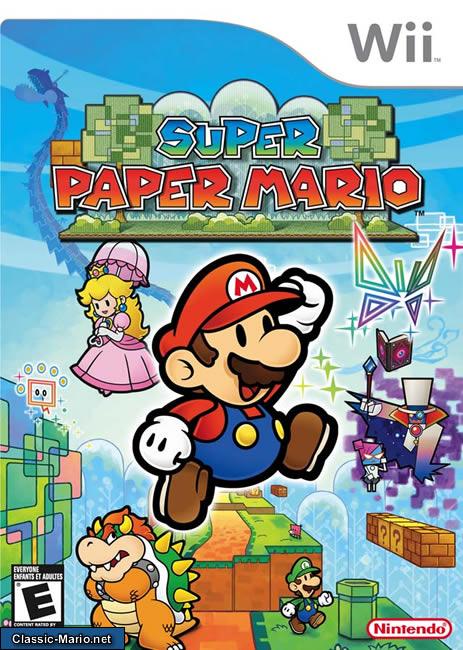
About a month later, by the end of the month of May, I beat Count Bleck and defeated Mr. L & Dimentio, thus finishing Super paper Mario for the Nintendo Wii! This is the 3rd Paper Mario game I have played and finished. In my playthrough, not only did I collect the 8 pure hearts, I also collected all 12 Pixls (which means I did do both Pixl side quests, including the Pit of 100 Trials in Flipside), 46 of 256 cards, 4 of 96 recipes and 999 coins, thus maxing out my coin counter. I earned a high score of 783,270, leveling up Mario (and team) to level 17, giving Mario (and gang) an HP of 50 and an attack of 10 (20 for Bowser). And I did it all in 18 3/4 gameplay hours over the span of roughly a month (more like 8 days because I only played Super Paper Mario on the weekends). Super Paper Mario is so controversial among Nintendo fans, not because it's a bad game, but because the gameplay shifted from a full RPG to a platformer with RPG elements. Yes, if you're looking for a full RPG, Super Paper Mario will disappoint you. If you're willing to try a platformer with RPG elements, Super Paper Mario is a good choice. They do seem to blend the two together well. For starters, some of the levels clearly have their inspiration from the first Super Mario Bros., which will give you a dose of nostalgia. Then inserting the RPG elements allows the developers to provide a new game experience to old level designs by experimenting. It was nice to take damage and not get an immediate game over. By adding elements from RPGs, which not only includes gameplay mechanics but also story mechanics, Super Paper Mario has demonstrated that platformers don't merely have to consist of reaching the end of the level. Platforming levels can have both enemies and NPCs to interact with, which can progress the story.  Platforming levels can have buildings to enter and dungeons to explore. The story does not have to be an overarching premise. It can develop in every world and in every level. It's a shame Shigeru Miyamoto tries to keep the story in a Mario game to a minimum because Super Paper Mario demonstrated that platformers can have in-depth stories, especially thanks to the RPG elements. Speaking of story, this story feels the closest to Super Mario RPG because it has Mario teaming up with Bowser and Princess Peach to fight a brand new boss, whose henchmen consist of both familiar enemies and new enemies. While criticism might come for taking Super Paper Mario far away from the RPG gameplay of Super Mario RPG (from which the Paper Mario series descended), Super Paper Mario has the closest story to Super Mario RPG yet in the series. While I lean more towards the like it than dislike it crowd, I do see it has faults. I don't understand why only Mario can flip from 2D to 3D, besides the fact it becomes Mario's special skill. If this is Paper Mario, where even enemies can flip, every team member should flip, too. Think of something else to give Mario a special skill. On a similar note, it became annoying that every team member's special skill was mapped to a different button. Since the A button has no use outside Mario (because the A button is mapped to Mario's special skill), then map all the special skills to the A button. Speaking of buttons, I also missed the feature where the player could back in dialogue if the player missed something by reading too fast. The B button remained unmapped throughout the whole game; it could've had that purpose. Sometimes the worlds felt unbalanced because one world could take a half hour and another world could take 2 hours. One could argue that the game is too easy. Coins are too easy to get. I maxed out my coin counter a couple times, despite buying 2 warp pipes. I didn't get a single game over (OK, technically I did once, but I would argue that I got softlocked because I got stuck in a place where I couldn't get out and only receive damage). This would especially include the final boss battle, but one could technically argue the final boss battle was so easy for me because I leveled Mario (and team) up so much. For my overall opinion, I will again say what I said earlier. If you're looking for a standard, typical RPG, it's a bad game. If you're looking for a platformer with RPG elements, it's a good game.


Almost a month to the date of finishing the last time, on June 27, I Defeated Bowser, thus finishing Paper Mario Sticker Star on the Nintendo 3DS. In my playthrough, I collected all 6 royal stickers, all 38 comet pieces and all 16 HP hearts, giving Mario the max HP of 100. Unfortunately, I only discovered 4/5 Luigi stickers, and I came up much shorter on secret doors. Altogether, it took me 20 gameplay hours over the span of about a month (according to my 3DS, I averaged 1 hour 57 minutes per session). And now I see why Nintendo fans and Paper Mario fans alike consider Sticker Star the worst game in the series. A little background to preface this review. When planning for Paper Mario Sticker Star, Shigeru Myamoto has 2 new rules for Paper Mario. First, since Paper Mario is a subseries of the Mario series, all characters had to come from the Mario world (i.e. Mushroom Kingdom) and no new characters could be created. Second, since Paper Mario is a subseries of the Mario series, Mario games do not have complicated stories, so the story must be simple. These 2 rules did a great disservice to the Paper Mario series. In order to keep the story short and sweet, the story downgraded to yet again Bowser kidnapping Peach to get ahold of a magical power. In order to keep the story to just Mario characters, there are no teammates for Mario. Mario works alone. Any "ally" (here defined as a non-combatant NPC) has to be a Toad, and there a lot of Toads in this game. All the enemies are familiar from the Super Mario series. Even Bowser's sidekick got downgraded from Kami Koopa to random generic magikoopa. The only original character is Kersti, a crown sticker personified, but she is the Navi of this Paper Mario game, only there to give hints and tips to Mario when lost. This lack of original characters and plot made the story quite bland. Then there's the gameplay. The "good news" (if you want to call it that) they brought back the turn-based battle system, and it even comes back with time hits. The bad news is that Mario does not gain experience points or level up from the battling. It makes you wonder, "Then what's the point of this battle system?" To make matters worse, in order to execute attacks, you must have a sticker, which can be found around the world and in shops. Without the sticker, you're out of luck. Without the experience points and leveling up, alongside needing stickers, the gamer wants to avoid battles. When caught in a battle, the player wants to run away, which he or she can, as long as he or she mashes A enough. Still sometimes, though, the even that won't allow Mario to escape. The gamer asks, "Why do I have to stay and battle?" and the game answers, "Just because." A game where the player wants to avoid the primary gameplay loop is not a good game. By the end of game and by the end of series, I joined so many others by concluding that Paper Mario: Sticker Star is the worst Paper Mario game in the series.


2 months and 1 day later, on August 28, I defeated Black Bowser (man, that sounds racist), thus finishing Paper Mario: Color Splash for the Nintendo Wii U! In my playthrough I collected all 60 basic cards, 37/72 enemy cards (that's a majority of them!), all 27 thing cards, 24/40 artwork (that's a majority of them!) and 20/33 records (that's a majority of them!). I also earned 5/6 banners, meaning I found all the cut-outs, executed over 200 excellent attacks, collected over 10,000 coins, bought over 200 cards, and beat all Roshambo temples. The only banner I did not earn was the colorization banner because I only reached 61% colorization (hey, that's 3/5!). And I did it all in 40 gameplay hours over a span of 2 months real time. Just like Thousand Year Door, Color Splash had both its positives and negatives. Let's start with the positives. Up to this point, Paper Mario: Color Splash is the most beautiful Paper Mario game, in aesthetic and graphics. Everything in the world genuinely looks like paper or carboard, especially with the white border around all the characters (I know that's a hot take, but I think the white border really sells the paper aesthetic ). Someone might even think Nintendo found a way to make a stop motion video game. Nintendo knew if they want to make the focal point of this Paper Mario game colors, they had to bring the colors. Indeed, they truly brought the colors. All the colors in the game were bright and vibrant.  I especially appreciate how they divided the game's world into 6 main colors, and the levels within the world all have shades of those colors (for example Cherry Lake & Crimson Tower in Red World and Plum Park & Violet Passage in Purple World). Also deserving praise is the soundtrack. Up to this point, Paper Mario: Color Splash has one of the most beautiful soundtracks. Koji Kondo has created one of the best soundtracks in his career. The soundtrack covers a wide array of genres, and none of them seem out of place. The game credits 29 musicians, each for their own instrument, and they deserve it. This game definitely needs to be played with television sound all the way up or wearing headphones or earbuds. Then comes the gameplay. The primary gameplay loop from Paper Mario: Sticker Star returns to Paper Mario: Color Splash. The battle sequence is turn-based, but it is not a turn-based RPG, meaning no experience points and no levels, but time hits still reappear. This time, however, it's more complicated. Instead of stickers, Color Splash uses cards. First, the gamer has to select the card on the touch screen. Nintendo must have heard the complaints about the lack of space for stickers because Color Splash has room for 99 cards, and all cards are the same size, just taking up 1 slot. Rarely will the player run out of room for cards (that only happened once or twice for me). Second, the player has to paint the card. After all, it would not be a color splash without paint. Paint increases damage and likelihood of perfectly timed attacks. Players can use cards without paint, but it will do less damage, and it will less likely lead to multiple attacks. Third, gamers have to flick the card from the Wii U Game Pad to the TV. Yes, 3 moves to execute an attack (four if including pressing A/tapping the screen for timed attacks). It felt like a lot to execute an attack, especially next to Sticker Star, in which the player had to merely tap on the sticker. Furthermore, this new primary game loop requires the gamer to have both cards and paint in inventory to execute an attack. Again, yes, technically an attack does not need paint, but it will hinder without it. And yes, some cards come already painted. Furthermore, to be honest, the game provides plenty of opportunities to collect point, as I personally only ran out of paint once or twice. Nevertheless, it complicates the primary game loop. It has come a far way from merely pressing a button to select an attack, as seen in the first 2 Paper Mario games. The complication becomes even less worth it knowing it will not give experience points or leveling up (oh, more HP comes as a result of beating a world boss and recovering a big paint star). Just like Paper Mario: Sticker Star, Paper Mario: Color Splash divides into 6 worlds. Since this Paper Mario game is subtitled Color Splash, all the worlds have color names. Furthermore, the levels within the world all  the levels within the world all have shades of those colors. For example Cherry Lake & Crimson Tower in Red World, and Plum Park & Violet Passage in Purple World. Nintendo deserves praise for that creativity. On the flip side, however, Color Splash has no good reason why the divide the game into worlds and levels. Dividing into worlds and levels made sense for Sticker Star, for the 3DS may not have the power to handle a single, open world. The original Paper Mario had a single, open world on the Nintendo 64, and Paper Mario: Thousand Year Door had a single, open world on the GameCube. Surely, the Wii U could handle a single, open world. Just like Sticker Star, Shigeru Miyamoto and Takashi Tezuka supervised Color Splash, which explains a lot. If unfamiliar with Nintendo, Shigeru Miyamoto and Takashi Tezuka supervise the Super Mario series. Super Mario games always divide into worlds and levels, so naturally, Paper Mario: Color Splash has to divide into worlds and level to feel like a Super Mario game (perhaps to attract a wider audience?). What makes worlds and level so bad is that it makes apparent the pacing of the game. I kept track how long it took me to get each big color star. It took me (in order of getting the stars) 6 1/4 hours for the red paint star, 4 3/4 hours for the yellow paint star, 5 3/4 hours for the blue paint star, 4 3/5 hours for the purple star, 5 1/2 hours for the orange star, 6 3/4 hours for the green star, 6 2/5 hours to beat Bowser, for a total of 40 hours. Paper Mario: Thousand Year Door took a little less (36 1/2 hours), and Thousand Year Door required collecting stars, but it did not feel so slow because it had a single, open world. Splitting the game into worlds and levels made apparently the slow pacing of the game. Once again, because Miyamoto and Takashi Tezuka supervised Paper Mario: Color Splash, the game has no unique characters besides the companion Hugh, a paint can (get the pun?). This companion Hugh is not to be confused with the partners of the original or Thousand Year Door (and maybe Super Paper Mario?) because Hugh does not attack. Just like Kersti in Sticker Star, Hugh merely gives hints, and to be honest, Hugh is not good at giving hints. Whenever the gamer wants a little hint, Hugh gives a big and obvious hint, pretty much saying the answer. Whenever the player needs a big hint, Hugh pretty much says, "I don't know, go ask the Hint Toad," which is all the way back at the "hub level" Prism Plaza and requires 10 coins for a vague hint! Just like Kersti in Sticker Star, Hugh is almost worthless. Also just like Sticker Star, Color Splash has a problem with puzzles that it thinks is obvious, but in reality, it is not so obvious. Similar to Sticker Star, nothing feels more annoying than needing a certain thing to solve the puzzle, but that thing is not in the inventory, so the gamer has to either find the thing again or traverse back to the "hub level" Prism Plaza to buy the thing. Also due to Shigeru Miyamoto and Takashi Tezuka supervising Color Splash, the game plot comes down to Bowser kidnapping Princess Peach. At least this time Bowser delays kidnapping Princess Peach to change things up a bit. [SPOILER ALERT!] The game tries to portray Bowser not in control, rather, controlled by the black paint, but this does not really change things up that much [/END SPOILER]. Probably also due to Miyamoto and Tezuka supervising Color Splash, each world's boss is a Koopaling. Although the first appearance of the Koopalings in the Paper Mario franchise, the oversaturation of the Koopalings in the Super Mario Bros. series makes the boss levels in Color Splash feel unoriginal. Even an oversized standard enemy, another staple of the Super Mario series, would have felt more original. While a bit tempting to mark this game as the worst, even worse than Sticker Star, I ultimately recognize this game is an improved Sticker Star, and since Nintendo improved on Sticker Star with Color Splash, Color Splash, by default, ends up higher than Sticker Star.


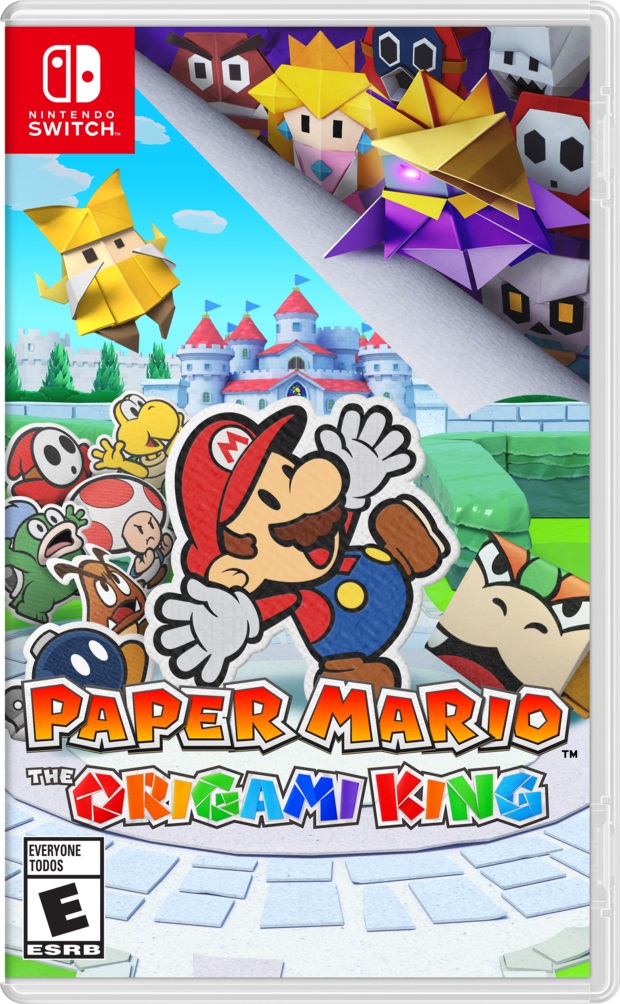
Once September rolled around, I started on Paper Mario: The Origami King, the most recent and last entry of the Paper Mario series. About a month and a half later, on October 16, I defeated Olly, thus finishing Paper Mario: The Origami King on the Nintendo Switch! This is the 6th Paper Mario game I have played and finished. During my playthrough, I also rescued 353 Toads. And I did it all in about 27 1/2 gameplay hours over a span of about 1 1/2 months. Aesthetically, Paper Mario: The Origami King looks just as good, if not better, than Paper Mario: Color Splash. The paper is so realistic-looking, somebody might even wonder how Nintendo made a stop-motion video game. This is especially noticeable when the game has ripped up paper and paper confetti, which both add to the aesthetic. The colors still vibe like Color Splash, although it had no reason to, which Color Splash did have a reason. New to Origami King, the water also has a paper aesthetic, and its physics work as it should. From a gameplay perspective, my favorite part of the aesthetic was that the enemies were origami, and the friendly NPC allies were flat paper. This made it easy to distinguish friend or foe, unlike past Paper Mario games, in which distinguishing friend or foe came down to past Mario experiences, and even that was sometimes unreliable. The soundtrack is good, just good. The music itself has the quality of the past 2 Paper Mario games. It just doesn't have the variety as Color Splash did. Don't get me wrong, Origami King's soundtrack isn't bad, but I would prefer the soundtracks of Sticker Star or Color Splash over Origami King (probably the only compliment I will give those 2 games). The premise of this game is that Olly, the Origami King (hence the title), wants to turn the world of Paper Mario into an Origami World and make himself king over it. He kidnaps Princess Peach and turns her into origami. He also kidnaps Princess Peach's castle by ripping it out of its foundation and wrapping it with 5 streamers. Mario must unwrap the 5 streamers to enter Princess Peach's castle and save Peach. Don't worry, though, Mario has Olly's sister, Olivia (yes, I know, how creative), to guide Mario. Finally Nintendo goes back to original characters!... well, they sort of go back to original characters. Well, technically, the only original characters are Olly and Olivia, but it at least makes the plot not a typical Mario vs. Bowser over Peach. And Olivia is tolerable as a companion. She has fun going on an adventure, and her advice actually helps. Paper Mario: The Origami wanted to focus on puzzles. Yes, as Nintendo continues to debate what genre the Paper Mario franchise will be, this time it tries a an action-adventure puzzle game. Let me tell you, though, when I say puzzle game, I mean puzzle game. Puzzles saturate this entire game, even the combat. Again, this entry in the Paper Mario series is pretty much stripped of its RPG elements. At the closest to an RPG, Mario's confetti bag increases in size after every boss battle, but that's about it when it comes to gaining experience and leveling up. Mario can gain more HP, but that comes by discovering hearts hidden in areas. Mario can increase attack and defense power, but that comes via buying items in a shop. Again, this creates the problem of encouraging gamers to avoid enemy encounters. To further discourage enemy encounters is the way battles are done. It's no longer a simple turn-based combat. Now the player has to line up enemies to create patterns, which in turn creates maximum damage. I can't count the number of times I paid off Toads to do it for me (yes, that's an option) or I just simply dealt lower damage because I gave up on the puzzle. It made me wonder just a one-worded question: Why? Why is this a thing? Why do it this way? The good news is that the gamer no longer needs stickers or cards to attack. The bad news is that upgraded weapons break, meaning the player will have to buy them again or suffice with the basic weapon, which do not break. The secondary gameplay loop is that you have to beat a vellumental creature halfway as a miniboss to gain a new, powerful attack, and then you have to defeat a boss to release the streamer. The game splits up into 5 "chapters" (besides the tutorial prologue and the final boss epilogue). 5 streamers means 5 bosses, but there is only 4 vellumentals. The vellumentals are earth, water, fire and ice. See something missing here? They could have easily made an air or wind vellumental, making 5 vellumentals and 5 bosses for 5 streamers. For the bosses, Nintendo really grasps the paper aesthetic, as they are all office supplies. Somehow Nintendo made bosses that are both very creative and lack creativity at the same time. Despite my gameplay session lasting 27 1/2 hours, I wish it would have lasted longer. They could have easily made a 6th streamer, an orange one. The miniboss before the final boss could have been the one guarding the 6th streamer, and it could have incorporated part of the final boss battle into that boss, so no need for a 6th vellumental. Yes, I know I shouldn't complain about not enough to do without fully completing the game, but fully completing the game is a collectathon: find all Toads, treasures, ? blocks and holes. That's not fun; that's boring. I would have liked some more secondary gameplay loop, but not the 1st or 3rd one. [SPOILER ALERT!] The final boss was dragged out. Yes, I know that typical Nintendo final bosses have 3 phrases, but the middle phase was unnecessary. The first phase has Olly transforming all vellumentals, and Mario has to figure out the type advantage vellumental. Technically, Mario doesn't have to face all the vellumentals. He can do it in 1 or 2 vellumentals. It all depends on how long it takes the gamer to figure it out, since Olly can replenish health. I would have preferred 1 health bar for each vellumental, instead of recharging health from Olly. The 2nd phase introduces brand new gameplay mechanics, which means it was totally unnecessary. The 3rd phase involves solving one last slide and spin puzzle, which is fair due to the primary gameplay loop, but the only problem is that is periodically is interrupted by QTEs, which can 1-hit or 2-hit kill Mario (also, this Paper Mario entry also has the problem of random 1-hit KOs throughout the game like past entries). The slide and spin puzzle is legit, but the QTEs are not. Either somehow introduce QTEs in the primary gameplay loop or do not bring into the final boss battle. [/END SPOILER]vWhile Paper Mario: The Origami King has realized that the gameplay of Sticker Star and Color Splash is not the way to go for the future of the Paper Mario franchise, it still stands far off from the RPGs of the original or Thousand Year Door. The Origami King truly does sit in the middle. If gamers still longs for the RPGs like the original and Thousand Year Door, they will feel disappointed by Origami King, but outside that, the player will enjoy a major improvement over Sticker Star and Color Splash.

And 9 1/2 months into the year, I have played and finished all 6 Paper Mario games! 🙂 Over those 9 1/2 months of the year, I played 163 3/4 hours of Paper Mario games, which means I averaged 27 2/7 hours per game. During my Year of Paper Mario, I felt the highs and lows of the Paper Mario series. I understand why the Paper Mario fanboys feel so upset. I would agree with the Paper fanboys that the first two games in the franchise rank the highest. I too would like to see them return to that form. Nintendo took the right step forward by abandoning the format used in Sticker Star and Color Splash, but I'm not sure Origami King has the right format either. I will disagree with the fanboys, however, in saying that Paper Mario should abandon their attention to the paper aesthetic. Indeed, I though Nintendo found some cool ways to incorporate it. I just don't think that paper has to take the forefront of the primary gameplay loop. I would agree with the fanboys in saying that the Paper Mario series should return to the RPG elements of the first two games. After all, Nintendo originally intended Paper Mario to succeed Super Mario RPG: Legend of the Seven Stars. I guess that still makes Super Mario: Legend of the Seven Stars the best Mario RPG, and I guess that means that if Nintendo fanboys ever want to see a truly good Mario RPG again, Nintendo must team up with Square Enix, the king of RPGs. Make it happen Nintendo and Square Enix!

Thursday, December 31, 2020

2020: The Year of Super Mario

On Christmas Morning 2018, I was surprised to find myself unwrapping a Nintendo Switch! My mentor and my best friend Louis Fritz had gifted me a Switch for Christmas, along with a small collection of games. I could not simply let such a good collection of Switch games go to waste, so I dedicated 2019 as the Year of the Switch, focusing on playing all those Switch games in that small collection. By the end of 2019, I had managed to play all but 1 of those games. That game was Super Mario Odyssey. As 2019 wound down to the end, I had a feeling I could not finish it by the end of the year. Another thought entered my mind: "What if Super Mario Odyssey became a part of a Year of the Super Mario?" I had considered a Year of Super Mario games in the past. I tended to avoid it because I had played Super Mario games in my past childhood, whereas there were so many other Nintendo franchises I had not even played a single game at all. At the same time, however, that past childhood experience with Super Mario had been all 2D Super Mario games. I neither owned Super Mario 64 when I owned a Nintendo 64, nor did I own Super Mario Sunshine when I owned a Game Cube. The first 3D Super Mario game I played was when I borrowed Super Mario Galaxy to play on my Wii, but I never finished it. I figured that a Year of the Super Mario might be more worthwhile if I focused on the 3D Super Mario games before the Super Mario games. Therefore, I declared 2020 the Year of Super Mario. I defined a Super Mario gas "a platforming game in which Mario is the main playable character," which disqualified puzzle games (no Dr. Mario, no Mario picross, etc.), racing games (none of the Mario Kart games), RPGs (no Paper Mario, no Mario&Luigi, etc.), party games (none of the Mario Party games) and sports games (no baseball, tennis, golf, Olympics, etc.). This also disqualified any platforming games in which Luigi, Toad, Peach and Yoshi are the main characters. That left 21 Super Mario games. I planned to go from least familiar to most familiar, which means I would begin with the 3D Super Mario games, because I never really played, then I would play the 2D handheld games, for I never played them, and then I would end with the rest of the 2D games that I played but never finished in childhood.


If I planned to begin the Year of Super Mario with the 3D Super Mario games, it naturally only made sense to go in order of year released, so the Year of Super Mario started with Super Mario 64. I had bought Super Mario 64 a few years back on the Wii U Virtual Console, and I even played a bit of it. I did not see a problem starting up when I left off, so I did. After collecting 80 stars and defeating Bowser over 26 1/2 hours of gameplay, I finished my first 3D Super Mario game. At first, I was taken aback by Super Mario 64. The camera angles were wonky, the controls were finicky and the gameplay seemed so foreign compared to the 2D Super Mario games (besides the jump from 2D to 3D). I even accused Super Mario 64 lovers of viewing the game with rose-colored nostalgia glasses. Looking back now, however I came to appreciate how the game did the best it could with the technology it had and how it did smoothly transition from 2D Super Mario to 3D Super, again with the technology limitations it had. Now looking back on it, I can easily say Super Mario 64 is my 2nd favorite Super Mario game.


Nintendo went from the Nintendo 64 to the Nintendo Game Cube, so I went from Super Mario 64 to Super Mario Sunshine. Since the Game Cube is near 20 years old, and since Nintendo has kept Game Cube games in the Nintendo vault, Game Cube games have gone up in price. I had to spend the same amount on Super Mario Sunshine as I would on a brand new Switch game (ironically, 8 months later, Nintendo would release Super Mario 3D All-Stars on the Switch, which would give 3 3D Super Mario games for the price of 1 brand new Switch game)! Before playing Super Mario Sunshine, I had heard of Super Mario Sunshine. First impression made me think Mario had gone environmentalist. I expected this game to be somewhat like the inverse of Splatoon or Epic Mickey. I was partially right. Indeed, there were a couple levels where the goal was to clean up the entire level. A few more levels had you cleaning up part of the level. But it was not the overwhelming theme of the game. F.L.U.D.D. was not merely to help Mario clean up Delfino Island. It helped Mario run to new speeds and jump to new heights. Therefore, some of the goals involved seeing if the players knew how to use F.L.U.D.D. This sometimes involved solving a puzzle, and at other times, involved beating a boss. I can appreciate all the ways Super Mario Sunshine uses the new mechanic. If players still did not like the new F.L.U.D.D. mechanic, Super Mario Sunshine has some old fashion 3D platforming areas. Honestly, these were my least favorite part of the game. All Mario's jumps have to be perfected, including the wall jump, backflip jump, triple jump, spin jump. Without knowing how to land them all perfectly, you die many times and get many game overs. It doesn't help there is no margin of error. Overjumping, under jumping. jumping too quickly and taking too long to jump will all kill Mario. The game must have known the difficulty of these areas, as the game provides plenty of opportunities to collect green mushrooms for extra levels, even to the point of farming extra lives. While all the extra lives provides plenty of opportunities to learn how to reach the end, it will still take much time to learn how to get to that goal. These platforming areas can easily take a half hour to a full hour to collect that 1 shine. These areas made me hate the word "secret" (all the platforming levels had "secret" somewhere in the episode title). The only thing I liked about these levels were the music for them, which was acapella bebopping of the original Super Mario theme song. These platforming areas need to be mastered, however, which leads me to the biggest complaint about this game. I liked the previous Mario game, Super Mario 64, because it allowed me to choose the 70 easier power stars to collect (or the 50 hardest power stars to avoid) in order to face off against Bowser. In Super Mario Sunshine, you need to beat Shadow Mario in each level to face off against Bowser. Shadow Mario is always the 7th shine. Unlike Super Mario 64, Super Mario Sunshine does not allow the player to go out of order. Therefore, in order to fight Shadow Mario, the player must collect the other 6 shines, which typically included 1-2 3D platforming episodes.  Despite all the hardships, I finished Super Mario Sunshine on February 11 after 24 2/3 hours of gameplay. Despite my complaints, I ultimately liked this game. When I finished this game, I actually felt like I accomplished a herculean task. No other Super Mario game would ever give me this feeling. Therefore, I could easily place Super Mario Sunshine in my top 5 Super Mario games.


After a short hiatus for my PhD residency, I moved on to Super Mario Galaxy 1 for the Nintendo Wii. Just like Super Mario 64, I had played Super Mario Galaxy 1 previously during my undergraduate years in college. At that time, my best friend was a completionist, and the completionist in him told me that beating the game involved collecting 120 stars as Mario and then the same 120 stars as Luigi. Bored with the repetitive game play and not wanting to collect 120 stars twice, I gave up when I got bored. When I picked it back up this year, after an almost 9 year hiatus (last played April 16, 2009), I resolved to collect enough stars to take on Bowser and then call its quits. I came to find out I was only a few stars away from doing just that! To make my Super Mario Galaxy 1 session last slightly longer, I decided to collect all the easier power stars. Well, 27 1/2 game play hours later (including about 15 hours played in college), I collected 92 stars and beat Bowser on March 2. Overall, I liked this game. Super Mario Galaxy 1 knew the mistakes from the past 2 3D Super Mario games, and they fixed them in Super Mario Galaxy 1. The gravity feature added fresh new level of complexity to platforming. Everything in the game felt doable and possible. Again, Super Mario Galaxy 1 easily made my top 5 Super Mario games.


Naturally, it only made sense to follow up Super Mario Galaxy 1 with Super Mario Galaxy 2. My first impressions of Super Mario Galaxy 2 was that is was more like an expansion pack than a sequel, and boy, were my first impressions right! The game just felt like more of the last game with no improvement. If anything, it felt look it took a step backwards. The linear story makes the game feel predictable. The gameplay feels recycled. The only benefit of Super Mario Galaxy 2 over Super Mario Galaxy 1 is having Yoshi and using Luigi sooner. Nevertheless, I collected 80 stars (that's 2/3 of them) and defeated Bowser, thus finishing Super Mario Galaxy 2 for the Nintendo Wii on March 28 after 18 1/3 hours of gameplay.

Between the stress-inducing Super Mario Sunshine and the lackluster Super Mario Galaxy 2, I was kind of over the 3D Super Mario games. I nostalgically missed the 2D Super Mario games. I didn't want to replay games I have already played in the past just yet, though. Therefore, I decided to jump ahead in my plan a bit to the handheld 2D Super Mario games, which I had never played before in my past. Again, it only made sense to go in order of release date, so I began with Super Mario Land 1 for the Nintendo Game Boy. I had heard it was a short game, but I was not prepared for how short it truly was. On April 4, I 100% fully completed all 12 levels in a matter of 2 gameplay hours over 4 days. I recognize the limitations of a launch title one of the first handheld systems. After all,  Kirby's Dreamland on the Game Boy would only have 5 levels (with the 5th level being a boss rush), and that game only takes about 1 1/4 hours. At the same time, however, the Game Boy would have The Legend of Zelda: Link's Awakening and Pokémon Red & Blue, and those games have hours of gameplay. And Nintendo did find ways around limitations. Since the original Game Boy does not have colors, Super Mario Land cannot have red and green mushrooms. Therefore, Nintendo used hearts to for extra lives. The Game Boy could not depict fireballs well, so Mario uses a Super Ball as a projectile. At the same time, however, Super Mario Land does not always find a way around its limitations. The playable character kind of, sort of looks like Mario, but not as well as the NES. While Super Mario does grow bigger, Super Ball Mario has no change. The player has to press B to see if Mario has the power. Nintendo could have found ways around the limitations, but they did not. Despite Nintendo submitting to the limitations of the Game Boy, I do appreciate how Nintendo took Mario in a different direction for the Mario series. No Toads, no Toadstool, no Mushroom Kingdom, no Bowser. This time, Mario saves Princess Daisy and her kingdom of Sarasaland from Tantanga. I like this different direction. Saving princesses doesn't have to be a quest for true love. Saving princesses could be a job. Maybe Mario could a plumber regularly, but when it comes time to save a princess, he become a princess saver. Overall, Super Mario Land is too limited, in the game's graphics, gameplay and game length. Honestly, I have to say that Super Mario Land 1 was my least favorite game this year.


Despite my disappointment with Super Mario Land 1, I moved on to its direct sequel Super Mario Land 2: 6 Golden Coins. On April 11, I Beat Wario, thus completing Super Mario Land 2: 6 Golden Coins for the Nintendo Game Boy (via the 3DS Virtual Console)! And when I say I completed it, I actually mean I completed it. I got through every level, including the bonus levels (I will admit I had to use a wiki to find them, but that's the only time I used a wiki!). I even maxed out my lives at 99 lives and my coins at 999 coins (I will confess used restore points, but I only used them moderately. I only restored at the beginning of levels.). And I did it all in 5 1/2 hours. Super Mario Land 2 hugely improves from Super Mario Land 1 graphically. Mario actually looks like Mario. As a matter of fact, Mario looks like the Mario from Super Mario World on the Super Nintendo. No wonder why some people said back in the day that Super Mario World could have been on the NES. After all, Nintendo somehow got SNES graphics on the Game Boy (somewhat). Nintendo did a better job working around graphical limitations this time. When Mario collects a fire flower (which actually look like the fire flowers in Super Mario World), Mario gains a feather in Mario's cap to signify Mario has fire power.  When Mario collects a carrot, Mario gains bunny ears (they look like wings to me) to signify he can fly. Of course, Super Mario Land 2 kept hearts for extra lives, as the Game Boy still had no way to distinguish red mushrooms for Super Mario from green mushrooms for extra lives, but that is understandable, and the symbolism makes sense. Super Mario Land 2 hugely improves from Super Mario Land 1 in gameplay. Super Mario Land 2 has 6 worlds and a total of 29 levels, much more than Super Mario 1, which had 4 world and 12 total levels. Nevertheless, it still falls short of Super Mario Bros. 1, which had 8 worlds and 32 total levels. If 8 world and 32 levels is possible on the NES, it should be on the Game Boy. What sets Super Mario Land 2 apart from other Super Mario games (at least in comparison to previous games) is that Super Mario Land 2 has a somewhat open world concept. The player can choose what order to complete the worlds. Knowing that the player has the option to go to whatever world, Nintendo kept the difficulty fairly easy for each of the worlds. Indeed, difficulty increases as the player progresses throughout the world, but no more than the other world. The hardest level is the final level, but that makes sense because the only way to unlock is to beat the other worlds, truly making it the last level. [SPOILER ALERT!] The final boss battle is worth appreciating. Not only is the player fighting a bad version of himself (Wario is pretty much and portmantua of "Bad Mario" in Japanese), but he truly fills the mantra, as he takes on the powers of fire and flight, just like Mario did in the game [/END SPOILERS]  As for story, it is hard to say if it is better or worse than Mario Land 1. It is different, and that alone makes it better than other Super Mario games. No saving Princess Peach Toadstool from Bowser. In fact, neither Bowser no Princess Toadstool even make an appearance. Not even a Toad makes an appearance. In Super Mario Land 2, Mario simply seeks to regain his castle from Wario, who took it from him when he was away saving Daisy in Sarasaland. Wario has locked Mario out of the castle by scattered the 6 golden coins, and now Mario must fetch them to open up the doors to the castles. Like I said, it simply works, and it's much better than the overused typical plot, which involves saving Princess Peach from Bowser. While a huge improvement from its prequel, Super Mario Land 2: 6 Golden Coins still ends up ranked on the bottom half of my favorite Super Mario games.


While in the past Nintendo fans had to wait 13 1/2 years after Super Mario Land 2: 6 Golden Coins to play another 2D Super Mario game on handheld, I started playing New Super Mario Bros 1 the day after finishing Super Mario Land 2. 2 weeks later on April 25, I finished the game in 11 gameplay hours. New Super Mario Bros. must have been a breath of fresh air for those who never cared for 3D Super Mario and kept replaying the 2D Super Mario games of the NES, SNES and Game Boy. This game legitimately feels like those 2D Super Mario games. I can't comment too much of the graphics because graphics meant for the DS does not transition well to the Wii U, but it does look it does surpass the graphics of the Game Boy and SNES. The map on the bottom of the screen help the player realize how much progress they made. The touch screen can also save a power up, which the player can use when in danger. The touch screen is neither overused nor underused, which is good. New Super Mario Bros. also retains the feel of the original 2D Super Mario games by mainly focusing on the traditional Super Mario power-ups of mushrooms, fire flowers and stars. Yes, they do have the mega mushroom, as advertised on the box art, but besides getting on the first level, I only got it 1 more time. You would think that the advertised power-up would get more attention, but no, it does not. They also added a blue shell to make shell Mario, but I didn't find the power-up worth it. Only for 1 star coin did it come in handy. The tiny mushroom allows Mario to get into small spaces and jump high, lofty jumps, but beside that, it adds no other benefit. In fact, it does not allow Mario to kill enemies by jumping on them! This brings the player's focus on the mushrooms, fire flowers and stars, which the traditional Super Mario player will not mind. If simply reaching the end of the stage becomes too easy and too boring for the player, the player can challenge himself or herself by collecting star coins. Each level has 3 star coins. Star coins are easy to find, a challenge to collect. Seeing the coin star is one thing; getting to that star is another. It adds another layer of difficulty if the player chooses to do so. [SPOILER ALERT!] While I liked the unique mini-bosses in some of the castles, even the giant goomba, I got tired of the repetition of Bowser Jr. in the towers. For the first half of the towers, Mario simply has to stomp on Bowser Jr. three times. The second half adds more complexity. Mario can't jump on his spiked shell, but when Bowser Jr. throws green koopa shells, it becomes apparent Mario must send them back to defeat koopa. On a similar note, I think Nintendo spoiled the surprise by introducing Dry Bowser too soon. I think Dry Bowser should have been the final boss, like a second form of Bowser. Instead Bowser dies as he mostly does in 2D Super Mario games. All the player has to do is get Mario to the end of the stage, and Bowser dies. That or fling fire balls, like I did. [/END SPOILERS]. Overall, I enjoyed New Super Mario Bros. It felt like a classic Super Mario game, while looking like a modern Super Mario game.


It only made sense to play the sequel, New Super Mario Bros. 2, next. After  9 2/3 gameplay hours over a span of 9 days (that's averaging 1 hour 4 minutes a day), I beat the Koopalings and then defeated Bowser, thus finishing New Super Mаrio Bros. 2 for the Nintendo 3DS! In my playthrough, I collected 154 star coins (that's 70% of them!), 24,441 coins and 167 lives (I had 175 lives at once). In the process, I earned a high score of 5,802,890. The gimmick mechanic meant to attract the gamer here is coins. For full completion (which I did not do), the player has to collect a grand total of 9,999,999 coins, 1 short of 10 million. Therefore, coins come aplenty in New Super Mario Bros. 2. If the levels themselves do not provide enough coins (which they do), the game provides plenty of power-ups that make coins, like the Gold Block and the Gold Flower. Many reviews have complained that emphasis on coin collecting should have changed the number of coins needed to earn an extra life. Clearly Nintendo did consider this, as the life counter can go up to 1,110 lives (another part of completion). Therefore, collecting lives becomes as much part of the game as collecting coins. Furthermore, I would even add that other Super Mario games (the 3D games mainly) have lowered the coins needed for an extra life down to 50, so Nintendo could have raised it or lowered in for New Super Mario Bros. 2, yet they decided not to do it, which I think means they felt comfortable keeping it at 100 coins. Besides, Kirby: Star Allies is guilty of the same thing (I had over 100 lives by the time I reached the final boss), yet it does not receive as much flack. Since the gameplay mechanic of New Super Mario Bros. 2 focuses on coin collecting, this changes the dynamic of level design. The new emphasis is now exploring the level, not reaching the end of the level. Therefore, reaching the end of the level is quite easy, so easy that the New Super Mario Bros. 2 subgame is a competition on how quickly the player can get Mario to the end of 3 random levels. While I think this works well for the 3D Super Mario games, it does not work as well for 2D Super Mario games. The main goal of a 2D Super Mario game should be reaching the end of the level, and collecting should merely be extra challenges. I would have liked more challenge in reaching the end of the level, not just in collecting. On top of that New Super Mario Bros. 2 has only 6 main worlds and 3 bonus worlds. While I do appreciate Nintendo named the bonus worlds after classic Mario items instead of numbering them like the main worlds, on the surface, it seems like New Super Mario Bros. 2 only has 6 worlds, which makes it kind of short. With the levels easy to get through, along side only 6 worlds, New Super Mario Bros. 2 feels like it lacks content. I had to consult a walkthrough to find all the hidden levels, just so I had more content to play. One of the biggest complaints I had about New Super Mario Bros 1. is the tower boss was always Bowser Jr., who only changes up his pattern halfway through the game. In New Super Mario Bros. 2., the new tower boss is Reznor, brought back from Super Mario World for the first time. I appreciate that Nintendo went back in its history and picked up a rarely used character to make a miniboss. I also appreciate that Reznor ramps in difficulty at each tower. My problem with Reznor is that the game gives plenty of time to defeat him, so overall, even with ramping up difficulty, he never becomes hard. For castle of each world, New Super Mario Bros. 2 resorts back to the Koopalings. Many reviews complain about the Koopalings as overused, but again, I will assert that it sure beats facing off against Bowser Jr. multiple times. [SPOILER ALERT!] In New Super Mario Bros 1., defeating Bowser could be as simple as throwing numerous fire balls at him. In New Super Mario Bros. 2, Bowser comes in 2 phases. The first phase is the classic phase, so classic it dates back to Super Mario Bros. 1 on the NES. Either get to the end of the bridge or throw many fireballs at Bowser, and Bowser dies. To add complexity, Bowser has a second phase. Bowser grows giant in the background, and Mario has to platform upward to jump on a giant switch to kill Bowser. While I get developers do this to make platforming beat the final boss in a platforming game, the game's animations never make it clear why jumping on the switch defeats Bowser. Bowser just falls, Peach's cage breaks open, Mario and Peach reunite, and credits roll. I still think that that a platforming game can have a challenging final boss fight without changing up the mechanics too much, yet does not resort to platforming [/END SPOILERS]. Despite the complaints about the coin gimmick and bringing back the Koppalings, New Super Mario Bros. 2 improved from New Super Mario Bros. 1.


After playing 4 2D Super Mario games back-to-back, I was ready to return to the 3D Mario games. Since I was on the 3DS, I figured I might as well stay on the 3DS with Super Mario Land 3D. After 7 1/2 gameplay hours over a 6-day span, I beat Bowser and saved Princess Peach, thus finishing Super Mario Land 3D for the Nintendo 3DS? I put a question mark in regard to "finishing" because after beating Bowser in the final level of world 8, it unlocks the special worlds, 8 more worlds. Whereas the 8 normal worlds ended with saving Peach, the 8 special worlds end with saving Luigi. In one regard, saving the princess is only half the game, and saving Luigi is the other half of the game. In another regard, saving Peach in the normal worlds is the main game and saving Luigi is the extra game. If I have done my research correctly, reaching the final level of the final world requires almost full completion (full completion to that point). At the beginning of the year, I said I finish all the Super Mario games, not complete them. I didn't complete Super Mario Galaxy to unlock Super Luigi Galaxy. I didn't play through star world in New Super Mario Bros. 2, which is an extra world unlocked after defeating Bowser and collecting 90 star coins. Therefore, I decided that I would playe what gamers call a "Main+" run of Super Mario 3D Land: I would fully complete the normal worlds, and I would get as far as possible in the extra worlds. I put in another 5 1/2 hours into Super Mario Land 3D. In total, I have spent the last 2 weeks playing Super Mario 3D Land for a grand total of 13 hours. I got through three-quarters of the special worlds, but then I hit a wall in Special World 7. I could not finish any of the levels. Therefore, I called it quits then and there. The additional gameplay did not go in vain, however. I proceeded to fully complete all normal world, collecting all the star medals (not counting gold flags toward "completion"). I also collected additional star medals in the special worlds, bringing my grand total up to 230 star medals, which is roughly four-fifths of them. I have heard it say of Super Mario 3D Land, "The real game begins after you beat Bowser." I hate to say it, but it's true. There's a reason completed three-quarters of the normal worlds on the first try. The game does not get difficult until the special worlds. The hardest it gets in the normal worlds is Bowser's castle, but even that I would call intense but not difficult. I hate to say that because a good game should not be that way. True, a game should not be so hard that it cannot be finished, but that does not mean the game should be a cakewalk to the finish line. A game should steadily rank up in difficulty. It is almost like the game is saying, "The normal worlds are the fake worlds. The special worlds are the real worlds." The contrast between the two worlds also makes it feel like two different games. Normal worlds offer plenty of opportunities to gain lives. At one point, I had as many as 55 lives, and because of this, I did not get first game over until special world 3, a quarter way through the special worlds. Special worlds rarely hand out extra lives. Most likely, the player will only collect extra lives from 100 coins, which appear seldom. Normal world provide plenty of chances to collect power ups. Special worlds made it hard to find much needed power ups. The player will find themselves constantly going back to item houses after a game over to stock up on items. Such a contrast makes it hard to transition from normal worlds to special worlds, which, again, makes the player unprepared for the hard "real game" after playing an easy "fake game." Besides these complaints, Super Mario 3D Land was an overall enjoyable game. Although very linear, checkpoints that require star medals will make a player go back and explore to find more star medals, but as I stated before, the ease to find and reach the star medals will usually keep the gamer at least 10 ahead of the minimum requirement. All the favorite power-ups return, including Tanooki Mario. Boomerang Mario is like an improve fire Mario, as the boomerang can collect coins and star medals. The game also utilizes the 3D feature of the 3DS to create some interesting puzzles, yet it provides alternative ways to solve the puzzles if playing on a 2DS. Despite my complaints of the game being both too easy and too hard at the same time, this game definitely belongs in my top 10 favorite Super Mario games, and it almost fell within the top 5.


After Super Mario 3D Land, it only made sense to follow it up with its spiritual successor of Super Mario 3D World on the Wii U. This time, I invited my wife Carrie to help me out by playing alongside me as Luigi. Originally, we finished the main game on May 30 after 11 1/2 gameplay hours. We had so much fun, however, that we went back to collect all the green stars and stamps in all the main worlds, as well as getting the golden flag. By doing so, we started unlocking the extra worlds. Then we completed the extra worlds of mushroom world, flower world and star world, which includes the green stars, stamps and gold flags. When all was said and done, we fully completed all worlds but crown world, the final world, with the 2 hardest levels in the whole game. Super Mario 3D World was very similar to Super Mario 3D Land, so similar I would say it's almost a tie over which one is my favorite. The tiebreaker, however, favors Super Mario 3D Land. Since Super Mario 3D Land has actual 3D built into the 3DS, it better utilizes the 3D aspect. Sometimes Super Mario 3D World can't decide whether it wants to be a 2D game or a 3D game. Nevertheless, Super Mario 3D World makes a great option for a multiplayer 3D Super Mario game, which is traditionally reserved for 2D games.


While playing Super Mario 3D World with Carrie, I simultaneously played Super Mario Maker 1 on the Wii U. I spent 12 1/2 gameplay hours over 11 days playing Super Mario Maker 1, with the last day on May 31. During that time, I cleared the 10 Mario Challenge, and I cleared the 100 Mario Challenge on easy and normal. I attempted to clear 100 Mario Challenge on expert a few times, but at best, I could get it halfway done before losing all 100 lives. After those few attempts, I called it quits. The names of 10 Mario challenge and 100 Mario challenge I found a bit deceiving. Indeed, the names do fit, as the 10 Mario Challenge gives the player 10 lives and the 100 Mario Challenge gives the player 100 lives. The numbers of lives, however, do not fit the challenge. The 10 Mario challenge almost fits, giving 10 lives for 8 levels. In regard to the 100 Mario challenge, however, 100 lives does not fit the 8 levels on easy and the 16 levels on normal or expert, especially when the player can earn up to 3 lives per levels. The 10 Mario challenge should involve 10 levels to beat 10 levels, and the 100 Mario challenge should involve 100 lives to beat 100 levels. I know I should not be talking. 100 lives could not get me beyond 8 levels on expert. But I had way too many lives for easy and normal, especially easy, when so many easy levels were "auto runners" (don't touch anything, and it will play out itself). That or have all 4 difficulties in the 100 Mario Challenge. The only problem with that, thought, is that I would hate to get stuck on an expert level too difficult to progress. That's the problem with random levels based off completion percentage. Some levels are hard to beat because there are troll levels (will kill you randomly by not starting right away or picking a wrong door/pipe), while others are hard to beat because they require precision jumping with no margin for error. That's the disadvantage of random player-made levels instead of creator-made levels, like the 10 Mario Challenge. As for the maker part, I did not really play it, except for the tutorial part. because I am not the creative type. From what I did play in the tutorial, the controls made good sense. I liked using the gamepad and stylus to design the level. It truly utilized have two screens at once.

Once again, it only made sense to follow up with the sequel. On June 1, I began playing Super Mario Maker 2 on the Switch. This time, Nintendo decided to include a story mode in this Super Mario Maker game. The story consists of doing "jobs" to rebuild Peach's castle. It took me 84 jobs (that's 2/3 of them!) to rebuild Peach's castle. After that, I attempted the endless challenge a few times to see how far I could get. At my best, on normal, I could clear 13 courses, and on hard, I could clear 2 courses. After I few tries, I called it quits after 10 gameplay hours over the span of a week. Overall, I'm glad Nintendo decided to give Super Mario Maker 2 a story, which Super Mario Maker 1 did not. While I wish Nintendo would have fleshed out the idea more, but again I realize that having a story mode is better than not having a story mode. Ultimately, the story mode serves, in a way, as a tutorial. It shows the player the new features and what the player can create with those new features. In order to do so, all "jobs" come from the actual developers, not content creators. I'm glad Nintendo did not choose to create its story mode around developer-made courses/levels, not randomly selected creator content. The player no longer has to fear getting stuck on levels which involve precision jumps or attacks from all enemies at all sides. My favorite feature in story mode is that, if the players get stuck and dies a couple or few times on the "job," the player can edit the course/level (to some extent) to make it easier. While it technically does not count as truly completing the job (a Luigi flag goes in place of the Mario flag), it teaches the gamer how to create levels just as much as play them. If you got ahold of Super Mario Maker 2 just to play and not to make, like I did, once you complete the story mode, not much left remains. Super Mario Maker did not bring back 10 Mario Challenge or 100 Mario Challenge from Super Mario Maker 1, which I wish they would have. Yes, they have endless challenge, but each difficulty only gives the gamer 5 lives. Easy is too easy, between the auto-play levels and the just-run levels, so endless challenge on easy goes on infinitely. Normal difficulty comes down to a coin flip whether it falls on the easy or hard end of difficulty, and there's absolutely no way to tell. Expert and Super Expert are some of the hardest and most frustrating difficulties, so much so that the player may die all 5 times on the first level. Ninji runs are only fun if you enjoy speed runs. And Yamayura's Dojo is just a tutorial for creators. Otherwise, you'll randomly be looking for levels. This is why I wish Story Mode was more fleshed out, and this is why I wish they would have brought back 10 & 100 Mario Challenge. Then again, with the last update allowing content creators to create whole worlds instead of just courses/levels, Super Mario Maker 2 becomes an infinite amount of Super Mario games! Super Mario Maker 2 is definitely an improved sequel over Super Mario Maker 1.


While on the Switch, it made the most sense to me to play the other big Super Mario hit on the Switch: Super Mario Odyssey. At first, I was taken aback by the short length of the game. I beat Bowser for the final time after a mere 10 hours of gameplay. This gameplay length fails in comparison to all the other 3D Super Mario games, which on average took about 18-28 hours. The short playtime may have to do with the bare minimum needed to complete the game. Super Mario Odyssey only required 120 moons out of a possible 999 moon. That's only about 1/8! Compare that to the other 3D Super Mario games, which most requires at least half of the collectable for the final showdown against Bowser. Besides this complaint, my only other complaint is the new minibosses the Broodals, these rabbit/hare-like creatures, which Bowser hired to stand between Mario and his wedding with Peach. Each Broodal has its own fighting mechanic, so fighting each one is different. The only probably is that there is only 4 of them. That means the player has to fight each one twice. The second match is supposed to be harder, but it only comes off as slightly harder. While I appreciate that Nintendo did not resort to the Koopalings again, I wish they would have made more Broodals, or at least have them paired up for some interesting combinations. Besides those 2 complaints, I have no other complaints for the game. Cappy, Mario's cap come to life, brings new gameplay to the Super Mario franchise, in both terms of jumping and power ups. While Super Mario Odyssey has some of the stereotypical kingdoms (oh look, another desert, snow and water world), the new worlds display the creativity behind the Nintendo developers. Super Mario Odyssey has open world exploration similar to Legend of Zelda: Breath of the Wild, and it works for it. Overall, Super Mario Odyssey returned to what made Super Mario 64 so great without any of gimmicks of past 3D Super Mario games, like a water backpack in Super Mario Sunshine or gravity in Super Mario Galaxy 1 & 2. No wonder this is my favorite Super Mario game!


Next I played Super Mario Run for mobile phones. Hey, it has Super Mario in its name, and it fits the definition of a Super Mario game, so I had to play it! I played the iOS version on my iPhone 6s+. By the time I beat Bowser on June 20, I  collected 90 of 120 pink coins (that's 3/4 of them!), collecting all the pink coins on 3 levels. On those 3 levels, I collected 3 purple coins (that's 2.5% of them). And I did it all in a matter of 1 1/4 gameplay hours over 6 days. understand Nintendo wanted the player to play the game in portrait/vertical mode, with only 1 hand, but in order to do so, Mario has to automatically run, hence the title Super Mario Run. Jumping comes down to tapping the screen, with longer presses resulting in bigger jumps. It's harder to line up jumps with a constantly moving Mario. Because this is the only control, the only power up Mario can have is the super mushroom and the invincibility star. I missed having the fire flower. Again, I get why Nintendo chose the portrait/vertical mode and 1 hand control, but I would have preferred a horizontal/landscape mode, with a virtual d-pad on the left side of the touchscreen and 2 virtual buttons on the right side of the touchscreen for the standard Mario controls. Yes, I know that would have made it a traditional Super Mario game, but it would have been nice to have a Super Mario game to take on the go without having to take a Nintendo handheld with you. There are other modes beside Tour mode (the main "story" mode), but they are just more of the Tour mode. Rally mode has the gamer race asynchronous with other players, aiming for high scores, on the same levels as tour mode. Rally 10 Mode has the gamer attempt to collect 3 rainbow coins/medallions on 10 courses in a row. While some of these courses are original, many of them are simply shortened version of the tour mode levels. Altogether, it feels like player plays the same levels over and over again. 24 levels does not feel like enough. Perhaps if there was over 32 levels, the repetition would not be that bad. Surprisingly, it did not fall down to my least favorite Super Mario game, but it definitely fell into the bottom 3.


Nearing the halfway point of the year and already finishing 2/3 of the Super Mario games, I figured I could spare the time to go back to the game I finished during childhood and refinish them again to see how long it would take me to do it now. I decided to refinish the first Super Mario game I ever finished: Super Mario World. On June 27, I beat the Koopalings and the defeated Bowser, thus finishing Super Mario World for the Super Nintendo (via the Wii U Virtual Console)! In my playthrough, I exited through 62 of 96 exits (that's a little under 2/3 of them). In the process, I had up to 26 lives at one point. I did not get a game over until the Valley of Bowser. While playing on the Wii U Virtual Console would allow me to use restore points, I only used restore points as a backup save when I finished playing for the day...well, up to the Valley of Bowser. At that point, since I was virtually almost done, I used restore points at the end of every level to prevent a game over, just so I could see my final high score. My final high score was over 1.5 million! And I did it all in 8 3/4 gameplay hours over the span of a week. I'm glad I did replay because it allowed me to fairly evaluate the game with adult eyes, hopefully not blinded my nostalgia glasses. I will admit that I may have softened up playing later Super Mario games, but playing Super Mario World now, I'm surprised I finished it as a child. This game is not as forgiving as I remember it to me. Enemy turns quicker. Mario's hit box is bigger. If Mario gets hit when Fire Mario or Cape Mario, Mario goes back to small Mario, not Super Mario. Indeed, I did rack up plenty of lives, but perhaps Nintendo allowed gamers to collect so many lives because they knew how easy it was to lose a life. Again, perhaps Super Mario World is right where it should be with difficulty, and the more recent Super Mario games just became easier, but then again, I did not feel this amount of difficulty on Legend of Zelda: Link to the Past, another game on the Super Nintendo. The single overworld map looks impressive, although it makes the game look smaller. I like the idea of multiple exits to a level, branching off to different levels, especially secret levels. Using red instead of yellow helps the player know what levels to look for an alternative exits. I would have preferred, though, if something happened to tell the player that he or she found all the exits. I know the Super Nintendo did not have the technology of today, but levels on Super Mario Bros 3. get marked with a M for Mario or L for Luigi once finished. Perhaps Super Mario World could have a red/green flag for finishing the level and a gold flag for exiting out of all the exits, or at least have the dot change color, even to black or white. This would make keeping track of progress a whole lot easier. I'm glad I decided to replay this game. Without my rose-colored nostalgia glasses on, I realize this game wasn't as great as I thought it was, especially in comparison to other entries in the series. It now definitely ranks on the bottom half of my Super Mario games.


Now crossing over the halfway point of the year, the only 4 Super Mario games that remained were the 4 on the NES. I did this on purpose because NES games are famous (infamous?) for their hard difficulty. I figured I would start with Super Mario Bros. 2 USA because, if you know its backstory, it should in theory be the easiest of the 4 NES Super Mario games. In 9 3/4 gameplay hours over a span of 11 days, I beat Wart, thus completing the game. I truly consider it complete because I played through every level without using warps. Because I played Super Mario Bros. 2 via Super Mario All Stars on the Wii, I had no restore points or rewind to help me. I did discover however, that if I save when I have numerous extra lives, if I run out of lives, I merely have to reset the game on the Wii, and it will start me at the beginning of the world with all my extra lives, instead of starting at the beginning of the world with just 5 lives. By doing so, at one point I racked up 27 lives. Boy did I need them! Quite often I would burn through 15 lives to get through a world. While the constant dying did frustrate me, it felt more like trial-and-error, which made the eventual succeeding feel even better. Just like with Super Mario Sunshine, finishing this game made me feel like I "got good" and accomplished something. Yes, it upset me when I lost my last life, got game over and had to start from the beginning of the world (no matter how many lives I had), but I found myself easily catching up to where I left off because I had mastered the previous areas. Therefore, I would not say this game is hard, but I would say it is challenging. Once you get over the challenge, you'll find yourself cruising through the levels.


After completing Super Mario 2 (USA), on August 15, I completed Super Mario Bros. 3! Now to be fair, Carrie and I completed this game earlier in April, but near the end, we used the restore points and rewind feature of Switch Online to get through world 8 and Bowser's castle. I wanted to see if I could get through Super Mario Bros. 3 on my own without any restore points or rewind. Therefore, I played the Super Mario All-Stars version on the Wii. By golly, I did it again. For Worlds 1-7, I legitimately beat all the worlds and all the levels according to original game design. During those first 7 worlds, I conserved all my items, especially the P-Wings. For World 8, I used the saved P-Wings to fly over the only 2 levels and the hardest air ship to make sure I got to the fortress with plenty of lives, so I could save a good checkpoint. Using the rest of my saved items, I marched into Bowser's castle and defeated him. And I did it all in 9 3/4 hours.


With 2 games left and avoiding possible the hardest one in the entire series, I played another game that I played and finished as a child: Super Mario Bros 1. This time I resolved to 100% fully complete the game. I played through all 32 levels. I even did a "no secrets" run, meaning I did not use any secret warp pipes, especially if the warp pipes shortened the level. Now if I had to redo a level, I would use a secret warp pipe because I knew I could clear the level, but I would not use them unless I knew I could clear the level. I actually got through the first 3 worlds without getting a game over. Yes, I did not get a game over until 4-1. In the process, I ended up with a high score of 228,250. I did not use the save lives exploit until I got to world 8, where I legitimately got stuck, but I only had to rack up 12 lives to defeat Bowser. And I did it all in a matter of 8 2/3 gameplay hours over 20 days. There's a reason why this game is considered a classic. The first world, especially the first level, does an excellent job providing a tutorial on how to play the game, without holding the player's hand too much. Sure, it might make the first world, especially the first level, easy, but finishing that first world makes the player feel like he or she has everything he or she needs to know to finish the game. If World 1 feels too easy, then World 8 might feel too hard. It definitely has the NES difficulty. I remember as a child getting stuck on 8-1 a few times. The player really has to master the controls and the abilities to get through that world. As much as this game deserves the title Classic, I'm glad Nintendo did not stop improving there. Themes to worlds, more power-ups (in both quantity and quality) and bonus levels (whole bonus levels, not just bonus areas within a level) were definitely missed. If Nintendo would have just kept repeating Super Mario Bros 1, the franchise would have become stale (as a matter of fact, I would theorize that some gamers hate the New Super Mario Bros games because the feel like it is just more of the classic Super Mario Bros). Don't get me wrong. I do not hate this game, nor would I even say I dislike it. I do like, if not love, this game. I'm just glad that Nintendo pushed the series further and continued to improvise.

That left the original Super Mario Bros. 2 (Japan) or Super Mario Bros.: The Lost Levels (USA). I knew the game was famous (infamous?) for its difficulty, Therefore, I used all the resources I had at hand. I played the Super Mario All-Stars version on Switch Online so I could have restore points and rewind at my fingertips. Boy, did I need them, and I used them liberally. Thanks to them, however, I could fully complete the game. I played every level in every world (Worlds 1-9 & A-D), and again, I did not use warp pipes.I racked up a total of 13 lives and high score of 856,000. And I did  it all in a matter of 3 1/2 hours game play hours in a span of the week of September 6-12.

2/3 the way through 2020, and I had already played and finished all 21 Super Mario games. With about a third of the year remaining, I figured I had enough time to go back and complete the near complete games. The first one was Super Mario Galaxy 1. For that game, I collected all 120 stars and beat Bowser a second time as Mario. So for Super Mario Galaxy 1, I completed the game as Mario, but I did not fully complete the game because that would involve completing it as Luigi, and this is the Year of Super Mario, not the Year of Luigi. From there I moved on to New Super Mario Bros. 1 on the Nintendo DS. This one I did 100% fully, earning those 3 beautiful stars on my profile. And I completed all these game by the end of October.


Also during October, Nintendo released Super Mario 35, a Super Mario battle royale to celebrate the 35th birthday of Mario. While there isn't a way to finish or complete Super Mario 35, with the help of my wife Carrie, we unlocked and cleared every level, collected over 100,000 coins, knocked out 150 other players and reached over level 150. I have finished in 1st place 13 times, and she finished in 1st place 2 times, for a total of 15 1st place finishes. This may be a hot take, but I feel like Super Mario Bros. 35 is what the original Super Mario Bros. 1 should have been. In Super Mario Bros. 1, there is no need to beat enemies, and many speedrunners have demonstrated this by avoiding enemies altogether. Super Mario Bros. 35 encourages defeating enemies in order to increase the time. While collecting 100 coins in Super Mario Bros. 1 can give the player an extra life, besides that, they have no need. In Super Mario Bros. 35, players can spend 20 coins to randomly get a helpful item in need. This encourages players to collect coins, which in the original games, players can do without collecting any coins. While I think that fan made Super Mario Battle Royale is better than Super Mario Bros. 35, I appreciate Nintendo made their own battle royale which does not favor speedrunners. Even speedrunners need to slow down to collect coins, collect items and beat enemies. I hope the popularity of the game will encourage Nintendo to keep the game active past its March expiration date.

And with Super Mario 35, thus concluded my Year of the Super Mario. In my Year of Super Mario, I played 19 of 21 Super Mario games (20 of 22, if you include Super Mario 35). I decided not play (or rather, replay) New Super Mario Bros. Wii and New Super Mario Bros. U because I played them in the recent past, and I came near completing them the first time playing them. In my Year of Super Mario, I spent a total of 243 hours 7 minutes on Super Mario games. That's averaging 11 hours 34 minutes per Super Mario game. While you can call me a Super Mario fanboy, I'm not sure you can call me a Mario fanboy just yet. I will have play some other Mario games to deserve that title, not just Super Mario platforming games ;)