Showing posts with label Luigi. Show all posts

Wednesday, December 27, 2023

Mario & Luigi: Paper Jam

Mario & Luigi: Paper Jam
Developer: AlphaDream
Publisher: Nintendo
Original System: 3DS
System Played On: 3DS
Rating: 4 stars

On November 15, 2023, I defeated Bowser and Paper Bowser, thus finishing Mario & Luigi: Paper Jam on the Nintendo 3DS! During my playthrough, I leveled up Mario & Luigi & Paper Mario to level 38, and I rescued all the Paper Toads, and I did it all in 35 1/4 gameplay hours over a span of 2 1/2 months.

To quote the Simpsons & Family Guy crossover: "Yay! A crossover always brings out the best in each show! It certainly doesn't smack of desperation, the priorities are always creative, and not driven by marketing..." This sarcasm accurately portrays how crossovers seem like a good idea, but too often they rely on the marketing of the crossover itself than actual good writing. I am glad to report that Mario & Luigi: Paper Jam does not fall under this category. Mario & Luigi: Paper Jam truly wants to explore the idea of what would happen if the characters of Mushroom Kingdom would meet their paper equivalent. The writing was on point. More on that later.

The most notable thing that a Mario & Luigi and Paper Mario crossover brings to the table is a third member to the party - Paper Mario. Mario & Luigi: Bowser's Insider Story had Bowser as a third playable character, but Bowser play was asynchronous with Mario & Luigi play. Mario & Luigi: Dream had a team of Luigis playing with Mario in Dream World, but it was more like the Luigis were powering up Mario than actual playing alongside him. The last game to really have more than 2 playable characters was Mario & Luigi: Partners in Time, which included Baby Mario & Baby Luigi. With 2 games between Partners in Time and Paper Jam, more party members felt fresh. Paper Mario wasn't just another member of the party, though. He had some unique properties. He can make up to 6 copies of himself, which get destroyed before Paper Mario loses health. Naturally, to balance things out, Paper Mario has less HP. Of course, feeding Paper Mario enough heart beans can get Paper Mario caught up. Just in case gamers struggle with Paper Mario having fewer hit points, Paper Mario has flutter jump to dodge enemy attacks. Naturally, the developers accounted for this, but it's still an advantage, nonetheless. Paper Mario copies also come in handy for the attack. Instead of the usual double jump Mario & Luigi can do with a timed jump attack, Paper Mario can do a jump for each copy, up to 6. Of course, the developers accounted for this, making Paper Mario's individual jumps less powerful, but again, enough pow beans and equipment can bump that up quite a bit. Paper Mario's hammer attack also comes with a benefit. With up to 6 paper copies, Paper Mario's hammer can attack up to 6 enemies at once. It's nice to have a basic attack that can attack multiple enemies. He even comes with his own special attacks called Trio Attacks. As the name hints, it requires all 3 party members to execute. All these characteristics of Paper Mario play into his paper attributes, characteristics and personality well. The only one thing I don't get about Paper Mario's RPG battles is that his input color is yellow! I think it would have made more sense to make his color blue. Not only because of R-G-B, but because they all blue overalls!

The one paper aspect that I don't get was the papercrafts. The papercrafts replace the Bowser battles from Bowser's Inside Story and the giant Dreamy Luigi battles from Dream Team. To some extent, I get the Bowser battles and the giant Dream Luigi battles. They show off the hardware capabilities of the 3DS: the vertical 3DS gameplay, the touch screen and the microphone. The papercrafts use none of these. The gamer holds the 3DS horizontally, not vertically. The player puts his inputs with the buttons, not with the touch screen or the microphone. Therefore, I don't understand why this is in the game. Perhaps its intention is to give the gamer a break from the RPG gameplay, but I came here to play an RPG! Maybe the developers needed a break from designing an RPG to design some other game play. Whatever the reason, I just don't understand it. This is the bad, if not the worst part of the Paper Mario series (or at least the latter part of the series)- distracting from the RPG with different gameplay.

Another gameplay mechanic that distracts from the RPG gameplay is making the papercrafts in the first place. In order to make the papercraft, Mario & Luigi & Paper Mario have to rescue Paper Toads. Sometimes rescuing Paper Toads means chasing and catching them, when other times rescuing Paper Toads means finding them hidden in an area. Sometimes the Paper Toads rescues requiring avoid enemies, and if you get attacked, you have to start from the beginning, while others have time limits. Some have both, while others have neither. Some are required to advance the game, while others are optional, but the optional have some good payoffs, like a Bros. attack. I rescued all the Paper Toads for these benefits, and I would recommend it, too.

I won't spoil the plot, but I will say it's not a McGuffin search. I can always appreciate it. The problem with McGuffin searches is that the plot ends once all the McGuffins are found. Without a McGuffin search, the plot always have the player guessing if the plot is resolving sooner than later.

I will spoil, however, the final boss. [SPOILER ALERT!] Ok, this isn't really too much of a spoiler because it's easy to guess. The final boss is Bowser and Paper Bowser. I will allow this because of the dynamic of Bowser and Paper Bowser teaming up for double the trouble. Something less expected is that, halfway through the battle, Paper Bowser turns into armor for Bowser. Again, the combination works, so I will allow it. Still, it on the easier end of boss battles. I only failed once before succeeding, and my one and only failure came during the Paper-armored Bowser, which they were kind enough to reset me to the beginning of the Paper-armor Bowser halfway point. This is a little disappointing, considering a lot of the other boss battles did take a few rounds to learn. On the other hand, the easiness of the battle made the battle feel very fair at all times [/END SPOILERS].

And with that, I have played and finished all 5 Mario & Luigi games, thus ending the Year of Mario & Luigi. Here's my ranking of the games within the series, from favorite to least favorite-

  1. Mario & Luigi: Partners in Time
  2. Mario & Luigi: Paper Jam
  3. Mario & Luigi: Bowser's Inside Story
  4. Mario & Luigi: Dream Team
  5. Mario & Luigi Superstar Saga

I will still say, however, that the best Mario RPG is Super Mario RPG: Legend of the Seven Stars. Good thing it's received a remake, so that future generations can enjoy it with easier access to it!

Tuesday, December 26, 2023

Mario & Luigi: Dream Team


Mario & Luigi: Dream Team
Developer: AlphaDream
Publisher: Nintendo
Original System: 3DS
System Played On: 3DS
Rating: 2 stars 


On August 21, 2023, I beat Antasma and defeated Dreamy Bowser, thus finishing Mario & Luigi: Dream Team for the Nintendo 3DS! In my playthrough, I leveled up Mario & Luigi both to level 37, I recovered 100% of the Pi'ilo, and I recovered 86% of the blocks. And I did it all in 43 1/3 gameplay hours spanning over about 1 3/4 months (average 1 1/2 hours per gameplay session).

What sets Mario & Luigi: Dream Team apart from the rest of the series, as the subtitle hints, is that Mario can enter Luigi's dreams. Therefore, the player plays in 2 different worlds: Pi'ilo Island and Dream World. This isn't just a change in setting, though. It's also a change in gameplay. Pi'ilo Island has Mario & Luigi exploring on a 3D plane, while Dream World has Mario & Luigi (Dreamy Luigi in the Dream World) explore on a 2D plane. This transition is so seamless that they gamer may not even tell unless they are actively paying attention to it. The change in worlds also denotes a change in battle. While exploring Pi'ilo Island, Mario & Luigi fight side-by-side, with their own attacks and stats, as with the tradition in other games in the series. When in Dream World, however, Mario and Luigi merge into one, giving Mario a stat boost, but reducing Luigi to a supporting role. Naturally you would expect this to mean 2 types of boss battles, but actually, it results in 3 types of boss encounters. Boss battles in Pi'ilo Island are just like traditional Mario & Luigi boss battles. Boss fights in Dream World can take on the same format, but they can also become giant battles, similar to the Bowser battles of Bowser's Inside Story.

Listen, I wasn't a fan of the giant battles in Bowser's Inside Story. To me, they were glorified quick time events with a little strategy thrown into them. Still, it did make a little sense to contrast big and brawly Bowser to Mario & Luigi. In Dream Team, giant boss battles make even less sense. Yes, I get they take place in Luigi's Dreams, so Luigi can make himself whatever he wants, but that leaves the question on why he doesn't make himself a giant whenever he approaches any enemy of any kind, especially ALL the boss battles (not just some). I think even the game knows this because after enough failures, the game asks if you rather just skip them. No, I did not skip them. After enough attempts of learning patterns, they make sense and can easily be learned.

Remember how, regarding Bowser's Inside Story, I complained about how it relied too much on DS features, as opposed to Partners in Time, which minimalized utilizing the DS hardware? Well, it's about to get worse with Dream Team. As the first Mario & Luigi meant for the 3DS, it wants to use all the 3DS features, including touch screen, gyroscope, and holding the 3DS vertically. This doesn't just infiltrate certain areas of the game; this molds the entire game as a whole. You'll find touchscreen controls, gyroscope and holding the 3DS vertically in exploration, puzzle solving, battles, quick time events, minigames, and the list goes on and on. It's sometimes a little jarring when the gamer constantly has to move the 3DS from vertical to horizontal, when the player has to keep taking the stylus out and putting it back in, and when the gamer has mentally switch over from controlling Mario & Luigi with the circle pad to controlling them with the gyroscope. I know developers receive more support from publisher Nintendo with the more hardware features they incorporate. Still, with this constant switching, it almost feels like AlphaDream did not know what direct they wanted to take Dream Team.

As the first Mario & Luigi game designed with the 3DS in mind, however, one positive does come from it. This is the first Mario & Luigi game that can actually be played in 3D. AlphaDream designed some pretty cool features with it, too. Previously, countering or dodging an attack from a foe came down to jumping over the attack or swinging your hammer in tandem. In Dream Team, dodging can also include moving up and down to move out of the way of the trajectory of the shot. Sometimes, countering a move requires moving up or down to line up with the shot. Furthermore, sometimes enemies will surround Mario & Luigi, and the gamer has to tell Mario & Luigi which way to look in order to counter or dodge. Sometimes, the game will add an extra enemy in the background, which the player can choose to engage with a taunt, which gives the potential of greater reward at the cost a more challenging opponent. To top things off, the 3D in this game is never too straining on the eyes. I may have only played and finish 16 3DS games, but this game is one of the better uses of 3D.

[SPOILER ALERT!] So since there is 3 types of boss battles in this game, the end game has to be all 3 boss battles in a row. The first one is a giant boss battle, the second one is traditional boss encounter but in Dream World, the third one is a traditional boss fight in a traditional Mario & Luigi fashion. Fortunately, and smart on their part, they did put save points in between the boss battles, so you can put it down if too frustrated and pick it back up later. Probably my least favorite was the giant boss battle with Bowser. It's already bad enough that I didn't get enough boss battle experiences because it's part of the tertiary gameplay loop, Bowser has got some attacks and counter never experienced in a giant boss battle before. This was the closest I was tempted to go into easy mode for any kind of boss battle. There is very little difference between the boss encounter with Antasma in Dream World and Dreamy Bowser on Pi'ilo Island. Both are allowed to bring minions in battle, both are allowed way too many attacks before Mario & Luigi can get off 1 attack, and both can way too easily heal themselves (yes, I know it's technically unfair that I brought in 40 1-Up Deluxe Mushrooms and 30 Max Mushrooms for healing, but the computer doesn't have feelings!). I will say, though, that this is the first final boss battle in a Mario & Luigi game that didn't feel like a huge difficulty spike. Yes, they still took an hour each to vanquish, but it never felt like it was because I was too weak. Heck, I think I could have done it with Mario & Luigi at level 35 or even level 30! Again, it came down to simply learning the patterns of their attack, and then either countering or dodging appropriately. [/END SPOILERS]

Just a few other things I will quickly note. I was a bit annoyed that they removed a control for both Mario & Luigi to jump at the same time. Typically, that was assigned to the Y button, but not anymore. Now the X button acts as a second A button, and the Y button acts as a second B button. I don't see why the gamer needs a second A button or B button, but I can see why the player needs a simultaneous jump button. More often, the gamer wants Mario & Luigi to jump at the same time, and less often, the player wants Mario & Luigi to jump differently. Heck, I can even see a better reason to have a simultaneous hammer button than a second A and B button. Speaking of controls, instead of the L and R buttons functioning as a sort of move wheel, with the R button rotating clockwise and L button rotating counterclockwise, the R button does indeed rotate clockwise, but the L button merely resets it back to the beginning. The former is intuitive; the latter is not intuitive. I can definitely attest to this, as halfway through my gameplay, my R button decided not to work too well. One last final minor gripe: why did they bring Starlow back? Starlow had a purpose in Bowser's Inside Story. He was the information dump, the tutorial coach and the hint guide. In Dream Team, Prince Dreambert acts as the information dump, the tutorial coach and the hint guide. So why is Starlow there then?! I can imagine some people say he's there to interact with real Luigi to change the environment in Dream World, but why couldn't Luigi just move in his sleep? One companion is enough. There is no need for 2 companions, and Starlow is the weaker companion here, so he should have went.

While I definitely like Dream Team better than Superstar Saga, I think it falls in comparison to the rest of the games in the series. It seems to fall back to the vanilla version of the series, except it utilizes the 3DS hardware to the fullest extent, perhaps even too much.

Tuesday, December 19, 2023

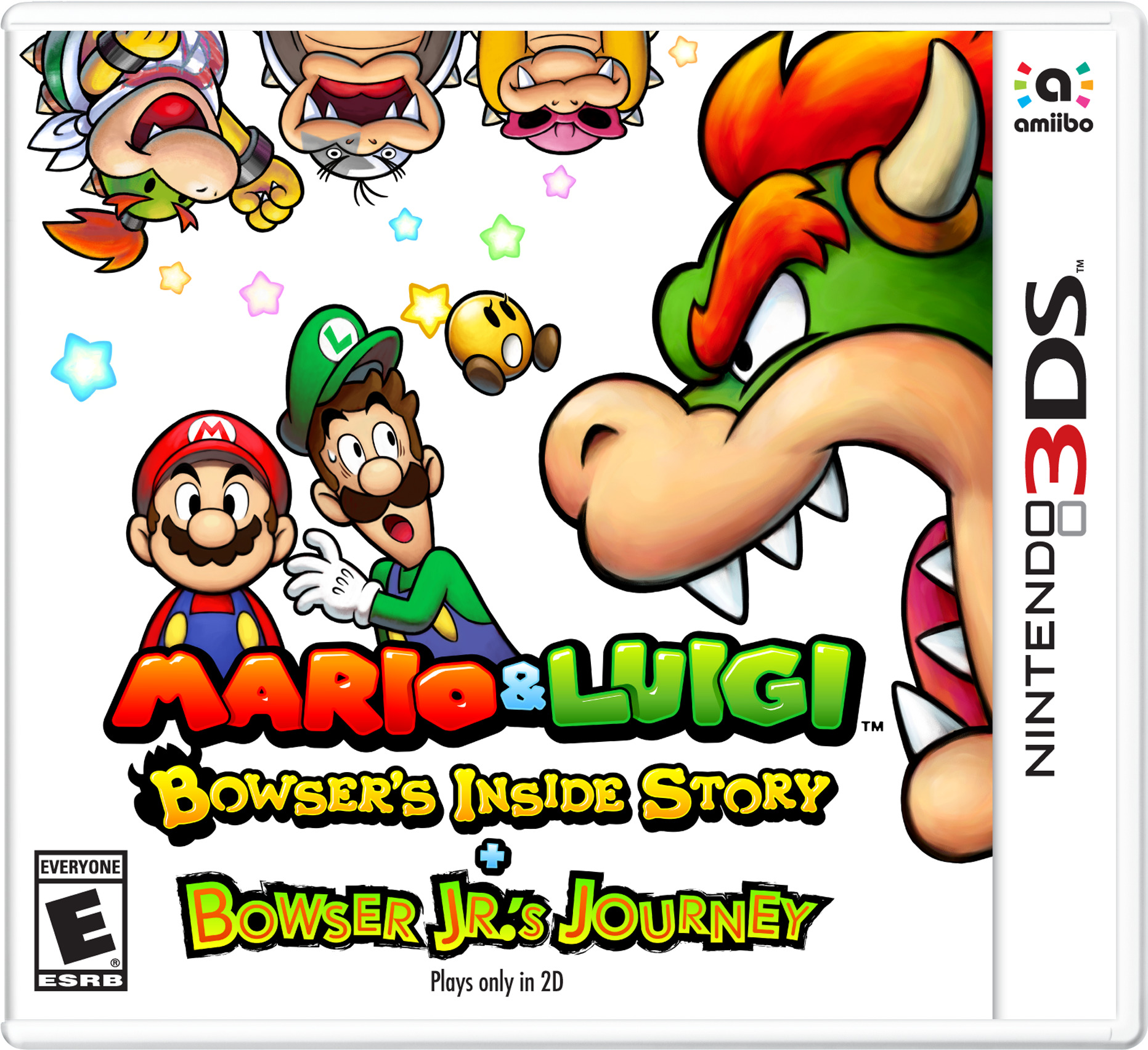
Mario & Luigi: Bowser's Inside Story + Bowser Jr.'s Journey


Mario & Luigi: Bowser's Inside Story + Bowser Jr.'s Journey

Developer: AlphaDream
Publisher: Nintendo
Original System: DS for Bowser's Inside Story, 3DS for Bowser's Inside Story + Bowser Jr.'s Journey
System Played On: 3DS
Rating: 3 stars 

On June 30, 2023, I defeated Dark Bowser and Dark Fawful (both products of the Dark Star), thus finishing Mario & Luigi: Bowser's Inside Story + Bowser Jr.'s Journey for the Nintendo 3DS. In my playthrough of the Bowser's Inside Story part, I leveled up Mario & Luigi to level 34, which is rainbow rank (the highest rank), and I leveled up Bowser to level 31, which is master boss rank (the second-highest rank). I also found 76% of the blocks, 54% of the beans, and 89% of the music. In my playthrough of the Bowser Jr.'s Journey section, I discovered 94% allies, 100% of the enemies, 66% challenges and 18% formations. I also cleared all 89 quests, thanks to getting my squad level 57. My playthrough for Bowser's Inside Story took 31 2/5 gameplay hours, and my playthrough of Bowser Jr.'s Journey took 18 1/4 hours, for a grand total of 49 2/3 gameplay hours over a 2-month span. [WARNING: SPOILERS ALERT AHEAD!]

Mario & Luigi: Bowser's Inside Story realized that 4 party members for 4 face buttons, like done for Partners in Time, was a bit too much, yet they didn't want to reduce it down to just 2 like in Superstar Saga. Therefore, the middle-ground was to have 3 playable characters. For this game, the 3rd playable character was Bowser. It only makes sense that a character as big as Bowser would take up the remainder face buttons. Yes, while Mario is the traditional A button, and Luigi is the typical B button, Bowser takes up X & Y. Bowser taking up 2 face buttons originally sounds helpful but ends up hurting. In regard to Mario and Luigi, when needing an action command, Mario is always A, and Luigi is always B. Regarding Bowser, however, when needing to do a quick time event, it could be X, or it could be Y. When you have to make quick-thinking reaction, it's easy to confuse the buttons, and that could be costly.

The 3 party members, however, do not play synchronous. Bowser plays separately from Mario and Luigi. This is the Inside Story of Bowser's Inside Story. At the beginning of the story, Fawful tricks Bowser into eating a vacuum shroom, which makes Bowser eat Mario & Luigi, as well as some Toads. Mario & Luigi spend a majority, if not most, of the game exploring Bowser's body. Bowser is the one exploring the outside world between Peach's castle and his castle. Therefore, the RPG battles will take place with either Bowser or both Mario & Luigi. Again, in regard to Mario & Luigi battles, the gamer merely has to tell which party member the attack is directed to, and then use the corresponding character's button. Regarding Bowser, however, the player has to figure which Bowser command counters the attack, which isn't always obvious. The kicker is that, in the 2nd half of the game, near the end, Mario & Luigi found a pipe in Bowser that leads to the outside world, allowing Mario & Luigi to traverse in between inside Bowser and the outside world. To quote CinemaSins, "WHAT ARE THE RULES?!" Did Bowser always have this pipe in him, or did he suck it up when sucking up everybody else? Did it always function in the sense it led to the outside world? How does it power itself? I don't get the point of this. I would have preferred the whole Mario & Luigi part of the game take inside Bowser, and leave Bowser alone the sole adventurer in the outside world. To me, the game should have ended when Mario & Luigi escaped Boswer's body.

Going back to RPG battles, Mario & Luigi have their traditional jump and hammer. Their special attacks, called Bros attacks, seem to be a combination of Superstar and Partners in Time. A lot of the attacks either come right from or are inspired by Partners in Time. The Bros attack are powered by Bros points, like in Superstar Saga, and not by items, like in Partners in Time. I like this best of both world approach. I liked the Partners in Time Bros attack better than the ones in Superstar Saga, but I like the single points system from Superstar Saga. The only problem, however, is to acquire these Bros. attacks, the gamer has to find puzzle pieces in a certain area. While well guided, they can still be missed. Bowser's regular attacks contain punching and fire-breathing, which fits Bowser. As a kind of sort of third attack, Bowser has inhale, which sucks up enemies for Mario & Luigi to deal with inside Bowser's body. I like this inclusion, as this is one of the ways to incorporate all 3 characters at the same time. Bowser has his own special attacks, known as Brawl attacks. When Bowser finds his minions in his exploration, he adds them to his party in the sense that he uses them for his special attacks. Whereas Mario & Luigi use their action buttons for their Bros attacks, Bowser uses the touch screen and stylus for his Brawl attacks. Ugh, why!?! It's somewhere between jarring and annoying that I have to take out my stylus to perform the Brawl attack, and then put it away for the rest of the battle. Half the time I just kept it out in my had while pressing the buttons.  Again, I ask why, just why. Speaking of which...

Well, way to go, everybody! Nintendo heard everybody mention how Partners in Time had so little touch screen input, so they stuffed it full of touch screen inputs for Bowser's Inside Story. In order for Mario & Luigi to activate parts of Bowser's body, it usually comes down to a minigame with touchscreen controls. The most famous (infamous) example is in the enzyme minigame for eating the carrot, but I didn't have too many struggles with it. As more touch screen minigames were added to gameplay, however, it became hard to keep track of which minigames requires which touch actions. It feels especially jarring when switching between button controls of the RPG battles and the touch screen minigames. Mario & Luigi has gone from not enough touch screen input to too much touch screen input.

Another added feature is when Bowser grows to kazu size to fight a building or a fortification. This too is based in touch screen. For these battles, the 3DS needs to be held vertical. While this is supposed to look cool, it does not feel cool. To start, the hinges of the 3DS gets in the way, unintentionally splitting a single image. On top of that, what's meant to be cool comes across as an inconvenience. The gamer has to turn the 3DS on its side when it begins, and then turn it back to normal when done. The player has to go to mashing buttons to furiously scribbling and tapping on the touchscreen. It almost feels like Alpha Dream or Nintendo had this gameplay mechanic in mind, but neither could think of a whole game of it, so they throw it into a Mario & Luigi game. This feels so out place. It does not need to be here.

Once again, Alpha Dream has a problem of escalating the final boss battle too much. On my final day of play, I did the battles between Fawful, Dark Star, Peach's Castles, and Dark Bowser/Dark Fawful. Those 4 battles alone took me 3 hours. Yes, each battle took about the same amount of time, so each battle took 45 minutes. Not only did the battle itself escalate, but the attacks within the battle escalate. One minute the enemies' attacks do 50 points of damage, and the next minute the foes' attacks do 150 damage! This makes it extremely hard to predict when to use items, and when you waste time to use items, you miss the window of opportunity to attack. I can't count the number of times that either a battle was elongated or I had to redo a battle because I miscalculated an escalated attack. Furthermore, Alpha Dream's final bosses once again gets an unfair amount of attacks. I can't count the number of turns when one of the bosses mentioned above got to use his entire arsenal of attacks before the player could even get off 1. Again, that turn is wasted if the gamer has to spend it using a healing item, only for the next turn to have the boss's whole arsenal of attacks to widdle down HP again. Once again, this feels unfair and unnecessary.

Just to briefly cover Bowser Jr.'s Journey. You'll notice Bowser Jr.'s Journey took longer than Bowser's Minion on Superstar Saga, 18 1/4 hours to 1 1/2 hours respectively. That's because Alpha Dream added more layers and gave it more depth. Bowser Jr.'s Journey adds "first mates," which gives Bowser Jr. extra leadership commands, which makes things more complicated. The 9 in your squad can form certain formations, which gives statistical advantages, as another layer of complexity. Whereas Bowser's Minions on Superstar Saga only had 1 extra challenge, a "true ending," Bowser Jr.'s Journey on Bowser's Insider Story has a whole after game, giving even more challenge. On top of that, Bowser Jr.'s Journey has a bigger and more complex story, especially considering it adds 3 brand-new antagonists. All these extra layers of complexity are good. I enjoyed them. My only complaint is that I got stuck in the middle and the end, which required grinding to advance. Still, I had to grind more often in Bowser's Minions, so Bowser Jr.'s Journey must have found a way to reduce it.

While not as exciting as the 4 party members of Partners in Time, the 3 party members of Bowser's Inside Story mixes up the formula from the 2 members of Superstar Saga. If the gamer is still wary about 3 party members, Bowser's Inside Story has the 3 party members play asynchronously, which still mixes up the formula plenty, considering both past and future games in the series. Bowser's Inside Story goes back to formatting of the Bros. Attacks from Superstar Saga, yet it keeps the style of the Bros. Items from Partners in Time, another example of the best of both worlds from the previous games in the franchise. Bowser's Inside Story utilizes the dual screens and the touch screen more than Partners in Time on the DS, for better or for worse. Bowser Jr's Journey fleshes out Bowser's Minions more, in both quality and quantity, making Bowser Jr.'s Journey worth playing more that Bowser's Minions. For all these reasons, I give Mario & Luigi: Bowser's Inside Story + Bowser Jr.'s Journey a 3-star rating out 5 stars. In comparison to the rest of the games in the Mario & Luigi series, Mario & Luigi: Bowser's Inside Story + Bowser Jr.'s Journey falls somewhere between average and mediocre. I would just play it, whether that be for an hour or until the player gets bored, but by no means feel obligated to either finish it or complete it.

Wednesday, December 6, 2023

Mario & Luigi: Superstar Saga + Bowser's Minions


Mario & Luigi: Superstar Saga + Bowser's Minions
Developer: AlphaDream
Publisher: Nintendo
Original System: Game Boy Advance for Superstar Saga, 3DS for Superstar Saga + Bowser's Minions
System Played On: 3DS
Rating: 1 star


On March 11, 2023, I finished Mario & Luigi: Superstar Saga + Bowser's Minions on the Nintendo 3DS, thus finishing my first Mario & Luigi game! For the record, I played both Superstar Saga and Bowser's Minions (because with the Kirby games I normally avoided the side/mini games). In regard to Superstar Saga, I beat Cackletta, leveled up both Mario & Luigi to level 36, and I also found 55% of the beans, 78% of the blocks and 88% of the music. Regarding Bowser's Minions, I beat Fawful, recruited 90% of the allies, saw 75% of the allies, learned 30% of the skills, and I did 63% of the challenges. It took me 46 hours to finish Superstar Saga, plus it took me another 1 1/2 hours to finish Bowser's Minions, equaling a grand total of 47 1/2 gameplay hours. And I did it all in a span of 2 1/3 months. Now I will review Superstar Saga and Bowser's Minions separately.

SUPERSTAR SAGA:

Nintendo has been on an ever so long quest to match or succeed the expectations set by Super Mario RPG: Legend of Seven Stars. This quest has produced both great hits and worst duds. Superstar Saga falls on the good half of the spectrum. Of course, this far exceeds Paper Mario games like Sticker Star and Color Splash, but even next to the original Paper Mario for the Nintendo 64 and The Thousand Year Door on the GameCube, Superstar Saga holds its ground. I expect nothing less AlphaDream, a video game development company made up of former Square employees. Since Super Mario RPG was a joint effort between Square and Nintendo, Superstar Saga feels more like a spiritual successor to Super Mario RPG than the original Paper Mario on the Nintendo 64 does. So many features of this game gave me nostalgic flashbacks of playing Super Mario RPG: the options of weak regular attacks or strong special attacks (they're called "Bros Attacks" in Superstar Saga), items including mushrooms to heal HP and syrups to regain Bros points, timed actions to give more damage or receive less damage, a well-balanced mix of turned-based RPG elements and platforming through a connected world (if anything, Superstar Saga feels more connected than Super Mario RPG), and minigame puzzles to solves, which were both connected to the main game and side games for bonuses. This is what I come to expect in an RPG game with Mario in it, thanks to Super Mario RPG: Legend of the Seven Stars, and I found it all in Superstar Saga.

What may be Superstar Saga's greatest hits may be also its worst duds. First, let's start with the difference between regular attacks and Bros. attacks, which is the special attacks. In Super Mario RPG: Legend of the Seven Stars, normal attacks all go in one menu and special attacks go in another. In Superstar Saga, while all the Bros. attacks go in 1 menu, jump attacks, hammer attacks and hand attacks (the common denominator category for Mario's fire attacks and Luigi's ice attacks), each have their own option on the battle screen. While I clearly remember the game pointing out hammer attacks upon getting the hammer, I don't recall a distinct point in which the game explained that fire/thunder can be used in battle. I didn't realize it until I saw my Bros. attacks now incorporated fire and thunder, so I figured the hand on the battle menu must be a simple fire or thunder attack. Speaking off difference between jump, hammer and hand attacks, the game really didn't do a good job of teaching these attacks had advantages and disadvantages. I knew from playing the Paper Mario series to not jump on spiny enemies or that hammers don't reach flying enemies, but the only way to learn this in Superstar Saga is to read through the in-game guides. I know the game encourages you to do so, but it does so in way that makes you feel like you're stupid for consulting the guide, and no game should do that. Make it evident in your gameplay. This gets worse with the hand attacks. Some enemies are weak to Mario's fire or Luigi's thunder. Some bosses can't even be defeated without using Mario's fire or Luigi's thunder! Does the game clearly tell you this? No. I guess I should have assumed that the boss that looks like a Christmas tree should be weak to fire, but I have played games that don't always play by those "common sense" rules (after all, in Mario's platforming games, you can shoot fireballs under water). To me, this is borderline sharing the same video game sin as Paper Mario entries Sticker Star and Color Splash committed. Unlike them, it's not as bad as requiring you to enter a battle with a specific item in mind to win. Like them, it's so bad that a game requires you to use certain attacks to defeat an enemy, especially a boss. I don't ever remember Super Mario RPG doing that to you. You just needed to widdle down the enemy's health, with either attacks or specials, and at worse, the enemy would disable one or the other. Superstar Saga takes away that freedom, and I don't like it at all.

Another shared feature between Super Mario RPG and Superstar Saga is the timed actions. Timed actions take the RPG formula up a step. No longer can gamers make a choice, set it and forget it. If the player taps the correct button when Mario's/Luigi's attack makes contact, the attack gives more damage. If the gamer taps the right button when Mario/Luigi is about to get hit, Mario/Luigi receives less damage. The only timed action not shared between Super Mario RPG and Superstar Saga is that Super Mario RPG had timed action for items. Timed actions have both advantages and disadvantages. As a disadvantage, if the gamer wants to indeed play an RPG that one can "set it and forget it" (like Pokémon), the gamer has to eliminate this game as an option. As an advantage, if the player gets just choosing commands and watching them play out, this kind of RPG keeps them busy. The problem with Superstar Saga's timed actions is that they seem to be a requirement. Forgive me if my childhood memories deceive me, but Super Mario RPG never required the gamer to use timed actions. Any enemy, including bosses, could be beaten without using timed actions. Timed actions merely gave an advantage by giving a bonus. Here in Superstar Saga, timed actions are a requirement. Some enemies, especially bosses, can one-hit KO you if you don't perform a timed action. If they don't one-hit KO you, they will two-hit KO you if you don't heal. This only gets worse as the game progresses. This is most evident playing defense, but it can also become apparently playing offense. Without timed attacks, if an opponent has a defense high enough, your attack will not damage the opponent. Even if it does land damage, quite possibly, your opponent will heal faster than you can damage. Anyone playing this game will quickly learn that the longer fights drag out, the less likely Mario & Luigi will win. Timed actions, whether attacking or defending, should not work this way. They should merely give the gamer something to do and merely give extra bonuses, not become a requirement for winning. I can't count the number of times I could only win by perfecting timed actions throughout the entire battle.

Both Super Mario RPG: Legend of the Seven Stars and Superstar Saga have platforming outside the RPG battles. Superstar Saga takes the platforming up quite a few notches. On top of jumping, Mario & Luigi have to high jump, spin, crawl low to the ground, crawl underground, dash and strafe. As a positive, this movement creates interesting puzzles. As a negative, since this game originally existed on the Game Boy Advance, and since A is Mario's action button and B is Luigi's action button, the L and R buttons become a scroll bar for scrolling through these actions. Now the 3DS remake makes this more feasible by making these movements accessible on the touchscreen, but since the touchscreen also has the map, I found more feasible to keep the map on the touchscreen and scroll through the movements with the L and R buttons. Now remember that a single room or environment might require several of these movements, and on top of scrolling through them to find the right one, you may have enemies attempting to attack you. Oh, and I forgot to mention that if Mario & Luigi attack the enemy, Mario & Luigi have an advantage, but if the enemy attacks Mario & Luigi, Mario & Luigi have the disadvantage. Sometimes it makes the most sense to clear the room of enemies before trying to solve the platforming puzzle, which maybe the developers intended, but I doubt it because sometimes an opponent will just wait at the end of the platforming puzzle, and that's not the gamer's fault.

[SPOILER ALERT!] That last dungeon of Bowser's castle is just ridiculous. Some of most basic and most simple minions can one-hit or two-hit KO you. It requires the gamer to constantly go back to the last heart box to heal, which slows down any feelings of progression. Then, all of a sudden, out of nowhere, Koopalings! Each Koopaling has his own gimmick, which I felt was never introduced previously in the game. So much for the final dungeon being a test of all skills learned throughout the game. It gets worse with the later Koopalings, in which, for some reason, need to be beaten in 8 turns. Why, game, why? Do you think I'm purposely drawing out my battles? To make matters even worse, the 3DS remake for someone reason makes Mario & Luigi defeat the last Koopaling in 5 turns! This is one of the shining examples of needing to do the timed actions perfectly in order to win, as I barely won that battle with 1 turn to spare. Then the final boss battle with Cackletta is more of an endurance run. In order to do that endurance run, however, make sure you're stocked up health restoring items (I would recommend at least 10 of each), and again, make sure you practiced your timed actions to perfection. Even then, some of Cackletta's attacks really don't give any hints on how to prepare for the attacks. [/END SPOILERS]

Just in case my length rants of the negatives portray me as not liking the game, let me throw in a few more positives to prove I enjoyed the game. I do like the fact that each Mario Bros. has his own button, with Mario's action button being A and Luigi's action button being B. It adds to the feeling that the gamer is truly controlling both Mario Bros. at the same time. I can appreciate that the first Mario & Luigi game, unlike the first Paper Mario game, did not resort to making Bowser the final boss and his traditional minions the typical enemies. It was nice to have a new setting, new NPCs and new enemies, especially including a new final boss (even if Bowletta did feel like Bowser battle in disguise). I also liked that the game did not resort to a McGuffin fetch quest. Honestly, I was expecting the premise and plot of the game to fetching a certain amount of McGuffins. After all, that's what Super Mario RPG and the first Paper Mario did (ironically, both were 7 stars). While there is technically a McGuffin search, it doesn't happen until near the end of the game, and one of the main NPCs actually aids in collecting the pieces. A very pleasant surprise. Lastly, I'm glad Nintendo decided to do a graphical remake, not just an enhanced port. The Game Boy Advance has the hardware power of a Super Nintendo, but the 3DS is somewhere between the Nintendo 64 and GameCube, so it had the power to look prettier, and Nintendo utilized that. I compared screenshots, and let me tell you, I preferred the 3DS look every time. I would highly advise playing the 3DS version, even if it's free with your Switch Online subscription, especially if you want to play Bowser's Minions. Speaking of which...

BOWSER'S MINIONS:

Bowser's Minions pretty much falls under the RTS genre. The gamer picks out minions to fight in a battle against other minions, based off their stats, and then the player proceeds to watch it play out, hoping to win. Just like with Superstar Saga, Bowser's Minions does provide timed actions to prevent the gamer from getting bored waiting for the outcome. As the captain, the player has such action as denying the enemy's timed action, giving a stat boost, doing a sneak attack, calling for extra help, challenging the opposing captain head on, etc. Of course, these have costs, which the player will have to weigh out during gameplay. Even when all the captain points have been spent, the gamer can assist the NPC teammates with random action commands, assuring the player will never get bored. Some levels will have 2 or 3 battles, while other levels with have 6 or 8 battles. While teammates heal between battles on every level, if your team struggles on the first battle, your team will less likely make it all the way until the end.

Believe it or not, the grinding is fairly low. Usually, when I lost a battle, it was less likely due to under-leveled fighters and more likely due to choosing the wrong team. All I had to do was simply edit the team, and I was good to go. It wasn't until the last world that I actually had to grind to level the fighters up to a level in which they could handle the upcoming level.

This side/mini game only took me 1 1/2 hours, although I will admit that sometimes it felt longer than that. That 1 1/2 hours is just about right for this kind of game. Any longer, and I would have gotten bored, but any shorter, I would have asked myself why I played in the first place (or why the developers took their time out developing the main game for this side/mini game). Now in all honesty, I played up to the false ending. I did not get the opportunity to play the true ending. I thought the true ending required me to first beat Superstar Saga. I found that the true ending required me to fully complete Bowser's Minions up to defeating Fawful, which I did not do. This brings me to my biggest and only complaint about this side/mini game.

Bowser's Minions has optional levels called captain's challenges. In these captain's challenges, the gamer must learn to master the captain's special skill to pass. In order to make sure the player has truly mastered the captain's special skill, the game puts in place extra barriers. First, the captain goes in alone, without any minions. Second, the opponent is way over leveled. With the early captain's challenges, this is a small barrier. Simply activate the captain's special skill ability, and winner winner chicken dinner. With the later captain's challenges, however, this is a big barrier. The captain has to be a certain level, the captain's special skill needs to be activated at exactly the right time, and still even then the challenge still feels like it was coming down to luck. In my opinion, it's not worth it, and if I were you, don't waste your time on fully completing Bowser's Minions to get the true ending. Just finish it with the false ending.

Wednesday, December 28, 2022

New Super Luigi U


New Super Luigi U
Developer: Nintendo EAD
Publisher: Nintendo
Original System: Wii U
System Played On: Wii U
Rating: 3 stars

On May 14, 2022, I beat Bowser, thus finishing New Super Luigi U on the Nintendo Wii U! In my playthrough, I did not collect all the star coins, not even for a single world, so I did not unlock any of the star road levels. I did find all the secret exits, so I at least unlocked all the secret levels. Between beating Bowser and playing every level (including the secret levels), I earned 2 stars on my profile. And I did it all in 7 1/3 gameplay hours over the span of about a month.

Way back when, I called New Super Luigi U an expansion pack to New super mario bros u, and after playing through the whole game, I still stand by it that. Nintendo would seem to agree with me, as New Super Luigi U would eventually come packaged with New Super Mario Bros U on the same disc, and they released the games together on the Nintendo Switch port. Therefore, going into this New Super Luigi U, I expected the same exact levels, except with the 100 second time limit for the extra challenge. While New Super Luigi U keeps the same worlds as New Super Mario Bros U, it did not keep the same levels. The developers of New Super Luigi U kept the 100 second time limit in the forefront of the brains when designing levels. The developers definitely shortened levels. They gave you plenty of time if the gamer merely wants to reach the flagpole at the end of the lee. If the player wants to fully complete the game by collecting all the star coins, he or she barely has enough time. Some of the levels probably need multiple playthroughs because the star coin needs all 100 seconds to reach, to grab and to make it to the flagpole at the end. This has its strengths and weaknesses. On one hand, it encourages multiple playthroughs of a level, giving the game replay value. On the other hand, this feels like padding, as the goal of every level should be to collect all 3 star coins and reach the flagpole. Then again, maybe I'm just a n00b who needs to "git gud."

As mentioned above, what separates New Super Luigi U from New Super Mario Bros U (or any New Super Mario Bros game or any Super Mario game, for that matter) is that every level has a 100 second time limit literally. If you ever paid close attention to a typical Super Mario game timer, you'll notice that the timer ticks fairly fast. That's because a tick off a Super Mario game timer last somewhere between 0.4 seconds and 0.7 seconds, depending on the game. In New Super Luigi U, a tick off the time literally takes 1 second. They are in perfect sync. I kind of like this better. Going into each level, I had a better sense of how much time I left if I needed to back track to attempt to get a star coin. I'm not saying all future 2D (2.5D?) Super Mario games need a 100 second time, but they should all keep the timer to real seconds, even if this means shorting the timer on average.

The only time the 100 second timer hurt the gameplay was with the Boo houses. In a traditional Boo house in a typical Super Mario game, the Boo house tries to get the gamer lost, and the gamer must find the way out of the Boo house. Since New Super Luigi U only gives the player 100 seconds to escape, the game really can't get the player lost. Therefore, Boo houses turn into just another level, just with a soft "horror" theme to it. Seriously, Boo houses feel just like another level, except the enemies are Boos instead of any other enemy. I guess it is technically harder because you can't jump on Boos, but that barely makes the level a bit harder to consider the Boo house a special level.

New Super Luigi U's worst weakness is the story. It's literally the exact same as New Super Mario Bros. U, except Mario is for some reason absent. I know so many people have already said it, but I will say it again. Why wasn't Luigi saving Daisy? Here, let me add a few more ideas, which are a bit more original. Perhaps Luigi could save Mario, like he does in the Luigi's Mansion trilogy. Maybe Bowser could have kidnapped both Mario and Peach at the same time, and Luigi has to rescue both of them. Either option would have been better than copy and paste from New Super Mario Bros U, except with Mario absent. Heck, New Super Luigi doesn't even provide a good answer for why Mario is absent!

Besides that, there is nothing much to say. Besides the 100 second timer and Luigi's loftier jumps, it's traditional Super Mario game, or more specifically, a typical New Super Mario Bros game. There are hidden 8-bit Luigi sprites in each level, but the game does not keep track of the ones you found, and it does not go towards completion. The one little thing I do appreciate is how Luigi responds to reaching the flagpole at the end of the level. Mario traditionally says, "Here we go!" or "I did it!" or "Let's Go!" When Luigi typically gets to the end of the level, he says, "Whew! Made it!" This little detail displays the less confident and more scaredy-cat nature of Luigi, as opposed to his brother Mario, who displays more confidence and less fear.

Tuesday, December 27, 2022

Luigi's Mansion 3


Luigi's Mansion 3
Developer: Next Level Games
Publisher: Nintendo
Original System: Switch
System Played On: Switch
Rating: 4 stars 

On April 16, 2022, I beat all 16 boss ghosts and defeated King Boo, thus finishing Luigi's Mansion 3 on the Nintendo Switch! In my playthrough, I captured all 16 Boos, and I also collected 32,600G (in-game currency), which earned me a rank B (improvement from Luigi's Mansion 1, which gave me a rank E). And I did it all in a matter 17 1/4 gameplay hours over a span of 1 1/2 months.

I finished Luigi's Mansion 3 and did not complete it because Nintendo made Luigi's Mansion 3 a nightmare to complete (no pun intended). On top of collecting all the Boos and all the gems, which is par for Luigi's Mansion games, Nintendo gave this game achievements. Now some of the game's achievements overlap with the Boo collecting and gem collecting, but for the rest, it can get quite ridiculous. On top of collecting boos and gems, you have to collect a certain number of each ghost (there's 6 types of ghosts), collect a certain amount of each currency (currency comes in coins, bills, bars and pearls) and collect a special collectable on each floor. Furthermore, each floor has a random achievement, which the gamer won't know until he does it, either by accident or on purpose. With all these achievements required for completion, it's not worth completion. It's a shame because Luigi's Mansion 3 has created a world in which the player wants to explore every nook and cranny. If it weren't for those achievements, and it was just the collectables (for which the game provides help), I probably would have gone for completing the game.

Luigi's Mansion 3 should have been named Luigi's Hotel (or at least Luigi's Mansion 3: Luigi's Hotel). Instead of doing multiple mansions, like Luigi's Mansion 2: Dark Moon, Luigi's Mansion 3 goes back to a single building, like Luigi's Mansion 1. Fortunately, it does bring over the themes of Luigi's Mansion 2: Dark Moon, one of the highlights of that game. The hotel has 15 floors plus 2 basement floors, and each floor has its own theme. Some of the floors make sense for a hotel, like boilerworks, a basement, a lobby, a mezzanine, a shopping mall, a theatre, a garden, a dance hall and a fitness center. I would expect those all in a hotel, especially a fancy hotel. Other floors do not make sense for a hotel. Would a hotel have a castle arena (unless they are going for a Medieval Times Dinner & Tournament kind of thing), a movie making studio, a museum, an Egyptian pyramid and a pirate ship? Unless it was a themed hotel, I would not imagine any of these in a hotel, and even in the case of a themed hotel, it would have 1 of these themes, not all of them. I get Nintendo did this to have more floors and expand game time, but it really lacks that universal theme, even for a hotel. Furthermore, all these floors are somewhat lacking balance. On some floors, the gamer has to explore a multi-level maze to get to the boss ghost. On other floors, the player just has to go down the hall to a single room, and the boss ghost is there.  Sometimes a floor can take hours, while at other times, a floor just takes minutes.

Luigi's Mansion 3 does boss ghosts right this time by leaning away from what Luigi's Mansion 2: Dark Moon did and learning towards what Luigi's Mansion 1 did. Each boss ghost as his or her own character and personality...well, kind of sort of. Each ghost boss fits the theme of its room. Garden room has a gardener, dance hall has a DJ, fitness center has a bodybuilder, Egyptian pyramid has a mummy, movie studio has a director, pirate ship has a pirate shark, etc. That's it. Furthermore, in Luigi's Mansion 1, upon capturing the boss ghost, the gamer could read a description of the boss ghost. Despite Luigi's Mansion 3 having a ghost gallery, the player has no description to read. This creates a 1-dimension character and personality for the ghost. Again, better than Luigi's Mansion 2: Dark Moon, but it still feels like a long shot from Luigi's Mansion 1.

Luigi's Mansion 3 brings back many features from Luigi's Mansion 2: Dark Moon, such as the strobe light and the dark light. Luigi's Mansion 3 also includes Gooigi, a goo clone of Luigi. Technically, Gooigi originated in the 3DS remake of Luigi's Mansion 1 to give that game co-op multiplayer, although I remember Nintendo advertising Gooigi as brand new for Luigi's Mansion 3. That could be due to the criticism that Gooigi did not work for Luigi's Mansion 1 because the game was never intended to have co-op multiplayer. Well, Luigi's Mansion 3 did intend for co-op multiplayer, and I would even say it encourages it. Luigi's Mansion 3 has some puzzles which require both Luigi and Gooigi to solve it. A single player can hop back and forth between Luigi and Gooigi to solve these puzzles by himself or herself. At best, this slows down game play, and at worse it makes game play harder. While I appreciate Nintendo thought of how co-op multiplayer could change up the game, I wish they would have made single player and co-op multiplayer into 2 different game modes. Luigi's Mansion 3 adds some new poltergust features. The poltergust G-00 comes with a plunger rope, which can be used grab ahold of things and throw them or tear them down, which can reveal new paths. It's another layer of gameplay, which contributes to new and innovative puzzles. In some rooms, Luigi can plug in poltergust G-00 into a socket to activate super suction, which tears down walls and other fixtures to reveal a new path. Unfortunately, this is its only use, and it's only used in some rooms on some floors. By pressing both ZL and ZR, Luigi has an air boost, which kind of acts as a jump. It does not go high, but it has good use for dodging floor attacks, and again, opening up new paths. In Luigi's Mansion 3, when Luigi has sucked in a ghost for long enough, Luigi can now slam the ghost onto the floor for extra damage. I like this over the "extra suction" in Luigi's Mansion 2: Dark Moon. This attack has further application when facing a wave of ghosts, for Luigi can slam ghosts into other ghosts, which does damage to both the slammer and the slammee. Again, a big improvement from the last game. The only thing that does not return are the elemental medals from the first game. Such a shame because those elemental medals added another level of gameplay for puzzles.

Just like in the previous Luigi's Mansion 2: Dark Moon, in-game currency in Luigi's Mansion 3 has more use than just ranking the gamer at the end of the game. In Luigi's Mansion 2: Dark Moon, the in-game currency just upgraded the poltergust, but in Luigi's Mansion 3, the poltergust comes updated. In Luigi's Mansion 3, in-game currency goes towards 3 things: gold bones, boo finders and gem finders. Gold bones serves as extra continues. When Luigi loses all 99 hearts, a gold bone gives Luigi an extra continue, so Luigi can pick up right where he left off, as opposed to a game over (which Luigi's Mansion games calls "good night"), which requires Luigi to start at the last saved checkpoint.  At first, the game only allows 5 golden bones at once, but later on in the game, it allows you to hold 10 golden. As if this game wasn't generous enough with its auto-saves (auto-saves happen every time Luigi enters or exits a room), the golden bones make it even more generous. Seriously, I went into the final boss with 9 gold bones, and I defeated with 3. I prefer the method in Luigi's Mansion 2: Dark Moon, with only 1 golden bone per mission (I know that doesn't exactly work for Luigi's Mansion 3, but they could have done something similar, like find 1 golden bone per floor). Boo finders and gem finders are cartridges installed into poltergust G-00, which causes poltergust (and the controller) to vibrate when close to a boo or gem. The closet Luigi, the strong the vibration. This aids greatly in collecting both boos and gems. Like I said before, if it wasn't for the achievements, the boo finders and the gem finders would make collecting easy. The catch with the boo and gem finders, as well as the golden bones, is that money spent does not go towards your grand total for your ranking, so you lose money (and possibly rank) by spending it on finders and bones. It causes the player to stop and weigh out his or her options before purchasing finders and bones.

Overall, a good game. Luigi's Mansion 3 has created a world in which the gamer wants to explore. The mansion/hotel has character, its ghosts (especially boss ghosts) have personality, and even Luigi feels relatable. Luigi's Mansion 3 has added new gameplay features, which puts new players and seasoned veterans on the same level. Money has more of a purpose than just ranking the player and losing that money to purchase it in the shop has the player weighing the pros and cons to determine whether rank or completion is more important to the player. Ultimately, though, I still miss Luigi's Mansion 1. Luigi's Mansion 1 feels like "baby's first horror." Although not too scary, Luigi's Mansion 1 still felt like a horror game with other horror game tropes, like slowly unlocking a haunted building. Luigi's Mansion 3 feels less like a horror game and more like an action/adventure game that just so happens to have ghosts in it. While the gamer needs to beat a boss ghost on one floor in order to unlock the next floor, it does not feel like the same level of exploration as Luigi's Mansion 1. With so many opportunities for continues and saves, Luigi's Mansion 3 does not even have the horror trope of worrying about your life. While the ghosts have more character and personality than the second, it still falls short in comparison to the first game. One step forward and one step back.

Friday, December 23, 2022

Luigi's Mansion (2): Dark Moon

Luigi's Mansion (2): Dark Moon
Developer: Next Level Games
Publisher: Nintendo
Original System: 3DS
System Played On: 3DS
Rating: 3 stars 


On February 26, 2022, I defeated King Boo and rescued Mario, thus finishing Luigi's Mansion: Dark Moon for the Nintendo 3DS! In my playthrough, I fully upgraded the poltergust & dark light, captured 18 Boos and collected 20,600G (the in-game currency). And I did it all 14 gameplay hours over a span of about 1 1/2 months.

Nintendo must have heard the complaints about the first Luigi's Manson game being too short, for they definitely fixed that. Luigi's Mansion: Dark Moon took 5 hours longer than the original Luigi's Mansion. Unfortunately, their approach to expanding Dark Moon's gameplay time wasn't exactly the best. Their solution to adding more gameplay time? Add more mansions! Dark Moon has a total of 5 mansions that need exploring. Give or take, that means I averaged 3 hours per mansion. The problem with that is, in the previous game, I spent 9 hours in 1 mansion. More mansions mean less things to do in each mansion. Each mansion has a set of missions. Nintendo laid out these missions on a monitor in E. Gadd's lab, so the gamer selects each mission, pretty much on a home screen. I'm not sure if this was to pad gameplay time, make the game more accessible to casual players or to make smaller gaming sessions for a handheld system (as opposed to a console, in which gaming sessions last longer), but either way, it definitely robs the game of a unified world (mansion?) that was ever-so-present in Luigi's Mansion 1. Clearly the emphasis has gone from exploring (a) mansion(s) to hunting ghosts, and technically, Nintendo fails on that one, too. Portrait ghosts no longer exist. While I continue to praise Nintendo for not making the Boos the only ghosts of the game, the ghosts in this game seem generic, besides their different colors and abilities. It's such a shame because with all these different mansions having different themes, they could have easily matched mansion themes with portrait ghost personalities. [SPOILER ALERT!] At least the final boss battle was actually against Boo instead of a pseudo-Bowser boss battle. And I'm actually glad they revealed near the end of the game that Luigi is rescuing Mario again. Yes, it's not really a plot twist (quite predictable, actually), but it gave Luigi more motivation than just "E. Gadd's ghost assistants went haywire, and E. Gadd thinks Luigi is the best solution to this problem." [/END SPOILER]
Overall, Luigi's Mansion: Dark Moon succeeds as another "baby's first horror game." I even recognized some spots that may be considered "jump scares" for children. Ultimately, though, I liked Luigi's Mansion 1 better. Like I said in my review of that, Luigi's Mansion has more of the feel of "baby's first horror game," as I could make more parallels to traditional horror games, like Silent Hill. At times, Luigi's Mansion: Dark Moon felt more like a typical action/adventure game, just with ghosts.

Wednesday, December 14, 2022

Luigi’s Mansion (1)


Luigi's Mansion (1)
Developer: Nintendo EAD
Publisher: Nintendo
Original System: GameCube
System Played On: 3DS
Rating: 5 stars 

On January 15, 2022, I defeated King Boo and rescued Mario, thus finishing Luigi's Mansion, originally on the Nintendo GameCube (I played the 3DS port)! In my play, not only did I defeat King Boo, I captured 21/22 ghosts (I think I glitched the game because I failed to capture 1 ghost, the lights turned on, and I could not find the ghost again), I captured 46/50 boos (that's over 90%!), I collected over 4 1/2 million G (the in-game currency), and I accomplished all beginner and easy achievements. All this, however, only got me a Rank E. And I did it all in 9 1/10 gameplay hours over a span of 2 weeks/half month (more like 3 weekends because I only played it on the weekends).

Overall, the gameplay was a new and fun concept. I've heard Luigi's Mansion called "baby's first horror game" because it has all the horror tropes (haunted house, ghosts, etc.) without the game feeling too scary. Well, as an adult, I did not feel too scared. I have friends, who played this game as a child, and they said it did scare them at points, so I guess the game ultimately succeeded at being a horror game for kids. In all seriousness, though, in a way, it succeeds as a horror game in general, even if it does not scare adults. At some points, Luigi's Mansion did give me some Silent Hill vibes. Like Silent Hill, the mansion had plenty of locked doors, which needed unlocking. Like Silent Hill, to unlock those doors, the gamer has to explore the unlocked rooms to find keys. Like Silent Hill, the player sometimes has to defeat the horrors in the room to get to the keys (with Luigi's Mansion, that's sucking them up with the Poltergust, unlike Silent Hill, which is attacking them with a weapon). Also, because Luigi's weapon is the Poltergust, the game gives off some serious Ghostbuster vibes. I imagine that was done on purpose.

I don't want to complain too much about the controls since I played on the 3DS, not the GameCube. I imagine the GameCube controllers are much more intuitive with the 2 joysticks. Nintendo did try to remedy this. They gave gamers 2 possible options, one of which Luigi always points the Poltergust in the direction the joystick moves and the other has Luigi move while facing the same direction. Players will have their own preference, but both still fail in comparison to 2 joysticks. The best way to play is to get the 2nd circle pad extension or play on a New 3DS that came with a second circle pad built into it. Without it, you'll have to learn to strafe by holding down the B button or use that D-pad to readjust the aim, but the game was originally made with 2 joysticks in mind, so the game isn't intending the gamer to take his hand off the circle pad (movement) to put it on the D-pad (aim). It expects players to move and aim at the same time, and the 3DS port doesn't calculate it. This is my biggest complaint, and possibly, my only complaint.

The game also felt a little short. Truth be told, it wasn't short. 9 1/10 hour is just slightly below average from what I expect for game (I expect on average 10 hours to finish the main story). It just felt short. It could be the Metroidvania-like aspect that there is only 1 area, which gamers unlock as play progresses. It could also be the fact that the players knows the end goal from the start, and the game does not to really add to it. Locked doors merely keep the player from marching down to the final boss and defeating it.

[SPOILER ALERT!] Speaking of final boss, the game had me a bit worried there. At first, when I heard of a King Boo, I actually didn't mind. Yeah, it's Nintendo typical "make common enemy bigger to make him a boss," but at least it wasn't Nintendo's typical Bowser as the final boss. Then I started hearing the name Bowser thrown around, and I thought Nintendo did make Bowser the final boss! To my relief, it was a faked out fake out. King Boo was indeed the final boss, even if he did wear a Bowser costume. Oh, and speaking of the final boss battle, I found my surprised that I missed Nintendo's typical 3 phases of the final boss. Once I figured out how to defeat King Boo, all I had to do was do it, and I was done. A little anticlimactic [/END SPOILERS]

In the end, I appreciate how Nintendo figured out a way to enter the horror genre and keep it family friendly. I also like that they did not simply make it another Mario game (in the sense that Mario is a main character), but rather, they handed it off to another character. It worked out well, too, as now Mario needed rescuing, not Princess Peach.