After The Year of Super Mario in 2020, after playing 21 platforming games in 2020 (22 if counting Super Mario 35), I wanted a changed in video game genre. I considered changing over to the RPG (role playing game) genre. I had not played an RPG since my Pokémon days, and I thought it would be nice to get back into them. My only hesitation is that I know RPGs can be an investment in time, and going through both an adoption and a dissertation, I could not afford a game which required an investment in time. I looked for a light RPG, and I assumed that Paper Mario looked like a lighter RPG. I also found myself interested about the recent conversation about the Paper Mario series. It seems like the Paper Mario series has gone from RPG to RPG Light to RPG elements. With the recent Paper Mario games, you either love them or hate them; there is no middle ground. As somebody not blinded by nostalgia glasses, I wanted to see if these games held up by themselves, with or without embracing the RPG genre, and if one can just like Paper Mario games. Therefore, I declared 2021 the Year of Paper Mario! For the year of 2021, I aimed to finish all 6 Paper Mario games. Naturally, it only made sense to begin with the original that started it all, and then play in order of release.
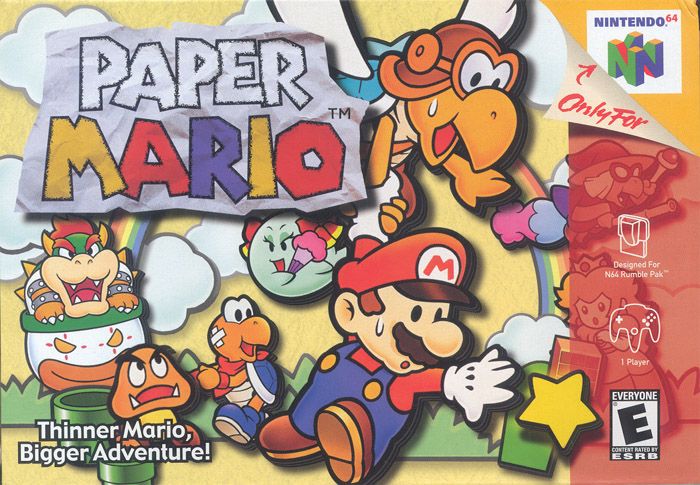
On February 27, 2 months in 2021, I saved all 7 star spirits and defeated Bowser (twice!), thus finishing Paper Mario for the Nintendo 64 (via the Wii U Virtual Console)! In my playthrough, I collected 33 star pieces and 28 badges. I leveled up Mario to level 23, giving up 55 HP (maxed out), 55 FP (maxed out) and 18 badge points. I also leveled up all 8 party members to super level and 5 party members to ultra level. And I did it all in a matter of 21 hours. If familiar with the back story of Paper Mario, this game was originally supposed to be a sequel to Super Mario RPG: Legend of the Seven Stars. While Nintendo went a different direction early in development, some of the gameplay still felt reminiscent of Super Mario RPG. For example, the quick time events give the gamer something to do, besides selecting attacks and waiting. At the same time, however, the gameplay feels watered down compared to Super Mario RPG. Mario only has 1 partner to help in battle, as opposed to 2, although these partners can switch out. Only Mario can use items and the special star moves, whereas each character in Super Mario RPG can use attacks, special attacks, items and a defense stance. The level up system rewards increasing HP first and then FP, whereas Super Mario RPG rewards equally improving the characters. I think I prefer the gameplay of Super Mario RPG over Paper Mario. Nintendo had a good attempt at an RPG, but Nintendo should have left RPGs to Square (Enix), the king of RPGs. Similarly, the story of Paper Mario resonates with Super Mario RPG: Legend of the Seven Stars. Again, Mario has to collect 7 stars, but this time, the stars are alive (that is, personified), and these stars give you power (which gives the stars more importance than the McGuffin status in Super Mario RPG). The only problem is that big bad boss is Bowser again, instead of an original character like Smithy. Yes, I know Shigeru Miyamoto does not like his original property messed with, and yes, I know it will get worse, but Mario versus Bowser just feels like another Mario game. It's just that now the combat is RPG instead of platforming. And why does Mario have to face off against Bowser? To save Princess Peach, of course! Again, this feels like another Mario game. Just substitute platforming with RPG.

About 2 months later, on May 1, I defeated the Shadow Queen, thus finishing Paper Mario: The Thousand Year Door for the Nintendo GameCube (via the backwards compatibility on the Nintendo Wii). During my playthrough, not only did I collect the 7 crystal stars, I collected 73 star pieces, 48 of 85 badges (that's a majority of them!), all 42 shine sprites (thus fully upgrading all partners but the optional partner Ms. Mouz), and I also journaled 95 of 124 tattles. And I did it in 36 1/2 hours. And I have a hot take: the original Paper Mario is better than The Thousand Year Door. I felt the game had both positives and negatives. Let me get the positives worth complimenting out of the way first. Paper Mario: The Thousand Year Door has more RPG elements. I like how now Mario's health and the partner's health are separate. I also like how the quick time events give something to do as turns play out, not just a set it and forget it. I like story, for the most part. I appreciate how it wasn't Bowser trying to steal the Mushroom Kingdom from Princess Peach. As a matter of fact, both Bowser and Peach have their own subplots, which the gamer can play. My favorite were the Bowser parts, as many of them re-enacted famous levels from the first Super Mario Bros. In some regards, Paper Mario: Thousand Year Door is more of the original Super Paper Mario, with some fine tuning. Now let's get to negative. Somebody should really discipline the game developers, for at sometimes I do not think they understand good game development. It seemed like every chapter involved backtracking with no good reason. I sometimes even thought the developers included so much backtracking to pad time, which it really didn't need. The worst infringement was near the end (semi-spoiler, I guess) when the game has the player travel the entire world map to look for a character, only to find out he was at the starting point! Yes, I know that was the joke, but without any real instant quick travel, it was annoying! The puzzle segments were not always self-explanatory. I got the official Nintendo Power walkthrough packaged with my game, and without it, I would never have solved the puzzles. True to Mario, sometimes the game required platforming, and the platforming felt off. I would press A and Mario would not jump. Mario would fall short to a jump he should have made. Yes, ultimately it is a RPG, so jumping is not supposed to spot on as a platformer, but it should be manageable and not frustrating. Then came final showdown, which was like an Elite Three because it had 3 boss fights in a row, only allowing healing and saving between the second and third. I only survived the first two because I figured out a way to level up between the first and second, thus healing me. But I legitimately got stuck on the final boss. The only way I could get through was through grinding. Those past 2 sentences I should never have to say in a casual RPG, like Paper Mario. Since Mario maxes out at level 30, once the player reaches level 25, leveling up becomes grinding to its fullest definition. No matter who are Mario's opponents, Mario only gains 1 star point (Paper Mario's experience points) per battle. If you do the math, then yes, leveling up Mario to level 30 would take 500 star points or 500 random battles. I managed to get to level 27, but from then, I focused on upgrading my partners. While Thousand Year Door had fine-tuned RPG gameplay and a fresh story, it also had dully repetitious backtracking, puzzles more confusing than intriguing, off platforming and bosses requiring grinding to the right level. Nevertheless, after playing through the entire series, I looked back at this game and decied the positives outweighed the negatives. Paper Mario: The Thousand Year Door would become my favorite game of the series.
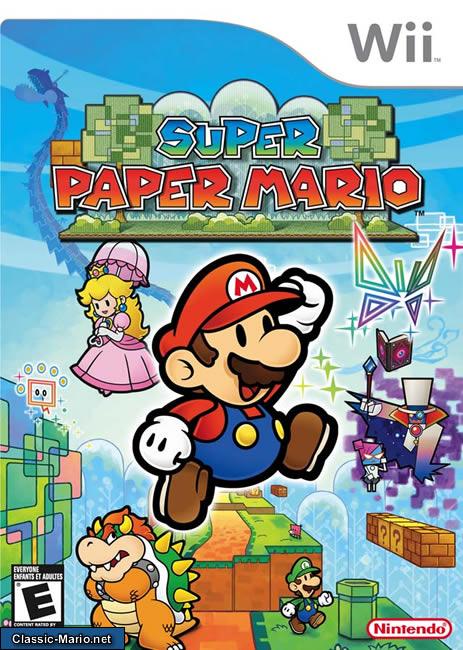
About a month later, by the end of the month of May, I beat Count Bleck and defeated Mr. L & Dimentio, thus finishing Super paper Mario for the Nintendo Wii! This is the 3rd Paper Mario game I have played and finished. In my playthrough, not only did I collect the 8 pure hearts, I also collected all 12 Pixls (which means I did do both Pixl side quests, including the Pit of 100 Trials in Flipside), 46 of 256 cards, 4 of 96 recipes and 999 coins, thus maxing out my coin counter. I earned a high score of 783,270, leveling up Mario (and team) to level 17, giving Mario (and gang) an HP of 50 and an attack of 10 (20 for Bowser). And I did it all in 18 3/4 gameplay hours over the span of roughly a month (more like 8 days because I only played Super Paper Mario on the weekends). Super Paper Mario is so controversial among Nintendo fans, not because it's a bad game, but because the gameplay shifted from a full RPG to a platformer with RPG elements. Yes, if you're looking for a full RPG, Super Paper Mario will disappoint you. If you're willing to try a platformer with RPG elements, Super Paper Mario is a good choice. They do seem to blend the two together well. For starters, some of the levels clearly have their inspiration from the first Super Mario Bros., which will give you a dose of nostalgia. Then inserting the RPG elements allows the developers to provide a new game experience to old level designs by experimenting. It was nice to take damage and not get an immediate game over. By adding elements from RPGs, which not only includes gameplay mechanics but also story mechanics, Super Paper Mario has demonstrated that platformers don't merely have to consist of reaching the end of the level. Platforming levels can have both enemies and NPCs to interact with, which can progress the story. Platforming levels can have buildings to enter and dungeons to explore. The story does not have to be an overarching premise. It can develop in every world and in every level. It's a shame Shigeru Miyamoto tries to keep the story in a Mario game to a minimum because Super Paper Mario demonstrated that platformers can have in-depth stories, especially thanks to the RPG elements. Speaking of story, this story feels the closest to Super Mario RPG because it has Mario teaming up with Bowser and Princess Peach to fight a brand new boss, whose henchmen consist of both familiar enemies and new enemies. While criticism might come for taking Super Paper Mario far away from the RPG gameplay of Super Mario RPG (from which the Paper Mario series descended), Super Paper Mario has the closest story to Super Mario RPG yet in the series. While I lean more towards the like it than dislike it crowd, I do see it has faults. I don't understand why only Mario can flip from 2D to 3D, besides the fact it becomes Mario's special skill. If this is Paper Mario, where even enemies can flip, every team member should flip, too. Think of something else to give Mario a special skill. On a similar note, it became annoying that every team member's special skill was mapped to a different button. Since the A button has no use outside Mario (because the A button is mapped to Mario's special skill), then map all the special skills to the A button. Speaking of buttons, I also missed the feature where the player could back in dialogue if the player missed something by reading too fast. The B button remained unmapped throughout the whole game; it could've had that purpose. Sometimes the worlds felt unbalanced because one world could take a half hour and another world could take 2 hours. One could argue that the game is too easy. Coins are too easy to get. I maxed out my coin counter a couple times, despite buying 2 warp pipes. I didn't get a single game over (OK, technically I did once, but I would argue that I got softlocked because I got stuck in a place where I couldn't get out and only receive damage). This would especially include the final boss battle, but one could technically argue the final boss battle was so easy for me because I leveled Mario (and team) up so much. For my overall opinion, I will again say what I said earlier. If you're looking for a standard, typical RPG, it's a bad game. If you're looking for a platformer with RPG elements, it's a good game.

Almost a month to the date of finishing the last time, on June 27, I Defeated Bowser, thus finishing Paper Mario Sticker Star on the Nintendo 3DS. In my playthrough, I collected all 6 royal stickers, all 38 comet pieces and all 16 HP hearts, giving Mario the max HP of 100. Unfortunately, I only discovered 4/5 Luigi stickers, and I came up much shorter on secret doors. Altogether, it took me 20 gameplay hours over the span of about a month (according to my 3DS, I averaged 1 hour 57 minutes per session). And now I see why Nintendo fans and Paper Mario fans alike consider Sticker Star the worst game in the series. A little background to preface this review. When planning for Paper Mario Sticker Star, Shigeru Myamoto has 2 new rules for Paper Mario. First, since Paper Mario is a subseries of the Mario series, all characters had to come from the Mario world (i.e. Mushroom Kingdom) and no new characters could be created. Second, since Paper Mario is a subseries of the Mario series, Mario games do not have complicated stories, so the story must be simple. These 2 rules did a great disservice to the Paper Mario series. In order to keep the story short and sweet, the story downgraded to yet again Bowser kidnapping Peach to get ahold of a magical power. In order to keep the story to just Mario characters, there are no teammates for Mario. Mario works alone. Any "ally" (here defined as a non-combatant NPC) has to be a Toad, and there a lot of Toads in this game. All the enemies are familiar from the Super Mario series. Even Bowser's sidekick got downgraded from Kami Koopa to random generic magikoopa. The only original character is Kersti, a crown sticker personified, but she is the Navi of this Paper Mario game, only there to give hints and tips to Mario when lost. This lack of original characters and plot made the story quite bland. Then there's the gameplay. The "good news" (if you want to call it that) they brought back the turn-based battle system, and it even comes back with time hits. The bad news is that Mario does not gain experience points or level up from the battling. It makes you wonder, "Then what's the point of this battle system?" To make matters worse, in order to execute attacks, you must have a sticker, which can be found around the world and in shops. Without the sticker, you're out of luck. Without the experience points and leveling up, alongside needing stickers, the gamer wants to avoid battles. When caught in a battle, the player wants to run away, which he or she can, as long as he or she mashes A enough. Still sometimes, though, the even that won't allow Mario to escape. The gamer asks, "Why do I have to stay and battle?" and the game answers, "Just because." A game where the player wants to avoid the primary gameplay loop is not a good game. By the end of game and by the end of series, I joined so many others by concluding that Paper Mario: Sticker Star is the worst Paper Mario game in the series.

2 months and 1 day later, on August 28, I defeated Black Bowser (man, that sounds racist), thus finishing Paper Mario: Color Splash for the Nintendo Wii U! In my playthrough I collected all 60 basic cards, 37/72 enemy cards (that's a majority of them!), all 27 thing cards, 24/40 artwork (that's a majority of them!) and 20/33 records (that's a majority of them!). I also earned 5/6 banners, meaning I found all the cut-outs, executed over 200 excellent attacks, collected over 10,000 coins, bought over 200 cards, and beat all Roshambo temples. The only banner I did not earn was the colorization banner because I only reached 61% colorization (hey, that's 3/5!). And I did it all in 40 gameplay hours over a span of 2 months real time. Just like Thousand Year Door, Color Splash had both its positives and negatives. Let's start with the positives. Up to this point, Paper Mario: Color Splash is the most beautiful Paper Mario game, in aesthetic and graphics. Everything in the world genuinely looks like paper or carboard, especially with the white border around all the characters (I know that's a hot take, but I think the white border really sells the paper aesthetic ). Someone might even think Nintendo found a way to make a stop motion video game. Nintendo knew if they want to make the focal point of this Paper Mario game colors, they had to bring the colors. Indeed, they truly brought the colors. All the colors in the game were bright and vibrant. I especially appreciate how they divided the game's world into 6 main colors, and the levels within the world all have shades of those colors (for example Cherry Lake & Crimson Tower in Red World and Plum Park & Violet Passage in Purple World). Also deserving praise is the soundtrack. Up to this point, Paper Mario: Color Splash has one of the most beautiful soundtracks. Koji Kondo has created one of the best soundtracks in his career. The soundtrack covers a wide array of genres, and none of them seem out of place. The game credits 29 musicians, each for their own instrument, and they deserve it. This game definitely needs to be played with television sound all the way up or wearing headphones or earbuds. Then comes the gameplay. The primary gameplay loop from Paper Mario: Sticker Star returns to Paper Mario: Color Splash. The battle sequence is turn-based, but it is not a turn-based RPG, meaning no experience points and no levels, but time hits still reappear. This time, however, it's more complicated. Instead of stickers, Color Splash uses cards. First, the gamer has to select the card on the touch screen. Nintendo must have heard the complaints about the lack of space for stickers because Color Splash has room for 99 cards, and all cards are the same size, just taking up 1 slot. Rarely will the player run out of room for cards (that only happened once or twice for me). Second, the player has to paint the card. After all, it would not be a color splash without paint. Paint increases damage and likelihood of perfectly timed attacks. Players can use cards without paint, but it will do less damage, and it will less likely lead to multiple attacks. Third, gamers have to flick the card from the Wii U Game Pad to the TV. Yes, 3 moves to execute an attack (four if including pressing A/tapping the screen for timed attacks). It felt like a lot to execute an attack, especially next to Sticker Star, in which the player had to merely tap on the sticker. Furthermore, this new primary game loop requires the gamer to have both cards and paint in inventory to execute an attack. Again, yes, technically an attack does not need paint, but it will hinder without it. And yes, some cards come already painted. Furthermore, to be honest, the game provides plenty of opportunities to collect point, as I personally only ran out of paint once or twice. Nevertheless, it complicates the primary game loop. It has come a far way from merely pressing a button to select an attack, as seen in the first 2 Paper Mario games. The complication becomes even less worth it knowing it will not give experience points or leveling up (oh, more HP comes as a result of beating a world boss and recovering a big paint star). Just like Paper Mario: Sticker Star, Paper Mario: Color Splash divides into 6 worlds. Since this Paper Mario game is subtitled Color Splash, all the worlds have color names. Furthermore, the levels within the world all the levels within the world all have shades of those colors. For example Cherry Lake & Crimson Tower in Red World, and Plum Park & Violet Passage in Purple World. Nintendo deserves praise for that creativity. On the flip side, however, Color Splash has no good reason why the divide the game into worlds and levels. Dividing into worlds and levels made sense for Sticker Star, for the 3DS may not have the power to handle a single, open world. The original Paper Mario had a single, open world on the Nintendo 64, and Paper Mario: Thousand Year Door had a single, open world on the GameCube. Surely, the Wii U could handle a single, open world. Just like Sticker Star, Shigeru Miyamoto and Takashi Tezuka supervised Color Splash, which explains a lot. If unfamiliar with Nintendo, Shigeru Miyamoto and Takashi Tezuka supervise the Super Mario series. Super Mario games always divide into worlds and levels, so naturally, Paper Mario: Color Splash has to divide into worlds and level to feel like a Super Mario game (perhaps to attract a wider audience?). What makes worlds and level so bad is that it makes apparent the pacing of the game. I kept track how long it took me to get each big color star. It took me (in order of getting the stars) 6 1/4 hours for the red paint star, 4 3/4 hours for the yellow paint star, 5 3/4 hours for the blue paint star, 4 3/5 hours for the purple star, 5 1/2 hours for the orange star, 6 3/4 hours for the green star, 6 2/5 hours to beat Bowser, for a total of 40 hours. Paper Mario: Thousand Year Door took a little less (36 1/2 hours), and Thousand Year Door required collecting stars, but it did not feel so slow because it had a single, open world. Splitting the game into worlds and levels made apparently the slow pacing of the game. Once again, because Miyamoto and Takashi Tezuka supervised Paper Mario: Color Splash, the game has no unique characters besides the companion Hugh, a paint can (get the pun?). This companion Hugh is not to be confused with the partners of the original or Thousand Year Door (and maybe Super Paper Mario?) because Hugh does not attack. Just like Kersti in Sticker Star, Hugh merely gives hints, and to be honest, Hugh is not good at giving hints. Whenever the gamer wants a little hint, Hugh gives a big and obvious hint, pretty much saying the answer. Whenever the player needs a big hint, Hugh pretty much says, "I don't know, go ask the Hint Toad," which is all the way back at the "hub level" Prism Plaza and requires 10 coins for a vague hint! Just like Kersti in Sticker Star, Hugh is almost worthless. Also just like Sticker Star, Color Splash has a problem with puzzles that it thinks is obvious, but in reality, it is not so obvious. Similar to Sticker Star, nothing feels more annoying than needing a certain thing to solve the puzzle, but that thing is not in the inventory, so the gamer has to either find the thing again or traverse back to the "hub level" Prism Plaza to buy the thing. Also due to Shigeru Miyamoto and Takashi Tezuka supervising Color Splash, the game plot comes down to Bowser kidnapping Princess Peach. At least this time Bowser delays kidnapping Princess Peach to change things up a bit. [SPOILER ALERT!] The game tries to portray Bowser not in control, rather, controlled by the black paint, but this does not really change things up that much [/END SPOILER]. Probably also due to Miyamoto and Tezuka supervising Color Splash, each world's boss is a Koopaling. Although the first appearance of the Koopalings in the Paper Mario franchise, the oversaturation of the Koopalings in the Super Mario Bros. series makes the boss levels in Color Splash feel unoriginal. Even an oversized standard enemy, another staple of the Super Mario series, would have felt more original. While a bit tempting to mark this game as the worst, even worse than Sticker Star, I ultimately recognize this game is an improved Sticker Star, and since Nintendo improved on Sticker Star with Color Splash, Color Splash, by default, ends up higher than Sticker Star.
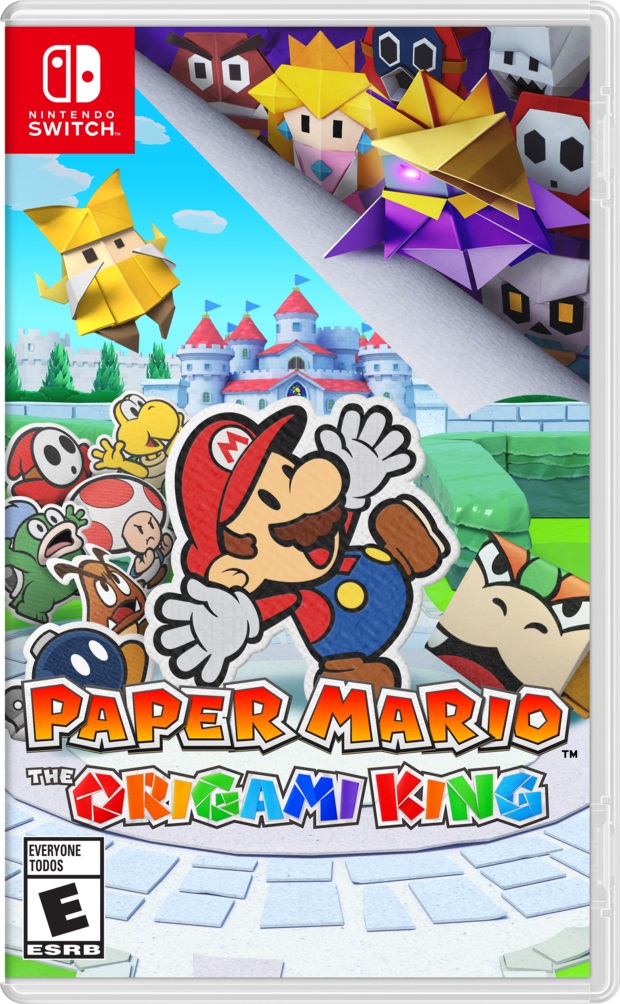
Once September rolled around, I started on Paper Mario: The Origami King, the most recent and last entry of the Paper Mario series. About a month and a half later, on October 16, I defeated Olly, thus finishing Paper Mario: The Origami King on the Nintendo Switch! This is the 6th Paper Mario game I have played and finished. During my playthrough, I also rescued 353 Toads. And I did it all in about 27 1/2 gameplay hours over a span of about 1 1/2 months. Aesthetically, Paper Mario: The Origami King looks just as good, if not better, than Paper Mario: Color Splash. The paper is so realistic-looking, somebody might even wonder how Nintendo made a stop-motion video game. This is especially noticeable when the game has ripped up paper and paper confetti, which both add to the aesthetic. The colors still vibe like Color Splash, although it had no reason to, which Color Splash did have a reason. New to Origami King, the water also has a paper aesthetic, and its physics work as it should. From a gameplay perspective, my favorite part of the aesthetic was that the enemies were origami, and the friendly NPC allies were flat paper. This made it easy to distinguish friend or foe, unlike past Paper Mario games, in which distinguishing friend or foe came down to past Mario experiences, and even that was sometimes unreliable. The soundtrack is good, just good. The music itself has the quality of the past 2 Paper Mario games. It just doesn't have the variety as Color Splash did. Don't get me wrong, Origami King's soundtrack isn't bad, but I would prefer the soundtracks of Sticker Star or Color Splash over Origami King (probably the only compliment I will give those 2 games). The premise of this game is that Olly, the Origami King (hence the title), wants to turn the world of Paper Mario into an Origami World and make himself king over it. He kidnaps Princess Peach and turns her into origami. He also kidnaps Princess Peach's castle by ripping it out of its foundation and wrapping it with 5 streamers. Mario must unwrap the 5 streamers to enter Princess Peach's castle and save Peach. Don't worry, though, Mario has Olly's sister, Olivia (yes, I know, how creative), to guide Mario. Finally Nintendo goes back to original characters!... well, they sort of go back to original characters. Well, technically, the only original characters are Olly and Olivia, but it at least makes the plot not a typical Mario vs. Bowser over Peach. And Olivia is tolerable as a companion. She has fun going on an adventure, and her advice actually helps. Paper Mario: The Origami wanted to focus on puzzles. Yes, as Nintendo continues to debate what genre the Paper Mario franchise will be, this time it tries a an action-adventure puzzle game. Let me tell you, though, when I say puzzle game, I mean puzzle game. Puzzles saturate this entire game, even the combat. Again, this entry in the Paper Mario series is pretty much stripped of its RPG elements. At the closest to an RPG, Mario's confetti bag increases in size after every boss battle, but that's about it when it comes to gaining experience and leveling up. Mario can gain more HP, but that comes by discovering hearts hidden in areas. Mario can increase attack and defense power, but that comes via buying items in a shop. Again, this creates the problem of encouraging gamers to avoid enemy encounters. To further discourage enemy encounters is the way battles are done. It's no longer a simple turn-based combat. Now the player has to line up enemies to create patterns, which in turn creates maximum damage. I can't count the number of times I paid off Toads to do it for me (yes, that's an option) or I just simply dealt lower damage because I gave up on the puzzle. It made me wonder just a one-worded question: Why? Why is this a thing? Why do it this way? The good news is that the gamer no longer needs stickers or cards to attack. The bad news is that upgraded weapons break, meaning the player will have to buy them again or suffice with the basic weapon, which do not break. The secondary gameplay loop is that you have to beat a vellumental creature halfway as a miniboss to gain a new, powerful attack, and then you have to defeat a boss to release the streamer. The game splits up into 5 "chapters" (besides the tutorial prologue and the final boss epilogue). 5 streamers means 5 bosses, but there is only 4 vellumentals. The vellumentals are earth, water, fire and ice. See something missing here? They could have easily made an air or wind vellumental, making 5 vellumentals and 5 bosses for 5 streamers. For the bosses, Nintendo really grasps the paper aesthetic, as they are all office supplies. Somehow Nintendo made bosses that are both very creative and lack creativity at the same time. Despite my gameplay session lasting 27 1/2 hours, I wish it would have lasted longer. They could have easily made a 6th streamer, an orange one. The miniboss before the final boss could have been the one guarding the 6th streamer, and it could have incorporated part of the final boss battle into that boss, so no need for a 6th vellumental. Yes, I know I shouldn't complain about not enough to do without fully completing the game, but fully completing the game is a collectathon: find all Toads, treasures, ? blocks and holes. That's not fun; that's boring. I would have liked some more secondary gameplay loop, but not the 1st or 3rd one. [SPOILER ALERT!] The final boss was dragged out. Yes, I know that typical Nintendo final bosses have 3 phrases, but the middle phase was unnecessary. The first phase has Olly transforming all vellumentals, and Mario has to figure out the type advantage vellumental. Technically, Mario doesn't have to face all the vellumentals. He can do it in 1 or 2 vellumentals. It all depends on how long it takes the gamer to figure it out, since Olly can replenish health. I would have preferred 1 health bar for each vellumental, instead of recharging health from Olly. The 2nd phase introduces brand new gameplay mechanics, which means it was totally unnecessary. The 3rd phase involves solving one last slide and spin puzzle, which is fair due to the primary gameplay loop, but the only problem is that is periodically is interrupted by QTEs, which can 1-hit or 2-hit kill Mario (also, this Paper Mario entry also has the problem of random 1-hit KOs throughout the game like past entries). The slide and spin puzzle is legit, but the QTEs are not. Either somehow introduce QTEs in the primary gameplay loop or do not bring into the final boss battle. [/END SPOILER]vWhile Paper Mario: The Origami King has realized that the gameplay of Sticker Star and Color Splash is not the way to go for the future of the Paper Mario franchise, it still stands far off from the RPGs of the original or Thousand Year Door. The Origami King truly does sit in the middle. If gamers still longs for the RPGs like the original and Thousand Year Door, they will feel disappointed by Origami King, but outside that, the player will enjoy a major improvement over Sticker Star and Color Splash.
And 9 1/2 months into the year, I have played and finished all 6 Paper Mario games! 🙂 Over those 9 1/2 months of the year, I played 163 3/4 hours of Paper Mario games, which means I averaged 27 2/7 hours per game. During my Year of Paper Mario, I felt the highs and lows of the Paper Mario series. I understand why the Paper Mario fanboys feel so upset. I would agree with the Paper fanboys that the first two games in the franchise rank the highest. I too would like to see them return to that form. Nintendo took the right step forward by abandoning the format used in Sticker Star and Color Splash, but I'm not sure Origami King has the right format either. I will disagree with the fanboys, however, in saying that Paper Mario should abandon their attention to the paper aesthetic. Indeed, I though Nintendo found some cool ways to incorporate it. I just don't think that paper has to take the forefront of the primary gameplay loop. I would agree with the fanboys in saying that the Paper Mario series should return to the RPG elements of the first two games. After all, Nintendo originally intended Paper Mario to succeed Super Mario RPG: Legend of the Seven Stars. I guess that still makes Super Mario: Legend of the Seven Stars the best Mario RPG, and I guess that means that if Nintendo fanboys ever want to see a truly good Mario RPG again, Nintendo must team up with Square Enix, the king of RPGs. Make it happen Nintendo and Square Enix!


