Showing posts with label Nintendo DS. Show all posts

Wednesday, November 19, 2025

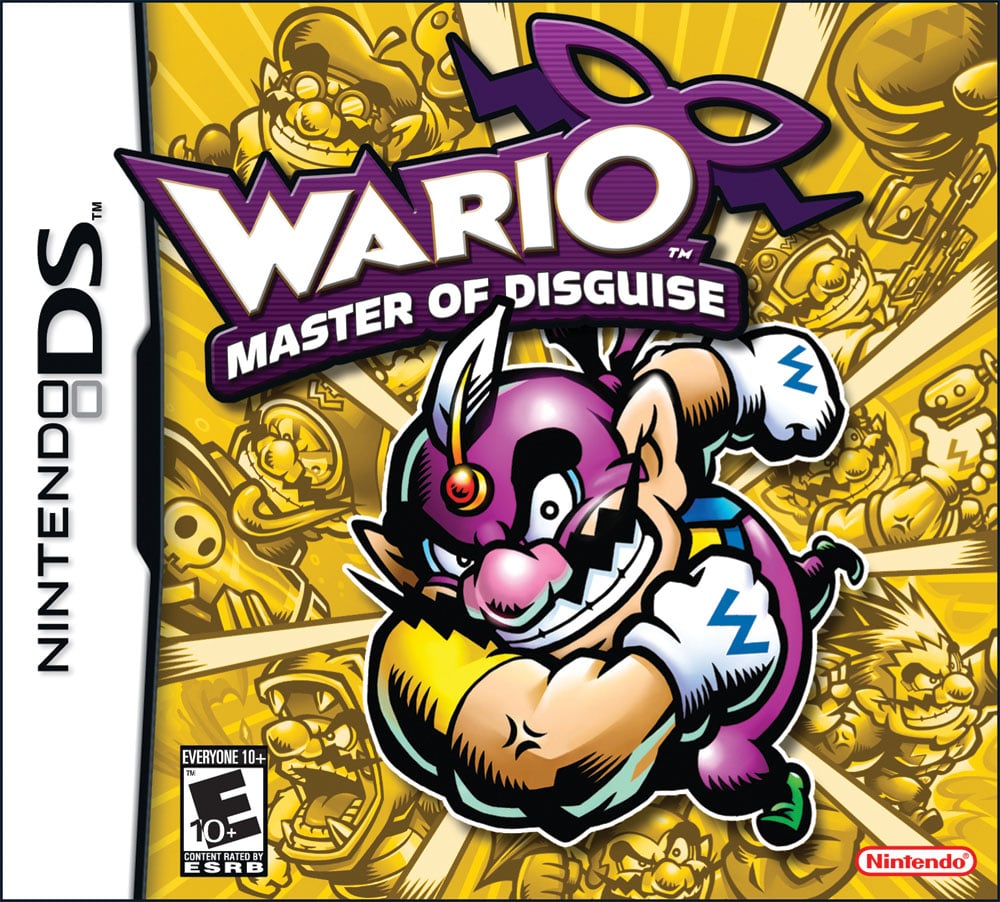
Wario: Master of Disguise


Wario: Master of Disguise

Developer: Suzak
Publisher: Nintendo
Original System: DS
System Played On: Wii U (Virtual Console)
Rating: 1 star 

On July 3, 2025, I defeated Terrormisu, thus finishing Wario Master of Disguise for the Nintendo DS (via the Wii U Virtual Console). My playthrough consisted of both the 10 episodes of the story and the 5 special episode time trials (remember this, this will become important later on). In my playthrough, I earned $580,258 in money and treasures, which earned me the title of "Paragon of Disguise," the third highest title in the game. And I did it all in 24 9/10 gameplay hours in 45 gameplay sessions, averaging 33 minutes 12 second per gameplay session, over the span of 3 months. Let me review this game in order of when the things needing critique appear.

Obviously, the story sets the premise of the game. A bored Wario is watching a television show about a master thief named Count Cannoli, who has entitled himself the Silver Zepher. Jealous of Count Cannoli's wealth, Wario invents the Telmet (portmantua of television helmet) to put himself in the television. Now the good guy of the show becomes the bad guy, the bad guy of the show becomes the worse guy, and the worse guy of the show becomes the worst guy. At least it's not predictable in the sense that the TV show's bad guy sees Wario as "the enemy of my enemy is my friend" or that the plot twist is the bad good is really the good guy and the good guy is really the bad guy. Still, the plot of this game felt predictable. The one thing I could appreciate about the antagonists, though, is that one is a caricature of Mario and another is a caricature of Peach. Very fitting for a Wario game.

As if the plot itself is not bad enough, what makes it worse is that the plot is developed over long discourses of information dump. This becomes most evident when dying multiple times to a boss and having to sit through long dialogues to just face off against the boss again. This got so bad that, while the game provides plenty of fair save points, rendering the Wii U Virtual Console restore points useless, I used them just so I wouldn't have to re-read the long dialogues again! Yes, the press of a button or the tap of the screen will make text move with more speed, but I wouldn't call it a fast forward. Yes, I get the developers were trying to communicate, "Look how witty all these thieves are!" but I never found it entertaining. It doesn't matter if you're into books, movies, television or video games, anyone writing for those mediums will tell you long exposition dumps is bad storytelling. Therefore, Wario: Master of Disguise has bad storytelling.

After a long introductory dialogue dumping some exposition, the gamer finally takes control of Wario. If you belong to the 90% of right-handed people, you will move Wario left and right with the left and right of the D-pad, you will crouch with down on the D-pad, and you will jump and ascend ladders/stairs with the up on the D-pad. Everything else will be controlled with the DS touchscreen stylus your right hand. Don't worry if you're the 10% that's left-handed. Left is Y, right is A, crouch is B, and jump/ascend is X. As if Suzak remembering the lefties is cool enough, even more awesome is that you can use both for movement. For example, if you wanted to jump from left to right, Nintendo expected the player to press right/A and up/X at the same time. The game, however, allows the gamer to press right and X at the same time for the same results. I used this option plenty. Sadly, however, all the other controls have to be done with the touchscreen. It's not as bad as Legend of Zelda: Phantom Hourglass or Legend of Zelda: Spirit Tracks, in which even the movement of Link was controlled by the touchscreen, but it's up there. To perform any attack, the gamer has to tap the enemy. Of course, the player has to first position Wario in close proximity of the enemy for the attack to work, but it still comes down to switching from button controls to touchscreen controls, which can easily be confused, as we will see as this review progresses.

The touchscreen issues become most apparent with the disguises. Of course, it can't be a Wario Land game (yes, I know it technically doesn't have "land" in the title, but most people put any Wario platforming game under the subcategory of "Wario Land") without transformation. Wario: Master of Disguise has 8 disguises Wario can transform into: Thief Wario, Cosmic Wario, Artsy Wario, Genius Wario, Sparky Wario, Captain Wario, Dragon Wario and Wicked Wario. For each transformation, the gamer has to draw a certain shape over Wario: checks for Thief Wario, circle for Cosmic Wario (to represent a space helmet), square/rectangle for Artsy Wario (to represent an easel), a magnifying glass for Genius Wario (looked more like a Greek letter to me), a lightning bolt for Sparky Wario, a semicircle for Captain Wario (I'm guessing a boat hull?), a less than sign for Dragon Wario (like a dragon tail) and a triangle for Wicked Wario (like bat wings). The mnemonic devices makes recalling the symbol for the transformation easy. I can't complain. What I can complain about is the game struggle to recognize these symbols. Constantly the game confused the circle for Cosmic Wario and the rectangle/square for Artsy Wario. Too often the game confused the dragon tail drawing for Dragon Wario with the triangle wing drawing for Wicked Wario. This becomes a problem throughout the  game, especially in the timed special levels, when the game expects the player to transform Wario on demand, yet he or she cannot because the game can't recognize the correct symbol. As if drawing to change costumes isn't bad enough, remember that a lot of these attacks require the gamer to draw on the screen more, which the game further cannot recognize. The worst offender is Artsy Wario. The game almost expect perfect squares to create blocks. One cool thing about this game's transformations is that some can level up to give more powers to the disguise. Cosmic Wario's space gun can ricochet. Artsy Wario can draw more blocks and draw hearts for healing. Genius Wario can punch. Captain Wario can dive with a submarine. Dragon Wario's fire breath can become hotter, destroying blue fire blocks. OK, that last one is lame, for it's just an excuse to create new temporary roadblocks. Lamer is Cosmic Wario's ricochet gun, for the lasers never ricochet where the players wants them to go. Lamest is Artsy Wario. Again, the game has a hard time recognizing the draw of a heart shape, whether big, small, skinny or fat. Even if the player can master drawing a recognizable heart, you can't do it with enemies on screen. Don't even dare during a boss battle (it's like the developers didn't want you to heal during boss battles).

These disguises can be found in treasure chests. Treasure chests hold everything from disguises to keys to money to treasure, depending on its color. All treasure chests are locked. To unlock a treasure chest, you have to play a microgame. Yes, a microgame. By this time, Nintendo has published 5 WarioWare games over the span of 7 years. Wario: Master of Disguise become a game that attempts to combine both Wario Land and WarioWare. There are 8 different microgames, which include connecting dots, tracing drawings, coloring in pictures, matching items with receptacles, squishing roaches, drawing a path and sliding puzzles. A cool thing is that these puzzles do level up, becoming progressively harder once the gamer has become a master expert in the easy puzzles. An uncool thing is that the higher-level puzzles become so hard to the point of becoming impossible. If the player ever fails a microgame, easy or hard, the game boots Wario back out with bombs. Wario must dodge the bombs and re-enter the treasure chest and do another random minigame. This becomes an even bigger pain for the special levels, when everything is on the clock, including the microgame! Yes, the clock continues to run on the microgame. The only fortunate relief is that if the clock expires on the microgame, and the gamer can successfully solve the microgame, the clock will reset. If the player gets stuck with a microgame that is not his or her strength, the player might as well reset the speedrun. If just playing just the 10 episodes of the story, the gamer will find himself or herself ranking puzzles by ease and difficulty, and then purposely losing some microgames in order to get the more favorable microgames. This isn't good game design.

I'll at least give the game credit on the level designs. It could have been way too easy to fall into the Super Mario trap of doing just a basic, generic grass level, desert level, ice level, water level, jungle level, sky level and volcano level. Instead, levels include a cruise ship, a museum, a pyramid, waterworks, a volcano (OK, that one is repeated, but it's taken a new direction with an under-lava experience!), a haunted castle and an ancient garden. As creative and original as these level settings are, they all have flaws. The museum, on the surface, looks creative with puzzles that can be solved with hints in exhibits, but the hints are way to cryptic. The volcano level depends on finding a heat-resistant suit every now and then, and they are hidden, so Wario can die just looking for one. The ancient garden teases the gamer by making it look like all the treasures chests needed to reach the final boss are nearby, but it instead has Wario travel the farthest. These are all flaws that ruin the creative atmosphere.

Most, if not all, episodes end on a boss. The bosses are interesting, and not in a good way. The boss itself gives no hint on a weak spot to defeat said boss. Instead, Goodstyle, Wario's magic wand, provides hints by telling Wario what disguise is necessary to defeat the boss, or at least this certain phase of the boss. This creates a dualist dilemma. Pay attention to Goodstyle's hints, and the boss is too easy. Don't pay attention Goodstyle's hints, and the boss is too hard because the gamer has no idea how to defeat him. I wish there was an option to turn his hints on and off, but I don't think that will solve anything.

Do yourselves a favor. Don't play Wario: Master of Disguise. Instead, watch Dana Carvey's family-friendly comedy Master of Disguise. You'll have a much better time.

Running Ranking
1. Wario Land 4
2. Wario Land 3
3. Wario Land II
4. Wario Land (1)
5. Wario World
6. Wario: Master of Disguise 

Tuesday, December 12, 2023

Mario & Luigi: Partners in Time


Mario & Luigi: Partners in Time
Developer: AlphaDream
Publisher: Nintendo
Original System: DS
System Played On: Wii U (Virtual Console)
Rating: 5 stars

On April 30, I defeated Princess Shroob (both of them) and Bowser (although he was possessed by Princess Shroob), thus finishing Mario & Luigi: Partners in Time for the Nintendo DS (via the Wii U Virtual Console)! At the time, this was the second Mario & Luigi game I played and finished. In my playthrough, I leveled up everybody to level 30. And I did it all in a matter of 21 3/5 gameplay hours over a span of about a month and a half.

For Mario & Luigi, Partners in Time, AlphaDream must have looked at the Nintendo DS, notice it had 4 face buttons, instead of 2 like the Game Boys before the DS, and then decided to form the gameplay around that mechanic. Since Superstar Saga focused gameplay around controlling Mario with the A button and Luigi with the B button, with the DS now having 4 face buttons, 4 face buttons means 4 controllable characters. Now the gamer's party consist of Mario, Luigi, Baby Mario and Baby Luigi. Each party member is controlled by his own button. The A button controls Mario, the B button controls Luigi, the X button controls Baby Mario, and the Y button controls Baby Luigi. While this gameplay mechanic makes sense, it's more tolling on the brain that you think, especially with special moves (more on that later) and defensive maneuvers. AlphaDream must have imagine this could be a hassle, so it created ways around it. Mario & Luigi could separate from baby Mario & Luigi for battles, but then the player runs the danger of having one pair over experienced and another pair underexperienced. The other workaround AlphaDream planned was to have the babies piggy-back on the adult counterparts, in a way creating a 2-member party. While the baby and the adult join together as one, it can still easily feel like two characters. For example, the babies counter with hammers, but the adults counter with jumps, so a hammer counter requires pressing x and/or y, but a jump counter requires pressing A and/or B. Remember, the gamer is supposed to do keep the 4 buttons straight while reading cues from the animation. It's too easy to mess up which character has which button assigned (especially if the player just went from play an Xbox game to a Nintendo game!).

This especially rings true for the special moves. The special moves in this game have gone from Bros. attacks to Bros items. That is because every special attack requires a special item to use it. Now I don't mind special attacks requiring use of flower points, and I don't mind items like honey syrup to recharge the flower points to use move special attacks, but for each special attack to have its own item makes the whole gameplay more complicated than needed. True, defeated enemies do drop the special items, and shop also sell these items, making Bros items available aplenty. Just like Superstar Saga, some enemies, especially bosses, can be immune to Bros items, while other enemies, especially bosses, require Bros items to defeat them. With no advance notice, if the gamer does not come with enough of the right item, that gamer will find himself or herself screwed in battle, and after losing, will have to backtrack to find a store, or grind with the hopes of a good drop. The game is smart enough to know that more complex Bros items should do more damage, and the game does right in this aspect. Some enemies, especially bosses, feel like they need the more powerful Bros items to beat them. In order to execute these items to give aplenty damage, the player will need press the 4 face buttons in a random order without messing up once. Again, that's harder than you think. While I could see why somebody thought Bros items were a good idea, it's ultimately not.

The issue with 4 face buttons also reflects on the action moves outside battle. Going from Superstar Saga to Partners in Time, AlphaDream cut down on the action moves, which is a blessing. Partners in Time brings it down to 4 actions, an action move for each character, and, you guessed it, an action move for each button. Mario is assigned a roll, Luigi is assigned a spin jump, Baby Mario is assigned a hammer, and Baby Luigi is assigned digging. Eventually, these action moves can be combined. For example, when ball Mario & Luigi run over Baby Mario & Luigi, the babies flatten, allowing them crawl into small spaces. When spinning Mario & Luigi bump into Baby Mario & Luigi, the babies go flying to high and out of reach places. Sometimes to solve area puzzles, all 4 action moves are required at once. Again, if the gamer can't keep up with which order to press the buttons, the player will finding themselves starting all over to begin the puzzle again.

While the gameplay centers around 4 face buttons, I'm glad to say that Partners in Time is one of the few first-party Nintendo DS games that does not heavily put emphasis on the touchscreen. Only a couple or few times do I remember the game utilizing the touchscreen. For example, at one point, Mario & Luigi receive a dirty drawing, and the gamer have use the touchscreen to wipe off the paper for them. That works because it uses the touchscreen without taking the player out of the world. While I'm not against the touchscreen aspect of the DS, and there's plenty of games that use it well, the games that use it poorly are the ones forced to shoehorn it in (looking at you, Phantom Hourglass and Spirit Tracks), and I'm delighted to say that Partners in Time is not one of them. Partners in Time understands that it's OK to use the D-pad and face buttons instead of the touchscreen.

The story centers around the gamer having to recollect the shards of the Colbalt star, which shattered. At first, the player expects that this game will become the classic adventure of collecting the five pieces and then beat the big bad boss to beat the game and watch the credits roll. For the most part, it is, but it does throw a few curveballs in their to keep the gamer on his or her feet. For example, after collecting 2 colbalt star shards, Baby Bowser steals them, and a whole part of the game is dedicated to chasing Baby Bowser down to retrieve them stolen pieces. At first, these feels like padding, but after playing the game, anybody can recognize that this part of the game was to divert from the stereotypical Macguffin collection story. As another example of subverting expectations, at one point, the game gives Mario & Luigi 2 cobalt star shards. To further illustrate how this game subverts expectations, sometimes yes, the gamer has to defeat the boss, to collect the cobalt star shard, yet at other times, the cobalt star shard just sits there at the end of the area, and the boss merely stands in the way of exiting the area. These subverting the expecations and the stereotypes prevents Partners in Time from becoming a boring collect the Macguffins and defeat the final boss.

As the subtitle "Partners in Time" hints, the game plays in both the past and the present. I don't get why, though. The only place in the present the gamer goes to is Peach's Castle, and that's it. Thus, Princess Peach's castle merely acts a hub world for visiting all the areas in the past to collect cobalt star shards. This doesn't make sense to why there is a past and present. If AlphaDream really wanted Peach's Castle to merely function as a hub world, could the portals have just brought the player to different locations, not different times? If AlphaDream is going to bring time travel into Partners in Time, the gamer should have to visit a location in both the past and present, the player would have travel in the past to change things in the future. Ultimately, the only reason AlphaDream brought time travel into this is to explain how Mario & Luigi are working with their baby selves, but that could have been a once and done time travel thing.

A nice touch AlphaDream added to Partners in Time was the characterization of all the characters. Not only does Mario have a Baby Mario and Luigi has a Baby Luigi, but Bowser has a Baby Bowser and Peach has a Baby Peach. Even old Toadsworth has a young Toadsworth to interact with throughout the game. The babies reflect the adults' character too. Baby Mario quickly jumps into action to reflect how brave Mario is. Baby Luigi cries a lot reflecting the scared nature of Luigi. Baby Bowser is greedy for food, which will later reflect adult Bowser's selfish desire for the kingdom. Baby Peach always needs comforting and soothing, reflecting how adult Peach needs to always be rescued. On the flips side, the Shroobs as the bad guys of this game work well because it's an evil side of the Mushroom Kingdom, even down to Princess Shroob as a nice counter to Princess Peach.

[SPOILER ALERT!] Just like Superstar Saga, Partners in Time has a problem of escalating the difficulty of the endgame, especially the final boss. The final dungeon alone took me close to 5 hours to even get to the final boss! That's close to a quarter of my gametime! Did AlphaDream realize they did not have enough content or gameplay time by the time they reached the final dugeon, so they stretched it out and vamped up the difficulty to make up for it? Then the final boss battle technically comes in the 3 phrases. Phase 1 is the Shroob Princess that has been there all game. Phase 2 is Shroob Princess's older sister, who is also a Shroob Princess. Phase 3 is Boswer, who is possessed by a Shroob Princess (which one is hard to tell). This alone took me 2 hours! Combining the final dungeon time plus the final boss time, it took me 7 hours, which is about a third of my gameplay time! That's ridiculous. To makes thing even worse, I came prepared! Every party member was leveled up to level 30, which is the minimum most walkthroughs recommend (for the record, I only used walkthrough when I got lost on where to go next, not for help to solve puzzles or defeat enemies, but after finishing the game, I did look up recommended stats and equip items). That is because I never avoided battles and I rarely ran away from battles (losing money also discouraged me from running away in battles). All my party members wore equipment that recovered HP. I stocked up on healing items, which I almost all used up in order to defeat the final boss. Because of all this preparation, I did not get a single game over for the entire stretch of the final boss battle, although it came close. In exchange of no gameover, I got a long and drawn-out boss battle, which might be just as bad. And it's not like I had no idea how to defeat any of the phases. Sure, it took me a few times of trial and error to figure it out, but even after figuring it out, it was long. It doesn't help that the final boss gets a couple or few attacks per turn, so it's quite possible the gamer's following turn is healing up the party, which is pretty much a lost turn to doing any damage, especially if the final boss heals. To make matters worse, the Bowser phase wasn't really needed. Yes, I get the concept is to see if the player can beat a boss with just defensive maneuvers, but that one felt like just padding. Sadly, AlphaDream will never fix this final boss difficulty escalation by the end of the series. [/END SPOILERS]

Looking back, after playing just the first 2 games in the Mario & Luigi series, Mario & Luigi: Partners in Time is the more enjoyable experience. Partners in Time did a better job communicating the gameplay mechanics, making the gameplay more understandable. AlphaDream successfully mapped 4 playable characters to 4 different face buttons in a way that made sense and was not confusing, even though it sometimes would take a toll on the brain. Partners in Time does the gamer a huge favor by reducing the action moves down to 4, even though sometimes inputting the order can get confusin. Partners in Time does not fall into the temptation of having to regularly incorporate touchscreen controls, which so many DS games fall into that temptation. While Partners in Time does give into the trope of collecting the McGuffins for the plot, it at least subverts expectations enough to keep the trope fresh. Partners in Time has some of the best characterization of all characters in the entire Mario & Luigi series, if not every single game with Mario in it! My biggest, and possibly only, complaint is that for a game subtitled Partners in Time, it spends most of the time in the past, and it only uses the present as a hub world. I can understand, however, that the time travel aspect may merely exist to explain why Mario & Luigi exist with the baby counterparts simontanteously. If I had to add a second biggest complaint, it would be that Partners in Time again has the problem of escalating the difficulty of the endgame, especially the final boss, but after playing through the entire series, I see that this is a mainstay of the series, so Partners in Time should not receive extra flack for this. Therefore, for these reasons, I give Mario & Luigi: Partners in Time 5 stars. Mario & Luigi: Partners in Time is a very good game; you should play to full completion.