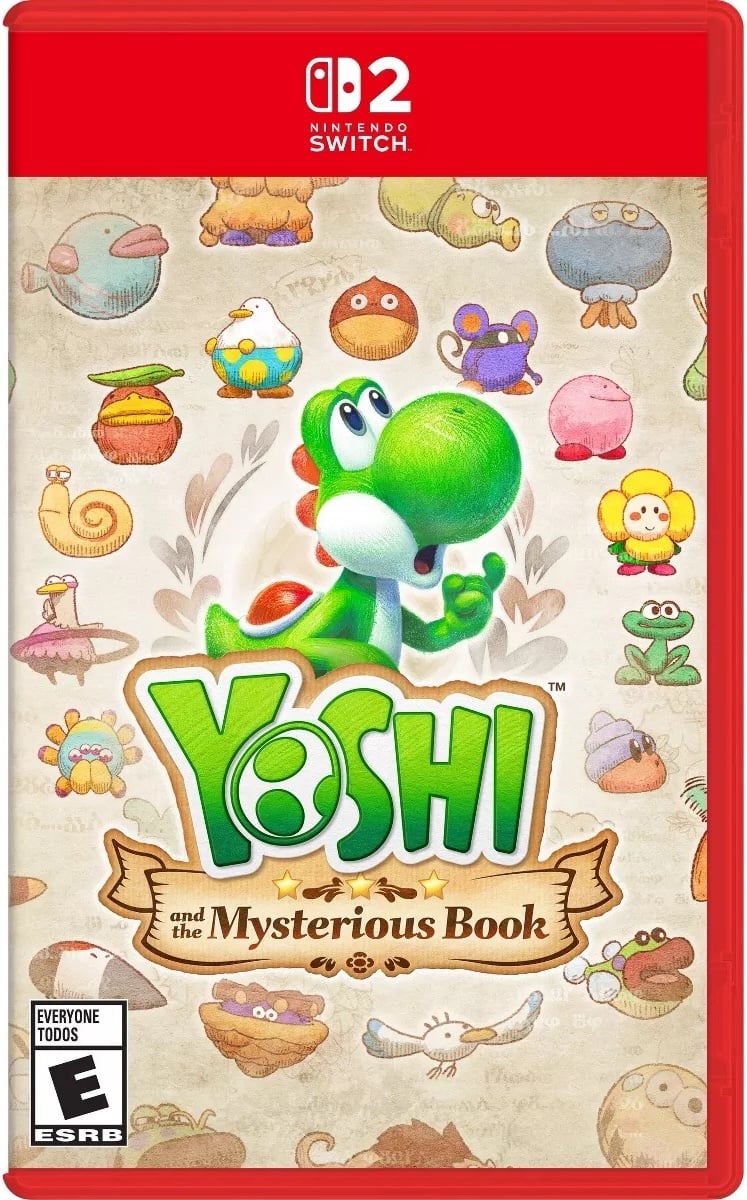
Developer: Good Feel
Publisher: Nintendo
Original System: Switch 2
System Played On: Switch 2
Rating: 2 stars

For my 4th game of The Year of Nintendo Switch 2, I played Yoshi and the Mysterious Book! In my playthrough, I collected 1,068 stars, which unlocked all 12 chapters to play. I also collected 127 smiley flowers and 5,951 tokens. And I did it all in about 15 gameplay hours in the span of about 1 1/2 months.
The primary gameplay loop for Yoshi and the Mysterious Book is exploration and discovery of the main creature of the level. From the onset, the gamer will quickly learn, upon entering the level, the first 4 things Yoshi should do is: 1) eat the creature, 2) put the creature on Yoshi's back, 3) jump on the creature, and 4) ground pound the creature. From there, the next obvious moves depend on the environment. If there is mud, put the creature in the mud. If there is water, put the creature in the water. If there are previously discovered creatures, see how the 2 creatures interact. Ultimately, yes, I get it, at the heart, this is science. I imagine zoologists follow a similar scientific method when they explore and discover a new animal. Still, this primary gameplay loop becomes quite repetitive, which in turn easily becomes stale. Since the primary gameplay loop centers around exploration and discovery, Yoshi can neither die, nor run out of time, nor reach any fail state. At worst, Yoshi will simply get stuck int the level until Yoshi can figure out how to accomplish the level's main mission. What would have caused Yoshi to die or to fail simply respawns Yoshi at a checkpoint to try again. Ultimately, yes, I get why the developers decided to remove death, time running out or failing. Nothing would feel more annoying than to do all this exploration and discovery, die, and then have to do all the exploration and discovery all over again. At the same time, however, as the saying goes, no risk, no reward. In fact, this game feels so not risky that the gamer will have no problem putting Yoshi in peril, knowing that he will respawn. Now on top of the game risking becoming too repetitive and too stale, it also risks becoming too easy, and in turn, too boring.
Part of the fun of the exploring and discovery is that the gamer can name the creature at the end of the level. If the player would rather not, then Mr. E will suggest a name, which can the player can accept or reject. Most, if not all, of Mr. E's suggestions are the traditionally canonical name to the creature, especially if the creature has a long standing with the Yoshi games in the Yoshi series (e.g. Shy Guys and Piranha Plants). Personally, more often than not, I let Mr. E name the creatures, but I did name a few myself. I thought the developers messed up on the portmanteau of croak and karaoke, so I changed the Croakaoke to the KariCroaki. I also called the Milde a KirbyClone for its close resemblance to Kirby. Creativity does have its limit, and so it is with naming these creatures. When naming a creature, it cannot be more than 10 characters long, and it cannot share a name with another character, either a main character or a creature. The 10 character or less is the bigger bummer. I would have loved to call the Detonut a VoltorbClone, a VoltorbCopy or a VoltorbEcho, but they all exceed 10 characters. I understand why there are character limits, but there are work arounds for this.
As typical with a Yoshi game, each level has collectables. In Yoshi and the Mysterious Book, each level has 3 collectables. The primary collectable is stars. Stars can be earned with each discovery, with small discoveries earning 1 star, medium discoveries earning 2 stars, and big discoveries earning 3 stars. Stars unlock future chapters, not just beating the previous boss. As long as the gamer is doing the basic exploration and discover steps described above, the player will have no problem earning enough stars to advance the story. Smiley Flowers return as a collectable. After all, it can't be a Yoshi game without Smiley Flowers as a collectable. The amount of Smiley Flowers in a level ranges from level to level, which makes it hard to keep track of Smiley Flowers, as I have stated with previous entries. Smiley Flowers can be traded in for Exploration Tools, which interface elements that can be added to the HUD. Exploration tools range from useful to useless. On the useful end of things, you have collectable radars, which make sounds and vibrate the control upon getting close to a collectable. On the useless of things, some Exploration Tools measure Yoshi's jump and measure the temperature of the level. Sadly, the number of useless Exploration Tools outweighs the useful Exploration Tools. The in-game currency of Yoshi and the Mysterious Book are tokens, which look like Greek symbols. The tokens unlock hints. Spending few tokens will merely give a silhouette of the discovery, but spending a lot of tokens unlocks more details. Spending tokens on hints helps with 100% full completion, but it really does rob from the joy of exploration and discovery.
Yoshi controls similarly to recent past entries in the series. Pressing A makes Yoshi jump, holding A makes Yoshi flutter jump, and 2 back-to-back presses of A makes Yoshi ground pound. Pressing B makes Yoshi eat, and following by pressing down turns enemies into eggs. If desiring the the traditional egg throwing controls, a press of the R button will start the egg roulette. If wanting a modern approach, the right stick provides immediate and more accurate results. As mentioned above, new to this game, Yoshi can have creates ride Yoshi's back, which function as a power up of sorts. With a press of the X button, Yoshi will flick his tail to put the creature on his back. All the controls are intuitive. Never had I ever had to look up how to perform a maneuver.
As tradition with a Yoshi game, the aesthetic takes on a certain art style, not just going for the most realistic graphics that the system can handle. For Yoshi and the Mysterious Book, since the gameplay has Yoshi inside a book, the art style resembles storybook illustrations. This art style does not stick out as much as more recent past entries, like Crafted World and Wooly World. Because this art style is less prevalent, it begs the question if such an artistic aesthetic is necessary in the first place. The recent past games had their art style contribute to the game play. Yoshi and the Mysterious Book's art style contributes to the story, but that's it. This game could have gone with the most realistic 3D rendered graphics, and it would have little to no impact.
Yoshi and the Mysterious Book does have a story. [SPOILER ALERT! - SPOILERS AHEAD!!] On a certain day, perusing through Bowser's Castle's library, Bowser Jr. discovers a sentient book. Within its contents, he learns about the Bewildered Bird flying above Yoshi Island. Desiring to have it, he flies in his Junior Clown Car to Yoshi Island with the book, in order to capture it. In flight, he notices the magnifying glass dangling from the book, and when he attempts to use it, Bowser Jr. gets sucked into the book. This causes the book to fall onto Yoshi Island, in the midst of a bunch of Yoshis, enjoying an apple lunch. At this point, the book comes to life, and it introduces itself as Mister Encyclopedia, or Mr. E, for short (get it? - Mister E/mystery - GET IT!). Mr. E asks the Yoshis to help him explore and discover as much as they can about the creatures within in the book, to which the Yoshis agree. During their exploration and discovery, it becomes apparent that the Yoshi are racing Bowser Jr. to reach the Bewilder Bird first. After 6 chapters, Yoshi finally finds the Bewildered Bird, disguised as a Crazee Dayzee. In fact, the Yoshis learn right away that the Bewildered Bird's power is the ability to transform into any previously discovered creature. This results in a fun final boss battle, in which the gamer can choose which previous creature he or she would like Yoshi to transform into, in order to beat Bowser Jr. Upon beating Bowser Jr., the credits roll, which would make anybody assume equates to the end of the game, but it does not. See, after beating Bowser Jr., Bowser Jr. desires to leave, but he cannot. Another 4 chapters will appear in Mr. E's book, and at the end of every chapter, the boss battle has something to do with helping Bowser Jr. escape from the boss. Chapter 10 has the Yoshis reach the Moon, but it turns out, the Moon is really just a giant Crazee Dayzee, on a collision course with the earth, and the only way to stop it is to destroy the core. Fortunately, the Bewildered Bird comes to the rescue, and once again, this creates a fun final boss battle with the Bewildered Bird transforming into any prior cataloged creature. The credits roll again, and this time the game is finished...with the exception of 2 bonus chapters, but those are more challenges to see how well Yoshi can manipulate the creature. The story suffices. It does a good job of explaining the reasons behind the game mechanics. I've heard better stories, and I've heard worse. Personally, I'm not a fan of the fake-out credits. When I see the credits, I want the game to be done. Seeing the credits roll, and then seeing 4 more chapters, made me let out a sigh and an "ugh." [/END SPOILERS]
In closing, I will again conclude the same way a Price Is Right game concludes - with the actual retail price. The actual retail price of Super Mario World is $69.99, or simply put, $70. I'm not sure if Yoshi and the Mysterious Book produced the same sticker shock as Mario Kart World did among Nintendo fans, but it should. The most complicated thing I could think of when it comes to Yoshi and the Mysterious Book is programming all the way the creatures can interact with the environment and the other creatures, and with it, the certain action triggering certain discoveries. I can't imagine, though, that took a huge development team, like Mario Kart World did. Even with that complicated programming involved, it is negated and balanced out by only 12 linear chapters and the short gameplay time to merely finish it. I can't justify $70 for this game. At most, I would value the game at $50, but a better price would be $40. Heck, I can't even justify it on the Switch 2 hardware! Unless the Switch 1 could not handle the complicated gameplay mechanics involved in exploration and discovery, this should have been a Switch 1 game, which could have been played on Switch 2 due to backward compatibility. Then that $40-$50 price tag would have come more easily. While I absolutely would play Yoshi and the Mysterious Book over all the Yoshi puzzle games and arcade games, this may be my least favorite Yoshi game in the main series. If you want a more fun Yoshi experience on the Switch 2, play Yoshi's Crafted World for the Switch 1, thanks to the Switch 2's backward compatibility.
+Positives+
+Exploration and discovery feels like actual science
+Getting to name the creatures is fun
+Easy to progress, won't get stuck
+Controls are familiar and intuitive
+Story does a good job of explaining the game mechanics
-Negatives-
-Repetitive gameplay easily becomes stale gameplay
-No fail state makes game too easy and too boring
-Naming creatures has limitations
-Collecting stars is too easy
-No fixed number on smiley flowers per level makes keeping track of smiley flowers hard
-More useless Exploration Tools than useful Exploration Tools
-Art style does not play into game mechanics
-Fake-out credits
-$70 price tag
~Favorite Part~: The feeling of endorphin for making a discovery

No comments:
Post a Comment