Showing posts with label Game Boy. Show all posts

Tuesday, November 4, 2025

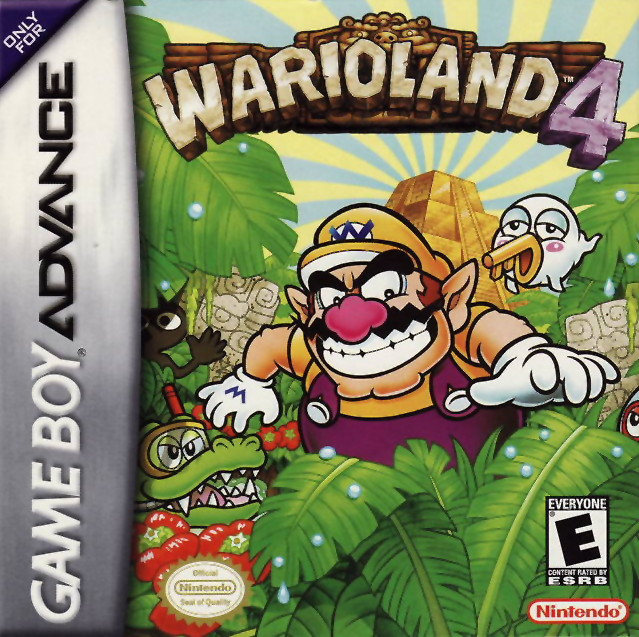
Wario Land 4

Wario Land 4
Developer: Nintendo
Publisher: Nintendo
Original System: Game Boy Advance
System Played On: Wii U (Virtual Console)
Rating: 5 stars 

On March 3, 2025, I defeated the Golden Diva, and earned the best ending on normal, thus finishing Wario Land 4 for the Game Boy Advance (via the Wii U Virtual Console)! In my playthrough, I collected 8 of 16 music tracks (that's half of them!), and I earned $130,270. And I did it all in 10 1/2 gameplay hours over the span of 17 days.

Wario Land 4 clearly has a primarily, secondary and tertiary gameplay loop built into each level. Let's break that down.
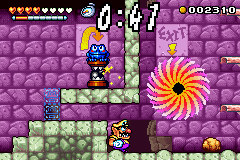

The primary gameplay loop is to find the switch in each level, which reopens the portal, allowing Wario to exit. Upon hitting said switch, a timer triggers, and Wario must race back to the portal at the beginning of the level. Yes, Wario Land 4 reintroduces the level timer, and they do so perfectly. The timer does not go off until the switch to trigger the exit becomes activated. Therefore, the game safely assumes that the gamer has explored everything, and he or she only desires to exit the level. Prior to hitting the switch, the player has no time limit, meaning the player can patiently explore the level. Only until the gamer wants to exit that the timer appears. Again, it's that perfect balance of exploring to find collectables and testing the player to see how well he or she knows the level. Yes, sometimes Wario Land 4 change up the level on the return, and yes, the game sometimes places collectables along the return road, but the timer accounts for that, adding more time. Still, even so, a seasoned veteran of video gamers could beat the clock in its own race with time to spare.


The secondary gameplay loop is finding Keyser. See, activating the switch and returning to the portal merely helps Wario escape the level with treasures intact. To actually advance to the next level, the gamer needs to discover Keyser in the level and collect Keyser before exiting the level. Most often, Keyser appears before switch in the level, but sometimes Keyser can show up after the switch activates. Again, the timer accounts for this, giving more time to find a hidden key. To me, this secondary gameplay loop is redundant. Getting out of the level feels like it should come with automatic advancement in the game. Nothing felt more disappointing than making it back to the exit portal, only to then witness the door not opening because the door. Keyser should have come automatically with activating the swtich, or at least come close nearby in every level.

The tertiary gameplay loop is finding the 4 pieces of a jewel. Once all 4 pieces come together, they form a jewel. 4 jewels unlock the door to that boss. Finding these jewels take a little bit more exploration, at least departing from the main path. At first, I thought I would have to a walkthrough for the missing jewel pieces. Upon a second playthrough of the levels, though, I easily saw the spaces I missed within the level, which made me in turn easily find the missing jewel pieces. I guess this is natural progression of how to maneuver Wario and how to navigate the level.

The bosses are really the lowest and weakest point of Wario Land 4. Most of the bosses have hard to see weak points. When the gamer can find these weak points, the bosses have small hit boxes, making  it hard to give and receive blows. On top of that, these bosses are damage sponges. I would have to say that, on average, a boss takes about 12 hits before defeating that boss. Did I also mention that these too are timed? I imagine the high hit count intended to combat the minigame rewards. See, Wario Land 4 has 3 minigames installed in it. These minigames could be the predecessors to WarioWare's microgames. Every time that the gamer reaches a milestone in the minigame, the game rewards that players with a token, which can be spent in the item store. While all items have funky names, they also all deal damage to the boss before Wario can engage in battle. Depending on the boss, some items do more damage, and some do less. I tried doing it item free, but I got too irritated at small hitboxes and damage sponging. Therefore, I grinded in the minigames to save up to enough tokens to buy an item at the item shop for Aerodent and Golden Diva. Since Golden Diva is the final boss, even the best item will only deliver half the damage. For the other bosses, however, the right item will deal all but 1 life in the health bar. It feels like cheating, but it also feels like you have no other choice when it feels like the bosses have an unfair advantage.

[SPOILER ALERT!] The end game is a well-done end game. It may be only 1 level before the final boss, but it's a good example of what an end level should look like. The level tests you on everything the gamer has learned to this point, for the player will need to know it to advance in this level and onward to the next level. On top of that, the developers put the switch for the time right below the portal, forcing the players to fall on it and trigger it immediately. Therefore, on top of the gamers proving they know everything about traversing levels, the gamers also have to prove they can do it with time constraints. The final boss follows the same pattern, as each one of the phases reflects back to a previous boss. Think of it as a boss gauntlet, just summed up in a single final boss. [/END SPOILERS]

While Wario Land 4 looks and feels more like Wario Land 1 and 2 than Wario Land 3, this observation should not be mistaken for a setback. On the contrary, Nintendo figured out a way to utilize the full potential of the Game Boy Advance hardware at launch to deliver a unique gameplay experience. Wario Land 4 reintroduces the timer, as well as adds a life bar, but it does so in a way that still encourages exploration. The addition of the life bar also does a better job of encouraging not taking a hit, for it could lead to a loss of company power. Wario finally has his iconic color palette of canary yellow and light purple, unlike the black and white on the Game Boy Color. The soundtrack, as well as the unlockable soundtracks, match the goofiness of Wario. The theming of the levels does not default to the typical themes found in the Super Mario series (grass land, desert land, water land, ice land, sky land, volcano land, etc.), minus emerald passage. As I play more games in the Wario Land series, and as I hear what other people have to say about these games, I would say these games grow on me with every passing game, instead of distract me. Wario Land 4 is a masterclass of how to do game development correctly, especially in the game mechanics department, as evident in the clear primary, secondary and tertiary gameplay loop naturally built into the game. The delayed and trigger timer allow the gamer the opportunity to explore the level, yet at the same time, it tests the player to see if they know how to traverse the level well. With proper exploration of the level, the game will easily find the switch, Keyser and the jewel pieces, and the player will never have to consult outside help, like a walkthrough. With this masterclass of game design, no wonder so many clones have popped up, like Pizza Tower! Therefore, for all these reasons, I give Wario Land 4 a ranking of 5 stars. Wario Land 4 is very good game, not just for the Wario Land series or a Wario game in general, but for all video games in general. If you can, I would 100% fully complete the game with the best ending on all difficulties.

Unfortunately, in my opinion, Wario Land 4 for will be the height of the Wario Land series. Every other game from here out will focus too much on the gimmick of its console and forgot this masterclass on game design. From here out on out, it will be a competition to just not end up on the bottom.

Running Ranking
1. Wario Land 4
2. Wario Land 3
3. Wario Land 2
4. Wario Land 1 

Wednesday, October 29, 2025

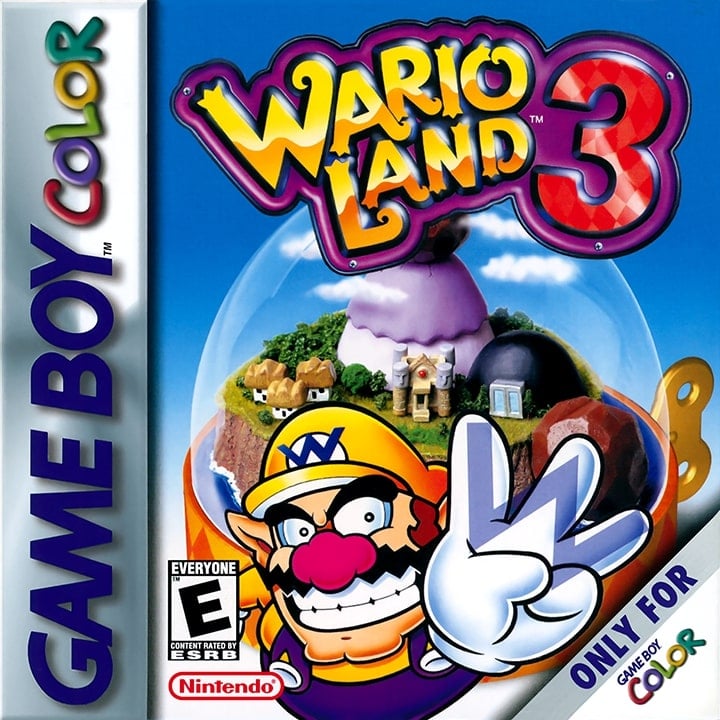
Wario Land 3


Wario Land 3

Developer: Nintendo
Publisher: Nintendo
Original System: Game Boy Color
System Played On: 3DS (Virtual Console)
Rating: 4 1/2 stars 

On February 15, 2025, I defeated the Hidden Figure, thus finishing Wario Land 3 for the Game Boy Color (via the 3DS Virtual Console)! This is the 3rd Wario Land game I have finished. And I did it in 14 3/5 gameplay hours in a span of about 2 weeks / half of a month.

I actually do have some prior experience with Wario Land 3. Sometime during childhood, shortly after getting my Game Boy Color, for either birthday or Christmas, I asked my parents for any Game Boy Color game, just to merely increase my library of Game Boy Color games. Randomly, they got me Wario Land 3. I remember playing the game, and I also remember never finishing it. I remember getting stuck, and with the internet still young and video game walkthrough websites still new, I couldn't find the answer online, so I gave up on the game. This is why, when it came time to sell my Game Boy Color to buy a Game Boy Advance, I included Wario Land 3 as a package deal. Replaying this game as an adult, my childhood frustration of getting lost and getting stuck is still warranted. The only in-game hint system is the temple, in which the Hidden Figure will tell you where to go, and that's it. It tells you neither which color key/chest to go after nor which power up you will need to get there nor were exactly that color key/chest is. While this hint system prevents anybody from becoming lost on where to go, it does not prevent getting lost once there. Luckily for me playing this game again as an adult in 2025, I found a very thorough walkthrough on GameFAQs, which I had to consult plenty, especially near the end of the game. I can't imagine how anyone can get through the game without it.

I wasn't expecting Wario Land 3 to belong to the "Metroidvania" genre. Yes, Wario Land 3 belongs to the Metroidvania genre. The entire game takes place in 1 world. Certain areas of the world map unlock depending on which treasures become unlocked. Certain areas within each level become unlocked by discovering treasure that give certain power ups. This requires a lot of backtracking to older levels, as now certain power ups allow Wario to travel to previously unreachable areas in the level. It was very interesting starting out a Wario Land game with a Wario who did not have all the abilities that he did in Wario Land 1 & 2 from the onset. Once near the end of the game, however, Wario does have all those abilities, and it once again feels natural controlling Wario.

Once again, Wario in Wario Land 3 does not have power ups like a traditional Super Mario game does. At best, Wario regains his abilities by collecting certain treasures, but that's about it. The next closest thing is that certain enemies give Wario status changes, almost like a "power down." In Wario Land 2, these power downs were implemented well, as most often, Wario needed these power downs to access certain parts of an area. While still happens in Wario Land 3, it happens a whole lot less. More often, these power downs become more of annoyance or an inconvenience, as they drag Wario away from where he needs to be. Therefore, I would say that the power downs in Wario Land 3 are done poorly, especially in light of Wario Land 2, where they are done well.

Once again, Wario Land 3 takes an alternative route when it comes to boss battles. Unlike a traditional Super Mario game, Wario cannot lose a life or get a game over in a boss battle (minus the final boss battle). Instead, Wario simply gets booted out of the boss area and has to go back to the boss area to start all over again. Between finishing Wario Land 2 and playing Wario Land 3, I watched a YouTube video which explained why this fits his character as originally a bad guy, and I have to say, I've come to like this way. Nintendo must have received complaints about how long it takes to get back to the boss area, though, for Nintendo fixed that with Wario Land 3. Wario Land 3 has a whole lot of shorter paths to return to the boss battle than Wario Land 2. Still, I would still prefer if the boss battle would allow me to pick up where I left off instead of having to begin the whole ordeal all over again.

You may have noticed I didn't record my progress toward completion. The game really doesn't do a good job of it, especially in comparison to prior games in the series, i.e. no completion percentage after the credits. As a matter of fact, one of the treasures to collect in the game is a magnifying glass, which lets the gamer know which treasures have already been collected without entering the level. Same goes for the music box coins, the other collectable in the game. While I know I collected all 4 treasures in multiple levels, only 1 level I collected all 8 of its music box coins. If previous games could let the player know the completion percentage, then so could this game. I could tell you, however, the game's coin counter maxes out at 999, for I did that a couple of times, including by the end of the game.

Wario Land 3 also has a minigame of minigolf. It does the typical golf video game gameplay, with a meter for both power and accuracy. Personally, I found it hard to control. I felt like the best strategy was to just it the ball as powerfully and accurately as possible and then hope for the best. The courses come up randomly, and it does cost money to play, but finding money becomes quite easy, so it's nothing to fret spending all this money.

In conclusion, to sum everything up, Nintendo continues to experiment on what makes a Wario Land game unique, distinct from a Super Mario game. The first game of the franchise was very linear. The second game of the series experimented with a branching narrative. The only way to go up from branching story was naturally a Metroidvania, which was exactly what Nintendo did. The Metroidvania genre makes Wario Land 3 feel fresh from the rest of the games in the franchise. At first, not having all of Wario's abilities expected from earlier games in the series feels quite frustrating for the seasoned veteran of Wario Land games. As the game progresses, however, the limitation allows and invites the gamer to experiment how to reach goals with said limitations. Despite the lack of game overs due to Wario's inability to die, the game finds way to annoy and frustrate the player to discourage the player from powering through the levels. While overall Wario Land 2 did a better job of the enemies powering down Wario, the power downs in Wario Land 3 further reinforce avoiding enemies, despite the fact Wario can't die. With all this in mind, I therefore give Wario Land 3 4 1/2 stars. It's somewhere between a good game and a very good game. I would play this game until you finish it, and if you liked it well enough, then fully complete it, but do not feel obligated to do so.

Running Ranking
1. Wario Land 3
2. Wario Land 2
3. Wario Land 1 

Tuesday, October 28, 2025

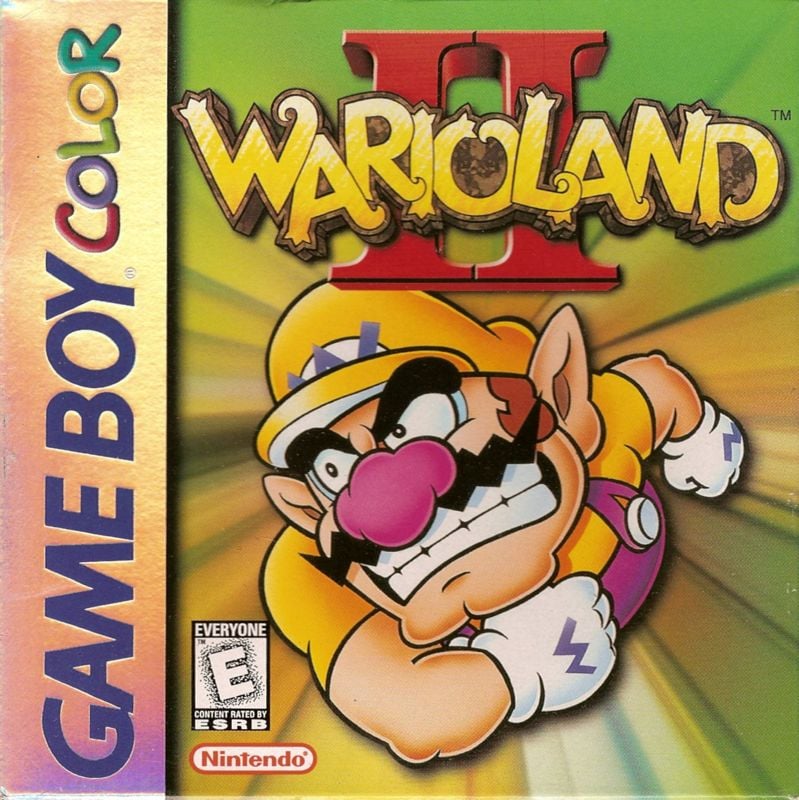
Wario Land II

Wario Land II
Developer: Nintendo
Publisher: Nintendo
Original System: Game Boy Color
System Played On: 3DS (Virtual Console)
Rating: 4 stars 

On February 1, 2025 I got all 5 endings, thus finishing Wario Land II for the Game Boy Color (via the 3DS Virtual Console)! This is the 2nd Wario game that I have finished. In my playthrough, I collected 54% of the treasures and 78% of the picture panels, as well as cleared 100% of the stages. And I did it all in 15 1/4 gameplay hours over the span of 21 days / 3 weeks / 2/3 a month. To change things up, and for the fun of it, I will make my comments with a plus (+) signifying a positive and a minus (-) signifying a negative. Then I will sum up my overall thoughts and feelings in the conclusion.

+The removal of the time clock does encourage exploration.

+Getting power-ups from the enemies instead of an item was definitely a very big positive. The last game felt like random items gave random effects. This time the enemy gives the effects, which have both advantages and disadvantages. Sometimes you actively pursue these power-ups, and at other times, you actively avoid them. Some puzzles even require them.

-The boss throwing Wario out of the ring, causing Wario's handler to retrace steps was an interesting take to boss battles. I would be on board with this change, if it weren't for one detail. When the boss throws Wario out of the room, Wario must begin from the boss battle from the start when he re-enters the room. If the boss battle would have merely picked up where it left off, that would have been fine. It's the fact the boss battles start all over again that has me annoyed by this feature.

-Why is Wario in white, especially in the Game Boy Color? I'm pretty sure he's established as purple overalls and yellow shirt & hat by now (see Mario Kart 64). Of all the systems to not show off Wario's colors, the Game Boy Color is the worst one to do so.

-This game is both linear and non-linear at the same time. On the first playthrough, the game is very linear, as it only gives you the option of 1 ending. The second and thereafter allows for multiple routes for multiple endings. I think multiple endings should be allowed from the onset.

-Wario Land II offers 2 minigames: a picture matching game and a number matching game. Completing all the minigames is required for 100% full completion. Both minigames become easier by putting more money into them. With the amount of money at the end of the game determining the gamer's final ranking in the game, however, both minigames discourage spending the money to make the minigame easier and encourage not spending money, which in turn results in a harder minigame. Putting the least amount of money into the picture matching game results in the pictures instantly flashing before the player's eyes, meaning the player must have immediate reaction. Failure to succeed at this game will result in having to play the minigame again, which costs more money. Putting the least amount of money into the number matching game will only reveal a ninth of the number, which the game has to guess from a range of 0 to 9. Virtually, the gamer is playing a guessing game based on luck, with a 10% probability of winning. Failure to win at this game requires replaying the whole level. Again, the prizes for winning these minigames are collectibles for 100% full completion and nothing more, and even then, they can be a detriment to fully completing the game with a high ranking. It almost feels like whoever plays Wario Land II has to choose whether he or she wants to 100% fully complete the game or go for the highest ranking but not both. Only the most season Wario Land II expert can do both.

In conclusion, to sum everything up, Nintendo continues to experiment on how to make a Wario Land game a unique platforing experience, at least unique from a Super Mario platforming game. The gameplay mechanic utilized to make Wario Land II unique is Wario's immortality. Enemy attacks that would kill Mario either knocks Wario back and costs Wario coins, or in some cases, gives him a power-up, which within itself can either be advantage or disadvantage. For this game, it works! Even though Wario can't die, the gamer won't want to just damage boost through the level. In a game which determines the final ranking based on the amount of currency at the end of the game, the player carefully avoids or attacks enemies, in fear of losing that precious money that will impact the final ranking. Overall, I would say that Wario Land II does a better job of making a Wario Land look and feel unique than its prequel. The prequel merely takes a Super Mario platforming game and gives it a Wario skin. This game stands out as unique in comparison to a Super Mario platforming game in the branching story, Wario's attacks, Wario's power-ups given by enemies and the bosses. Wario Land II is definitely an improvement from its prequel. I give it 4 stars. It's a good game. Make sure you play it until finish, but don't worry about ranking or completion.

Running Ranking
1. Wario Land II
2. Wario Land (1) 

Wednesday, October 22, 2025

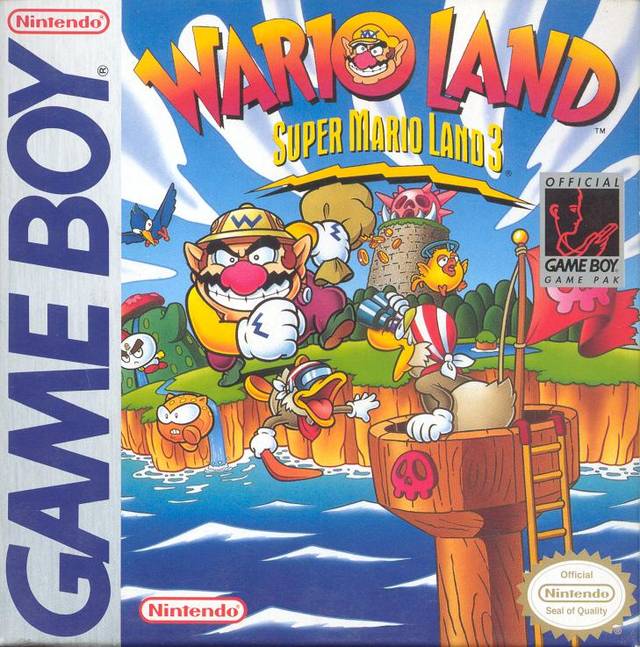
Wario Land (1): Super Mario Land 3


Wario Land (1): Super Mario Land 3

Developer: Nintendo
Publisher: Nintendo
Original System: Game Boy
System Played On: 3DS (Virtual Console)
Rating: 3 1/2 stars 

On January 10, 2025, I cleared all 40 courses and defeated the Genie, thus finishing Wario Land (1), also known as Super Mario Land 3, for the Game Boy (via the 3DS Virtual Console)! This is the 1st Wario [Land] game I have finished. After my playthrough, I ended with 1,585 coins and 3 treasures. Once I traded those treasures in for coins, my price increased to 12,585 coins, which equates to 2 moneybags, which earned Wario the tree stump house. I also collected a maximum of 19 extra lives. And I did this all in a matter of 5 3/4 hours over 7 gameplay sessions (averaging 3/4 hour per playing session) over the real-time span of 10 days / 1 1/2 weeks / 1/3 month.

Just like the Yoshi games, Nintendo did not want Wario Land to become just another platforming game. The gamer can play that way, however, if he or she chooses. I did choose that route, hence why it only took me 5 1/4 hours, hence why I had a poor final score. This game encourages exploration. I do have some grievances, however, for some of the game mechanics go contrary to this encouraged exploration.

First, why is there a time clock again? Yoshi was smart about this. They turned off the time clock, so the player did not feel rushed to find all the collectables and raise to the finish line. Wario does bring back the time clock, causing a hesitancy in exploring, because spending the time to seek and find will be something the player may not be able to afford down the road.

Second, why didn't the game just leave the end goal gates wide open? OK, to be fair, Nintendo did try to teach this in game. At the close of the first level, Wario watches an NPC opens the door to conclude the level. The only problem, however, is that the game never tells the gamer which controller inputs to use. I honestly had to look up a walkthrough on how to progress. Apparently, the correct answer was Up+B. To be fair, I don't have the manual, and to be fair, I imagine a player with a manual can easily look it up. As a gamer new to this series, however, I am neither familiar with the mechanic of having to open the end goal gates, nor do I have a manual to look these things up for myself (people lose manuals, as evident by the number of "game cartridge only" listings on eBay). Do better, Nintendo, for your future games. You need to more explicitly teach this in the game.

Third, the treasure concept was never fully fleshed out for the players. All my trophies were found randomly because I just so happened to stumble upon either the key or the chest at the end. To make matters worse, if you get a game over, you lose a treasure. If you have no treasures to surrender, upon getting a game over, you lose half your coins. To me, this is too steep of a punishment. Because you lose trophies, you now need to go back to that course to find it again and manage your way through that level again. Losing half your coins is not as bad in the beginning of the game, but is a whole lot worse near the end of the game. That's unfair to players who have experience who just slip up near the end. I say the penalty for game over should have been a simple loss of 100 coins. Not too little, not too much.

Bosses lacked creativity. Most of the bosses were just giant-sized common enemies. Most of those bosses had the same exact way to defeat them: throw their babies at them. I don't know how many of my enemies and foes I defeated by throwing their kids at them. Speaking of bosses...

[SPOILER ALERT!!] I did not enjoy playing flip cup, or rather, flip lamp, while dodging genie attacks. As far as I am concerned, there is no way to guarantee for the lamp to land right side up, so the gamer can catch the cloud elevator up. Therefore, the player is just playing points at this point. Of course, as a Game Boy game, final boss battle takes 6 hits, not 3. Since the boss never changes phases, this rote repetition, which is tedious [/END SPOILERS]

Despite my gripes with the game, I found the game to an overall enjoyable experience, and I liked playing it. Although the subtitle of "Super Mario Land 3" was probably attached at the end to sell more games as a sequel to a beloved series, the subtitle fits. At the heart, this game is a platformer, just like the previous Super Mario Land games on the Game Boy. Just like the prior Super Mario Land games, the gamer aims to reach the goal at the end of level by jumping from platform to platform while either avoiding or attacking enemies. Just like Super Mario Land 1 & 2, the player has power-ups at Wario's disposal to make gameplay easier. At the same time, however, Nintendo mad enough changes to the formula to make the experience feel unique to Wario. Mario eats mushrooms to grow big; Wario eats garlic to grow big. Mario uses flowers to throw fireballs; Wario uses a dragon pot to breathe fire. It's not just the power-ups, it's also the attacks. Small and weak Mario can only resort to jumping on enemies; big and bulked up Wario can body slam and ground point. It's not just the attacks and the power-ups, but it's also the worlds, the enemies and the bosses, too. Yes, even the bosses. While the bosses lacked creativity, they felt like they could not belong in a Mario game, but they definitely belonged in a Wario game. Nintendo will continue to experiment on how to make a Wario Land game feel unique to Wario and not just another platforming game, but as for right now, having a Mario-like platforming game with Wario skin suffices.