On Christmas Morning 2018, I was surprised to find myself unwrapping a Nintendo Switch! My mentor and my best friend Louis Fritz had gifted me a Switch for Christmas, along with a small collection of games. I could not simply let such a good collection of Switch games go to waste, so I dedicated 2019 as the Year of the Switch, focusing on playing all those Switch games in that small collection. By the end of 2019, I had managed to play all but 1 of those games. That game was Super Mario Odyssey. As 2019 wound down to the end, I had a feeling I could not finish it by the end of the year. Another thought entered my mind: "What if Super Mario Odyssey became a part of a Year of the Super Mario?" I had considered a Year of Super Mario games in the past. I tended to avoid it because I had played Super Mario games in my past childhood, whereas there were so many other Nintendo franchises I had not even played a single game at all. At the same time, however, that past childhood experience with Super Mario had been all 2D Super Mario games. I neither owned Super Mario 64 when I owned a Nintendo 64, nor did I own Super Mario Sunshine when I owned a Game Cube. The first 3D Super Mario game I played was when I borrowed Super Mario Galaxy to play on my Wii, but I never finished it. I figured that a Year of the Super Mario might be more worthwhile if I focused on the 3D Super Mario games before the Super Mario games. Therefore, I declared 2020 the Year of Super Mario. I defined a Super Mario gas "a platforming game in which Mario is the main playable character," which disqualified puzzle games (no Dr. Mario, no Mario picross, etc.), racing games (none of the Mario Kart games), RPGs (no Paper Mario, no Mario&Luigi, etc.), party games (none of the Mario Party games) and sports games (no baseball, tennis, golf, Olympics, etc.). This also disqualified any platforming games in which Luigi, Toad, Peach and Yoshi are the main characters. That left 21 Super Mario games. I planned to go from least familiar to most familiar, which means I would begin with the 3D Super Mario games, because I never really played, then I would play the 2D handheld games, for I never played them, and then I would end with the rest of the 2D games that I played but never finished in childhood.

If I planned to begin the Year of Super Mario with the 3D Super Mario games, it naturally only made sense to go in order of year released, so the Year of Super Mario started with Super Mario 64. I had bought Super Mario 64 a few years back on the Wii U Virtual Console, and I even played a bit of it. I did not see a problem starting up when I left off, so I did. After collecting 80 stars and defeating Bowser over 26 1/2 hours of gameplay, I finished my first 3D Super Mario game. At first, I was taken aback by Super Mario 64. The camera angles were wonky, the controls were finicky and the gameplay seemed so foreign compared to the 2D Super Mario games (besides the jump from 2D to 3D). I even accused Super Mario 64 lovers of viewing the game with rose-colored nostalgia glasses. Looking back now, however I came to appreciate how the game did the best it could with the technology it had and how it did smoothly transition from 2D Super Mario to 3D Super, again with the technology limitations it had. Now looking back on it, I can easily say Super Mario 64 is my 2nd favorite Super Mario game.

Nintendo went from the Nintendo 64 to the Nintendo Game Cube, so I went from Super Mario 64 to Super Mario Sunshine. Since the Game Cube is near 20 years old, and since Nintendo has kept Game Cube games in the Nintendo vault, Game Cube games have gone up in price. I had to spend the same amount on Super Mario Sunshine as I would on a brand new Switch game (ironically, 8 months later, Nintendo would release Super Mario 3D All-Stars on the Switch, which would give 3 3D Super Mario games for the price of 1 brand new Switch game)! Before playing Super Mario Sunshine, I had heard of Super Mario Sunshine. First impression made me think Mario had gone environmentalist. I expected this game to be somewhat like the inverse of Splatoon or Epic Mickey. I was partially right. Indeed, there were a couple levels where the goal was to clean up the entire level. A few more levels had you cleaning up part of the level. But it was not the overwhelming theme of the game. F.L.U.D.D. was not merely to help Mario clean up Delfino Island. It helped Mario run to new speeds and jump to new heights. Therefore, some of the goals involved seeing if the players knew how to use F.L.U.D.D. This sometimes involved solving a puzzle, and at other times, involved beating a boss. I can appreciate all the ways Super Mario Sunshine uses the new mechanic. If players still did not like the new F.L.U.D.D. mechanic, Super Mario Sunshine has some old fashion 3D platforming areas. Honestly, these were my least favorite part of the game. All Mario's jumps have to be perfected, including the wall jump, backflip jump, triple jump, spin jump. Without knowing how to land them all perfectly, you die many times and get many game overs. It doesn't help there is no margin of error. Overjumping, under jumping. jumping too quickly and taking too long to jump will all kill Mario. The game must have known the difficulty of these areas, as the game provides plenty of opportunities to collect green mushrooms for extra levels, even to the point of farming extra lives. While all the extra lives provides plenty of opportunities to learn how to reach the end, it will still take much time to learn how to get to that goal. These platforming areas can easily take a half hour to a full hour to collect that 1 shine. These areas made me hate the word "secret" (all the platforming levels had "secret" somewhere in the episode title). The only thing I liked about these levels were the music for them, which was acapella bebopping of the original Super Mario theme song. These platforming areas need to be mastered, however, which leads me to the biggest complaint about this game. I liked the previous Mario game, Super Mario 64, because it allowed me to choose the 70 easier power stars to collect (or the 50 hardest power stars to avoid) in order to face off against Bowser. In Super Mario Sunshine, you need to beat Shadow Mario in each level to face off against Bowser. Shadow Mario is always the 7th shine. Unlike Super Mario 64, Super Mario Sunshine does not allow the player to go out of order. Therefore, in order to fight Shadow Mario, the player must collect the other 6 shines, which typically included 1-2 3D platforming episodes. Despite all the hardships, I finished Super Mario Sunshine on February 11 after 24 2/3 hours of gameplay. Despite my complaints, I ultimately liked this game. When I finished this game, I actually felt like I accomplished a herculean task. No other Super Mario game would ever give me this feeling. Therefore, I could easily place Super Mario Sunshine in my top 5 Super Mario games.

After a short hiatus for my PhD residency, I moved on to Super Mario Galaxy 1 for the Nintendo Wii. Just like Super Mario 64, I had played Super Mario Galaxy 1 previously during my undergraduate years in college. At that time, my best friend was a completionist, and the completionist in him told me that beating the game involved collecting 120 stars as Mario and then the same 120 stars as Luigi. Bored with the repetitive game play and not wanting to collect 120 stars twice, I gave up when I got bored. When I picked it back up this year, after an almost 9 year hiatus (last played April 16, 2009), I resolved to collect enough stars to take on Bowser and then call its quits. I came to find out I was only a few stars away from doing just that! To make my Super Mario Galaxy 1 session last slightly longer, I decided to collect all the easier power stars. Well, 27 1/2 game play hours later (including about 15 hours played in college), I collected 92 stars and beat Bowser on March 2. Overall, I liked this game. Super Mario Galaxy 1 knew the mistakes from the past 2 3D Super Mario games, and they fixed them in Super Mario Galaxy 1. The gravity feature added fresh new level of complexity to platforming. Everything in the game felt doable and possible. Again, Super Mario Galaxy 1 easily made my top 5 Super Mario games.

Naturally, it only made sense to follow up Super Mario Galaxy 1 with Super Mario Galaxy 2. My first impressions of Super Mario Galaxy 2 was that is was more like an expansion pack than a sequel, and boy, were my first impressions right! The game just felt like more of the last game with no improvement. If anything, it felt look it took a step backwards. The linear story makes the game feel predictable. The gameplay feels recycled. The only benefit of Super Mario Galaxy 2 over Super Mario Galaxy 1 is having Yoshi and using Luigi sooner. Nevertheless, I collected 80 stars (that's 2/3 of them) and defeated Bowser, thus finishing Super Mario Galaxy 2 for the Nintendo Wii on March 28 after 18 1/3 hours of gameplay.
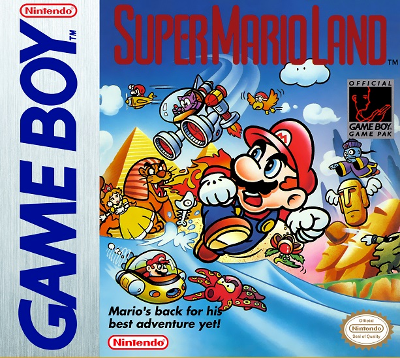
Between the stress-inducing Super Mario Sunshine and the lackluster Super Mario Galaxy 2, I was kind of over the 3D Super Mario games. I nostalgically missed the 2D Super Mario games. I didn't want to replay games I have already played in the past just yet, though. Therefore, I decided to jump ahead in my plan a bit to the handheld 2D Super Mario games, which I had never played before in my past. Again, it only made sense to go in order of release date, so I began with Super Mario Land 1 for the Nintendo Game Boy. I had heard it was a short game, but I was not prepared for how short it truly was. On April 4, I 100% fully completed all 12 levels in a matter of 2 gameplay hours over 4 days. I recognize the limitations of a launch title one of the first handheld systems. After all, Kirby's Dreamland on the Game Boy would only have 5 levels (with the 5th level being a boss rush), and that game only takes about 1 1/4 hours. At the same time, however, the Game Boy would have The Legend of Zelda: Link's Awakening and Pokémon Red & Blue, and those games have hours of gameplay. And Nintendo did find ways around limitations. Since the original Game Boy does not have colors, Super Mario Land cannot have red and green mushrooms. Therefore, Nintendo used hearts to for extra lives. The Game Boy could not depict fireballs well, so Mario uses a Super Ball as a projectile. At the same time, however, Super Mario Land does not always find a way around its limitations. The playable character kind of, sort of looks like Mario, but not as well as the NES. While Super Mario does grow bigger, Super Ball Mario has no change. The player has to press B to see if Mario has the power. Nintendo could have found ways around the limitations, but they did not. Despite Nintendo submitting to the limitations of the Game Boy, I do appreciate how Nintendo took Mario in a different direction for the Mario series. No Toads, no Toadstool, no Mushroom Kingdom, no Bowser. This time, Mario saves Princess Daisy and her kingdom of Sarasaland from Tantanga. I like this different direction. Saving princesses doesn't have to be a quest for true love. Saving princesses could be a job. Maybe Mario could a plumber regularly, but when it comes time to save a princess, he become a princess saver. Overall, Super Mario Land is too limited, in the game's graphics, gameplay and game length. Honestly, I have to say that Super Mario Land 1 was my least favorite game this year.

Despite my disappointment with Super Mario Land 1, I moved on to its direct sequel Super Mario Land 2: 6 Golden Coins. On April 11, I Beat Wario, thus completing Super Mario Land 2: 6 Golden Coins for the Nintendo Game Boy (via the 3DS Virtual Console)! And when I say I completed it, I actually mean I completed it. I got through every level, including the bonus levels (I will admit I had to use a wiki to find them, but that's the only time I used a wiki!). I even maxed out my lives at 99 lives and my coins at 999 coins (I will confess used restore points, but I only used them moderately. I only restored at the beginning of levels.). And I did it all in 5 1/2 hours. Super Mario Land 2 hugely improves from Super Mario Land 1 graphically. Mario actually looks like Mario. As a matter of fact, Mario looks like the Mario from Super Mario World on the Super Nintendo. No wonder why some people said back in the day that Super Mario World could have been on the NES. After all, Nintendo somehow got SNES graphics on the Game Boy (somewhat). Nintendo did a better job working around graphical limitations this time. When Mario collects a fire flower (which actually look like the fire flowers in Super Mario World), Mario gains a feather in Mario's cap to signify Mario has fire power. When Mario collects a carrot, Mario gains bunny ears (they look like wings to me) to signify he can fly. Of course, Super Mario Land 2 kept hearts for extra lives, as the Game Boy still had no way to distinguish red mushrooms for Super Mario from green mushrooms for extra lives, but that is understandable, and the symbolism makes sense. Super Mario Land 2 hugely improves from Super Mario Land 1 in gameplay. Super Mario Land 2 has 6 worlds and a total of 29 levels, much more than Super Mario 1, which had 4 world and 12 total levels. Nevertheless, it still falls short of Super Mario Bros. 1, which had 8 worlds and 32 total levels. If 8 world and 32 levels is possible on the NES, it should be on the Game Boy. What sets Super Mario Land 2 apart from other Super Mario games (at least in comparison to previous games) is that Super Mario Land 2 has a somewhat open world concept. The player can choose what order to complete the worlds. Knowing that the player has the option to go to whatever world, Nintendo kept the difficulty fairly easy for each of the worlds. Indeed, difficulty increases as the player progresses throughout the world, but no more than the other world. The hardest level is the final level, but that makes sense because the only way to unlock is to beat the other worlds, truly making it the last level. [SPOILER ALERT!] The final boss battle is worth appreciating. Not only is the player fighting a bad version of himself (Wario is pretty much and portmantua of "Bad Mario" in Japanese), but he truly fills the mantra, as he takes on the powers of fire and flight, just like Mario did in the game [/END SPOILERS] As for story, it is hard to say if it is better or worse than Mario Land 1. It is different, and that alone makes it better than other Super Mario games. No saving Princess Peach Toadstool from Bowser. In fact, neither Bowser no Princess Toadstool even make an appearance. Not even a Toad makes an appearance. In Super Mario Land 2, Mario simply seeks to regain his castle from Wario, who took it from him when he was away saving Daisy in Sarasaland. Wario has locked Mario out of the castle by scattered the 6 golden coins, and now Mario must fetch them to open up the doors to the castles. Like I said, it simply works, and it's much better than the overused typical plot, which involves saving Princess Peach from Bowser. While a huge improvement from its prequel, Super Mario Land 2: 6 Golden Coins still ends up ranked on the bottom half of my favorite Super Mario games.

While in the past Nintendo fans had to wait 13 1/2 years after Super Mario Land 2: 6 Golden Coins to play another 2D Super Mario game on handheld, I started playing New Super Mario Bros 1 the day after finishing Super Mario Land 2. 2 weeks later on April 25, I finished the game in 11 gameplay hours. New Super Mario Bros. must have been a breath of fresh air for those who never cared for 3D Super Mario and kept replaying the 2D Super Mario games of the NES, SNES and Game Boy. This game legitimately feels like those 2D Super Mario games. I can't comment too much of the graphics because graphics meant for the DS does not transition well to the Wii U, but it does look it does surpass the graphics of the Game Boy and SNES. The map on the bottom of the screen help the player realize how much progress they made. The touch screen can also save a power up, which the player can use when in danger. The touch screen is neither overused nor underused, which is good. New Super Mario Bros. also retains the feel of the original 2D Super Mario games by mainly focusing on the traditional Super Mario power-ups of mushrooms, fire flowers and stars. Yes, they do have the mega mushroom, as advertised on the box art, but besides getting on the first level, I only got it 1 more time. You would think that the advertised power-up would get more attention, but no, it does not. They also added a blue shell to make shell Mario, but I didn't find the power-up worth it. Only for 1 star coin did it come in handy. The tiny mushroom allows Mario to get into small spaces and jump high, lofty jumps, but beside that, it adds no other benefit. In fact, it does not allow Mario to kill enemies by jumping on them! This brings the player's focus on the mushrooms, fire flowers and stars, which the traditional Super Mario player will not mind. If simply reaching the end of the stage becomes too easy and too boring for the player, the player can challenge himself or herself by collecting star coins. Each level has 3 star coins. Star coins are easy to find, a challenge to collect. Seeing the coin star is one thing; getting to that star is another. It adds another layer of difficulty if the player chooses to do so. [SPOILER ALERT!] While I liked the unique mini-bosses in some of the castles, even the giant goomba, I got tired of the repetition of Bowser Jr. in the towers. For the first half of the towers, Mario simply has to stomp on Bowser Jr. three times. The second half adds more complexity. Mario can't jump on his spiked shell, but when Bowser Jr. throws green koopa shells, it becomes apparent Mario must send them back to defeat koopa. On a similar note, I think Nintendo spoiled the surprise by introducing Dry Bowser too soon. I think Dry Bowser should have been the final boss, like a second form of Bowser. Instead Bowser dies as he mostly does in 2D Super Mario games. All the player has to do is get Mario to the end of the stage, and Bowser dies. That or fling fire balls, like I did. [/END SPOILERS]. Overall, I enjoyed New Super Mario Bros. It felt like a classic Super Mario game, while looking like a modern Super Mario game.

It only made sense to play the sequel, New Super Mario Bros. 2, next. After 9 2/3 gameplay hours over a span of 9 days (that's averaging 1 hour 4 minutes a day), I beat the Koopalings and then defeated Bowser, thus finishing New Super Mаrio Bros. 2 for the Nintendo 3DS! In my playthrough, I collected 154 star coins (that's 70% of them!), 24,441 coins and 167 lives (I had 175 lives at once). In the process, I earned a high score of 5,802,890. The gimmick mechanic meant to attract the gamer here is coins. For full completion (which I did not do), the player has to collect a grand total of 9,999,999 coins, 1 short of 10 million. Therefore, coins come aplenty in New Super Mario Bros. 2. If the levels themselves do not provide enough coins (which they do), the game provides plenty of power-ups that make coins, like the Gold Block and the Gold Flower. Many reviews have complained that emphasis on coin collecting should have changed the number of coins needed to earn an extra life. Clearly Nintendo did consider this, as the life counter can go up to 1,110 lives (another part of completion). Therefore, collecting lives becomes as much part of the game as collecting coins. Furthermore, I would even add that other Super Mario games (the 3D games mainly) have lowered the coins needed for an extra life down to 50, so Nintendo could have raised it or lowered in for New Super Mario Bros. 2, yet they decided not to do it, which I think means they felt comfortable keeping it at 100 coins. Besides, Kirby: Star Allies is guilty of the same thing (I had over 100 lives by the time I reached the final boss), yet it does not receive as much flack. Since the gameplay mechanic of New Super Mario Bros. 2 focuses on coin collecting, this changes the dynamic of level design. The new emphasis is now exploring the level, not reaching the end of the level. Therefore, reaching the end of the level is quite easy, so easy that the New Super Mario Bros. 2 subgame is a competition on how quickly the player can get Mario to the end of 3 random levels. While I think this works well for the 3D Super Mario games, it does not work as well for 2D Super Mario games. The main goal of a 2D Super Mario game should be reaching the end of the level, and collecting should merely be extra challenges. I would have liked more challenge in reaching the end of the level, not just in collecting. On top of that New Super Mario Bros. 2 has only 6 main worlds and 3 bonus worlds. While I do appreciate Nintendo named the bonus worlds after classic Mario items instead of numbering them like the main worlds, on the surface, it seems like New Super Mario Bros. 2 only has 6 worlds, which makes it kind of short. With the levels easy to get through, along side only 6 worlds, New Super Mario Bros. 2 feels like it lacks content. I had to consult a walkthrough to find all the hidden levels, just so I had more content to play. One of the biggest complaints I had about New Super Mario Bros 1. is the tower boss was always Bowser Jr., who only changes up his pattern halfway through the game. In New Super Mario Bros. 2., the new tower boss is Reznor, brought back from Super Mario World for the first time. I appreciate that Nintendo went back in its history and picked up a rarely used character to make a miniboss. I also appreciate that Reznor ramps in difficulty at each tower. My problem with Reznor is that the game gives plenty of time to defeat him, so overall, even with ramping up difficulty, he never becomes hard. For castle of each world, New Super Mario Bros. 2 resorts back to the Koopalings. Many reviews complain about the Koopalings as overused, but again, I will assert that it sure beats facing off against Bowser Jr. multiple times. [SPOILER ALERT!] In New Super Mario Bros 1., defeating Bowser could be as simple as throwing numerous fire balls at him. In New Super Mario Bros. 2, Bowser comes in 2 phases. The first phase is the classic phase, so classic it dates back to Super Mario Bros. 1 on the NES. Either get to the end of the bridge or throw many fireballs at Bowser, and Bowser dies. To add complexity, Bowser has a second phase. Bowser grows giant in the background, and Mario has to platform upward to jump on a giant switch to kill Bowser. While I get developers do this to make platforming beat the final boss in a platforming game, the game's animations never make it clear why jumping on the switch defeats Bowser. Bowser just falls, Peach's cage breaks open, Mario and Peach reunite, and credits roll. I still think that that a platforming game can have a challenging final boss fight without changing up the mechanics too much, yet does not resort to platforming [/END SPOILERS]. Despite the complaints about the coin gimmick and bringing back the Koppalings, New Super Mario Bros. 2 improved from New Super Mario Bros. 1.

After playing 4 2D Super Mario games back-to-back, I was ready to return to the 3D Mario games. Since I was on the 3DS, I figured I might as well stay on the 3DS with Super Mario Land 3D. After 7 1/2 gameplay hours over a 6-day span, I beat Bowser and saved Princess Peach, thus finishing Super Mario Land 3D for the Nintendo 3DS? I put a question mark in regard to "finishing" because after beating Bowser in the final level of world 8, it unlocks the special worlds, 8 more worlds. Whereas the 8 normal worlds ended with saving Peach, the 8 special worlds end with saving Luigi. In one regard, saving the princess is only half the game, and saving Luigi is the other half of the game. In another regard, saving Peach in the normal worlds is the main game and saving Luigi is the extra game. If I have done my research correctly, reaching the final level of the final world requires almost full completion (full completion to that point). At the beginning of the year, I said I finish all the Super Mario games, not complete them. I didn't complete Super Mario Galaxy to unlock Super Luigi Galaxy. I didn't play through star world in New Super Mario Bros. 2, which is an extra world unlocked after defeating Bowser and collecting 90 star coins. Therefore, I decided that I would playe what gamers call a "Main+" run of Super Mario 3D Land: I would fully complete the normal worlds, and I would get as far as possible in the extra worlds. I put in another 5 1/2 hours into Super Mario Land 3D. In total, I have spent the last 2 weeks playing Super Mario 3D Land for a grand total of 13 hours. I got through three-quarters of the special worlds, but then I hit a wall in Special World 7. I could not finish any of the levels. Therefore, I called it quits then and there. The additional gameplay did not go in vain, however. I proceeded to fully complete all normal world, collecting all the star medals (not counting gold flags toward "completion"). I also collected additional star medals in the special worlds, bringing my grand total up to 230 star medals, which is roughly four-fifths of them. I have heard it say of Super Mario 3D Land, "The real game begins after you beat Bowser." I hate to say it, but it's true. There's a reason completed three-quarters of the normal worlds on the first try. The game does not get difficult until the special worlds. The hardest it gets in the normal worlds is Bowser's castle, but even that I would call intense but not difficult. I hate to say that because a good game should not be that way. True, a game should not be so hard that it cannot be finished, but that does not mean the game should be a cakewalk to the finish line. A game should steadily rank up in difficulty. It is almost like the game is saying, "The normal worlds are the fake worlds. The special worlds are the real worlds." The contrast between the two worlds also makes it feel like two different games. Normal worlds offer plenty of opportunities to gain lives. At one point, I had as many as 55 lives, and because of this, I did not get first game over until special world 3, a quarter way through the special worlds. Special worlds rarely hand out extra lives. Most likely, the player will only collect extra lives from 100 coins, which appear seldom. Normal world provide plenty of chances to collect power ups. Special worlds made it hard to find much needed power ups. The player will find themselves constantly going back to item houses after a game over to stock up on items. Such a contrast makes it hard to transition from normal worlds to special worlds, which, again, makes the player unprepared for the hard "real game" after playing an easy "fake game." Besides these complaints, Super Mario 3D Land was an overall enjoyable game. Although very linear, checkpoints that require star medals will make a player go back and explore to find more star medals, but as I stated before, the ease to find and reach the star medals will usually keep the gamer at least 10 ahead of the minimum requirement. All the favorite power-ups return, including Tanooki Mario. Boomerang Mario is like an improve fire Mario, as the boomerang can collect coins and star medals. The game also utilizes the 3D feature of the 3DS to create some interesting puzzles, yet it provides alternative ways to solve the puzzles if playing on a 2DS. Despite my complaints of the game being both too easy and too hard at the same time, this game definitely belongs in my top 10 favorite Super Mario games, and it almost fell within the top 5.

After Super Mario 3D Land, it only made sense to follow it up with its spiritual successor of Super Mario 3D World on the Wii U. This time, I invited my wife Carrie to help me out by playing alongside me as Luigi. Originally, we finished the main game on May 30 after 11 1/2 gameplay hours. We had so much fun, however, that we went back to collect all the green stars and stamps in all the main worlds, as well as getting the golden flag. By doing so, we started unlocking the extra worlds. Then we completed the extra worlds of mushroom world, flower world and star world, which includes the green stars, stamps and gold flags. When all was said and done, we fully completed all worlds but crown world, the final world, with the 2 hardest levels in the whole game. Super Mario 3D World was very similar to Super Mario 3D Land, so similar I would say it's almost a tie over which one is my favorite. The tiebreaker, however, favors Super Mario 3D Land. Since Super Mario 3D Land has actual 3D built into the 3DS, it better utilizes the 3D aspect. Sometimes Super Mario 3D World can't decide whether it wants to be a 2D game or a 3D game. Nevertheless, Super Mario 3D World makes a great option for a multiplayer 3D Super Mario game, which is traditionally reserved for 2D games.

While playing Super Mario 3D World with Carrie, I simultaneously played Super Mario Maker 1 on the Wii U. I spent 12 1/2 gameplay hours over 11 days playing Super Mario Maker 1, with the last day on May 31. During that time, I cleared the 10 Mario Challenge, and I cleared the 100 Mario Challenge on easy and normal. I attempted to clear 100 Mario Challenge on expert a few times, but at best, I could get it halfway done before losing all 100 lives. After those few attempts, I called it quits. The names of 10 Mario challenge and 100 Mario challenge I found a bit deceiving. Indeed, the names do fit, as the 10 Mario Challenge gives the player 10 lives and the 100 Mario Challenge gives the player 100 lives. The numbers of lives, however, do not fit the challenge. The 10 Mario challenge almost fits, giving 10 lives for 8 levels. In regard to the 100 Mario challenge, however, 100 lives does not fit the 8 levels on easy and the 16 levels on normal or expert, especially when the player can earn up to 3 lives per levels. The 10 Mario challenge should involve 10 levels to beat 10 levels, and the 100 Mario challenge should involve 100 lives to beat 100 levels. I know I should not be talking. 100 lives could not get me beyond 8 levels on expert. But I had way too many lives for easy and normal, especially easy, when so many easy levels were "auto runners" (don't touch anything, and it will play out itself). That or have all 4 difficulties in the 100 Mario Challenge. The only problem with that, thought, is that I would hate to get stuck on an expert level too difficult to progress. That's the problem with random levels based off completion percentage. Some levels are hard to beat because there are troll levels (will kill you randomly by not starting right away or picking a wrong door/pipe), while others are hard to beat because they require precision jumping with no margin for error. That's the disadvantage of random player-made levels instead of creator-made levels, like the 10 Mario Challenge. As for the maker part, I did not really play it, except for the tutorial part. because I am not the creative type. From what I did play in the tutorial, the controls made good sense. I liked using the gamepad and stylus to design the level. It truly utilized have two screens at once.
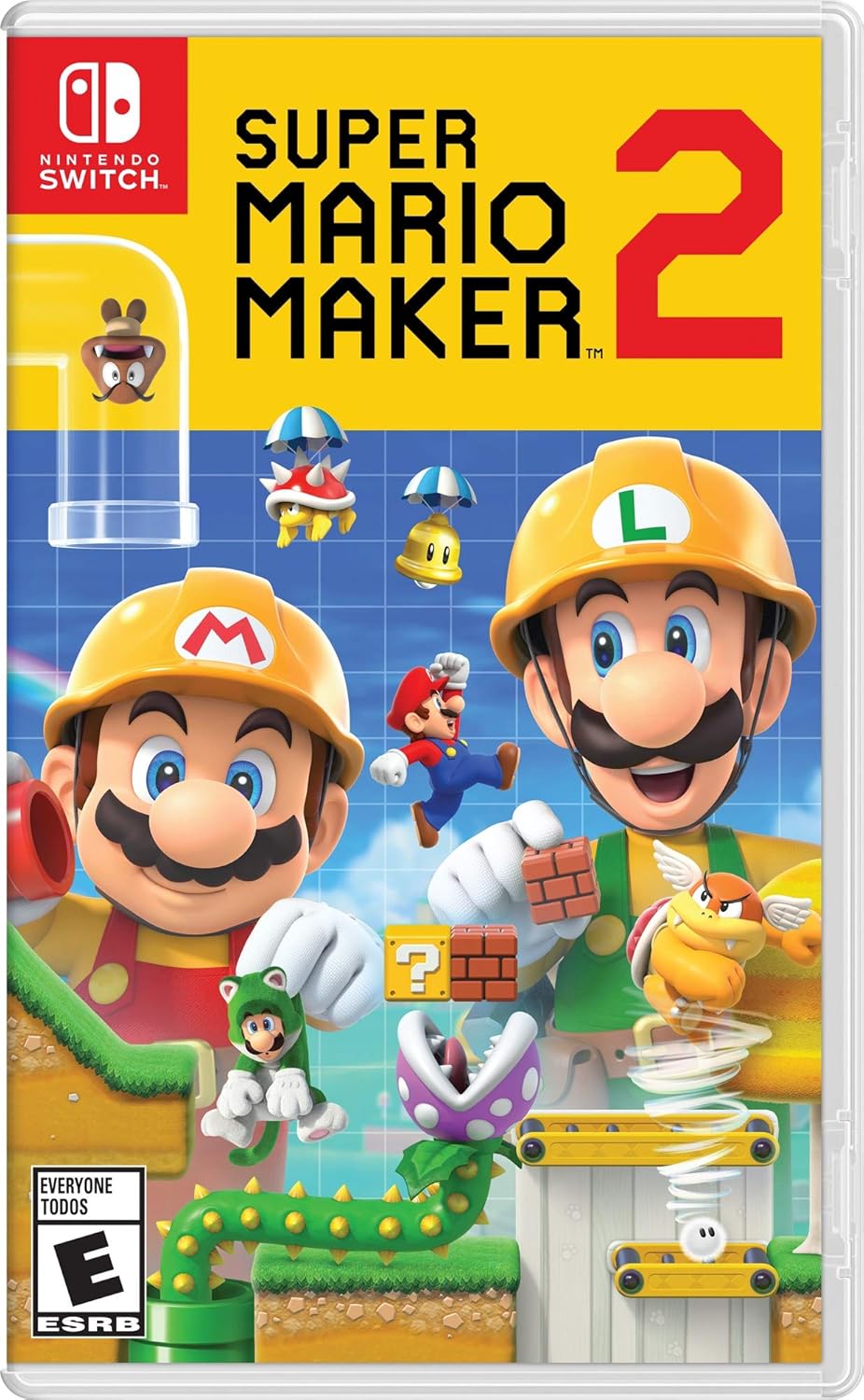
Once again, it only made sense to follow up with the sequel. On June 1, I began playing Super Mario Maker 2 on the Switch. This time, Nintendo decided to include a story mode in this Super Mario Maker game. The story consists of doing "jobs" to rebuild Peach's castle. It took me 84 jobs (that's 2/3 of them!) to rebuild Peach's castle. After that, I attempted the endless challenge a few times to see how far I could get. At my best, on normal, I could clear 13 courses, and on hard, I could clear 2 courses. After I few tries, I called it quits after 10 gameplay hours over the span of a week. Overall, I'm glad Nintendo decided to give Super Mario Maker 2 a story, which Super Mario Maker 1 did not. While I wish Nintendo would have fleshed out the idea more, but again I realize that having a story mode is better than not having a story mode. Ultimately, the story mode serves, in a way, as a tutorial. It shows the player the new features and what the player can create with those new features. In order to do so, all "jobs" come from the actual developers, not content creators. I'm glad Nintendo did not choose to create its story mode around developer-made courses/levels, not randomly selected creator content. The player no longer has to fear getting stuck on levels which involve precision jumps or attacks from all enemies at all sides. My favorite feature in story mode is that, if the players get stuck and dies a couple or few times on the "job," the player can edit the course/level (to some extent) to make it easier. While it technically does not count as truly completing the job (a Luigi flag goes in place of the Mario flag), it teaches the gamer how to create levels just as much as play them. If you got ahold of Super Mario Maker 2 just to play and not to make, like I did, once you complete the story mode, not much left remains. Super Mario Maker did not bring back 10 Mario Challenge or 100 Mario Challenge from Super Mario Maker 1, which I wish they would have. Yes, they have endless challenge, but each difficulty only gives the gamer 5 lives. Easy is too easy, between the auto-play levels and the just-run levels, so endless challenge on easy goes on infinitely. Normal difficulty comes down to a coin flip whether it falls on the easy or hard end of difficulty, and there's absolutely no way to tell. Expert and Super Expert are some of the hardest and most frustrating difficulties, so much so that the player may die all 5 times on the first level. Ninji runs are only fun if you enjoy speed runs. And Yamayura's Dojo is just a tutorial for creators. Otherwise, you'll randomly be looking for levels. This is why I wish Story Mode was more fleshed out, and this is why I wish they would have brought back 10 & 100 Mario Challenge. Then again, with the last update allowing content creators to create whole worlds instead of just courses/levels, Super Mario Maker 2 becomes an infinite amount of Super Mario games! Super Mario Maker 2 is definitely an improved sequel over Super Mario Maker 1.

While on the Switch, it made the most sense to me to play the other big Super Mario hit on the Switch: Super Mario Odyssey. At first, I was taken aback by the short length of the game. I beat Bowser for the final time after a mere 10 hours of gameplay. This gameplay length fails in comparison to all the other 3D Super Mario games, which on average took about 18-28 hours. The short playtime may have to do with the bare minimum needed to complete the game. Super Mario Odyssey only required 120 moons out of a possible 999 moon. That's only about 1/8! Compare that to the other 3D Super Mario games, which most requires at least half of the collectable for the final showdown against Bowser. Besides this complaint, my only other complaint is the new minibosses the Broodals, these rabbit/hare-like creatures, which Bowser hired to stand between Mario and his wedding with Peach. Each Broodal has its own fighting mechanic, so fighting each one is different. The only probably is that there is only 4 of them. That means the player has to fight each one twice. The second match is supposed to be harder, but it only comes off as slightly harder. While I appreciate that Nintendo did not resort to the Koopalings again, I wish they would have made more Broodals, or at least have them paired up for some interesting combinations. Besides those 2 complaints, I have no other complaints for the game. Cappy, Mario's cap come to life, brings new gameplay to the Super Mario franchise, in both terms of jumping and power ups. While Super Mario Odyssey has some of the stereotypical kingdoms (oh look, another desert, snow and water world), the new worlds display the creativity behind the Nintendo developers. Super Mario Odyssey has open world exploration similar to Legend of Zelda: Breath of the Wild, and it works for it. Overall, Super Mario Odyssey returned to what made Super Mario 64 so great without any of gimmicks of past 3D Super Mario games, like a water backpack in Super Mario Sunshine or gravity in Super Mario Galaxy 1 & 2. No wonder this is my favorite Super Mario game!

Next I played Super Mario Run for mobile phones. Hey, it has Super Mario in its name, and it fits the definition of a Super Mario game, so I had to play it! I played the iOS version on my iPhone 6s+. By the time I beat Bowser on June 20, I collected 90 of 120 pink coins (that's 3/4 of them!), collecting all the pink coins on 3 levels. On those 3 levels, I collected 3 purple coins (that's 2.5% of them). And I did it all in a matter of 1 1/4 gameplay hours over 6 days. understand Nintendo wanted the player to play the game in portrait/vertical mode, with only 1 hand, but in order to do so, Mario has to automatically run, hence the title Super Mario Run. Jumping comes down to tapping the screen, with longer presses resulting in bigger jumps. It's harder to line up jumps with a constantly moving Mario. Because this is the only control, the only power up Mario can have is the super mushroom and the invincibility star. I missed having the fire flower. Again, I get why Nintendo chose the portrait/vertical mode and 1 hand control, but I would have preferred a horizontal/landscape mode, with a virtual d-pad on the left side of the touchscreen and 2 virtual buttons on the right side of the touchscreen for the standard Mario controls. Yes, I know that would have made it a traditional Super Mario game, but it would have been nice to have a Super Mario game to take on the go without having to take a Nintendo handheld with you. There are other modes beside Tour mode (the main "story" mode), but they are just more of the Tour mode. Rally mode has the gamer race asynchronous with other players, aiming for high scores, on the same levels as tour mode. Rally 10 Mode has the gamer attempt to collect 3 rainbow coins/medallions on 10 courses in a row. While some of these courses are original, many of them are simply shortened version of the tour mode levels. Altogether, it feels like player plays the same levels over and over again. 24 levels does not feel like enough. Perhaps if there was over 32 levels, the repetition would not be that bad. Surprisingly, it did not fall down to my least favorite Super Mario game, but it definitely fell into the bottom 3.

Nearing the halfway point of the year and already finishing 2/3 of the Super Mario games, I figured I could spare the time to go back to the game I finished during childhood and refinish them again to see how long it would take me to do it now. I decided to refinish the first Super Mario game I ever finished: Super Mario World. On June 27, I beat the Koopalings and the defeated Bowser, thus finishing Super Mario World for the Super Nintendo (via the Wii U Virtual Console)! In my playthrough, I exited through 62 of 96 exits (that's a little under 2/3 of them). In the process, I had up to 26 lives at one point. I did not get a game over until the Valley of Bowser. While playing on the Wii U Virtual Console would allow me to use restore points, I only used restore points as a backup save when I finished playing for the day...well, up to the Valley of Bowser. At that point, since I was virtually almost done, I used restore points at the end of every level to prevent a game over, just so I could see my final high score. My final high score was over 1.5 million! And I did it all in 8 3/4 gameplay hours over the span of a week. I'm glad I did replay because it allowed me to fairly evaluate the game with adult eyes, hopefully not blinded my nostalgia glasses. I will admit that I may have softened up playing later Super Mario games, but playing Super Mario World now, I'm surprised I finished it as a child. This game is not as forgiving as I remember it to me. Enemy turns quicker. Mario's hit box is bigger. If Mario gets hit when Fire Mario or Cape Mario, Mario goes back to small Mario, not Super Mario. Indeed, I did rack up plenty of lives, but perhaps Nintendo allowed gamers to collect so many lives because they knew how easy it was to lose a life. Again, perhaps Super Mario World is right where it should be with difficulty, and the more recent Super Mario games just became easier, but then again, I did not feel this amount of difficulty on Legend of Zelda: Link to the Past, another game on the Super Nintendo. The single overworld map looks impressive, although it makes the game look smaller. I like the idea of multiple exits to a level, branching off to different levels, especially secret levels. Using red instead of yellow helps the player know what levels to look for an alternative exits. I would have preferred, though, if something happened to tell the player that he or she found all the exits. I know the Super Nintendo did not have the technology of today, but levels on Super Mario Bros 3. get marked with a M for Mario or L for Luigi once finished. Perhaps Super Mario World could have a red/green flag for finishing the level and a gold flag for exiting out of all the exits, or at least have the dot change color, even to black or white. This would make keeping track of progress a whole lot easier. I'm glad I decided to replay this game. Without my rose-colored nostalgia glasses on, I realize this game wasn't as great as I thought it was, especially in comparison to other entries in the series. It now definitely ranks on the bottom half of my Super Mario games.

Now crossing over the halfway point of the year, the only 4 Super Mario games that remained were the 4 on the NES. I did this on purpose because NES games are famous (infamous?) for their hard difficulty. I figured I would start with Super Mario Bros. 2 USA because, if you know its backstory, it should in theory be the easiest of the 4 NES Super Mario games. In 9 3/4 gameplay hours over a span of 11 days, I beat Wart, thus completing the game. I truly consider it complete because I played through every level without using warps. Because I played Super Mario Bros. 2 via Super Mario All Stars on the Wii, I had no restore points or rewind to help me. I did discover however, that if I save when I have numerous extra lives, if I run out of lives, I merely have to reset the game on the Wii, and it will start me at the beginning of the world with all my extra lives, instead of starting at the beginning of the world with just 5 lives. By doing so, at one point I racked up 27 lives. Boy did I need them! Quite often I would burn through 15 lives to get through a world. While the constant dying did frustrate me, it felt more like trial-and-error, which made the eventual succeeding feel even better. Just like with Super Mario Sunshine, finishing this game made me feel like I "got good" and accomplished something. Yes, it upset me when I lost my last life, got game over and had to start from the beginning of the world (no matter how many lives I had), but I found myself easily catching up to where I left off because I had mastered the previous areas. Therefore, I would not say this game is hard, but I would say it is challenging. Once you get over the challenge, you'll find yourself cruising through the levels.

After completing Super Mario 2 (USA), on August 15, I completed Super Mario Bros. 3! Now to be fair, Carrie and I completed this game earlier in April, but near the end, we used the restore points and rewind feature of Switch Online to get through world 8 and Bowser's castle. I wanted to see if I could get through Super Mario Bros. 3 on my own without any restore points or rewind. Therefore, I played the Super Mario All-Stars version on the Wii. By golly, I did it again. For Worlds 1-7, I legitimately beat all the worlds and all the levels according to original game design. During those first 7 worlds, I conserved all my items, especially the P-Wings. For World 8, I used the saved P-Wings to fly over the only 2 levels and the hardest air ship to make sure I got to the fortress with plenty of lives, so I could save a good checkpoint. Using the rest of my saved items, I marched into Bowser's castle and defeated him. And I did it all in 9 3/4 hours.

With 2 games left and avoiding possible the hardest one in the entire series, I played another game that I played and finished as a child: Super Mario Bros 1. This time I resolved to 100% fully complete the game. I played through all 32 levels. I even did a "no secrets" run, meaning I did not use any secret warp pipes, especially if the warp pipes shortened the level. Now if I had to redo a level, I would use a secret warp pipe because I knew I could clear the level, but I would not use them unless I knew I could clear the level. I actually got through the first 3 worlds without getting a game over. Yes, I did not get a game over until 4-1. In the process, I ended up with a high score of 228,250. I did not use the save lives exploit until I got to world 8, where I legitimately got stuck, but I only had to rack up 12 lives to defeat Bowser. And I did it all in a matter of 8 2/3 gameplay hours over 20 days. There's a reason why this game is considered a classic. The first world, especially the first level, does an excellent job providing a tutorial on how to play the game, without holding the player's hand too much. Sure, it might make the first world, especially the first level, easy, but finishing that first world makes the player feel like he or she has everything he or she needs to know to finish the game. If World 1 feels too easy, then World 8 might feel too hard. It definitely has the NES difficulty. I remember as a child getting stuck on 8-1 a few times. The player really has to master the controls and the abilities to get through that world. As much as this game deserves the title Classic, I'm glad Nintendo did not stop improving there. Themes to worlds, more power-ups (in both quantity and quality) and bonus levels (whole bonus levels, not just bonus areas within a level) were definitely missed. If Nintendo would have just kept repeating Super Mario Bros 1, the franchise would have become stale (as a matter of fact, I would theorize that some gamers hate the New Super Mario Bros games because the feel like it is just more of the classic Super Mario Bros). Don't get me wrong. I do not hate this game, nor would I even say I dislike it. I do like, if not love, this game. I'm just glad that Nintendo pushed the series further and continued to improvise.
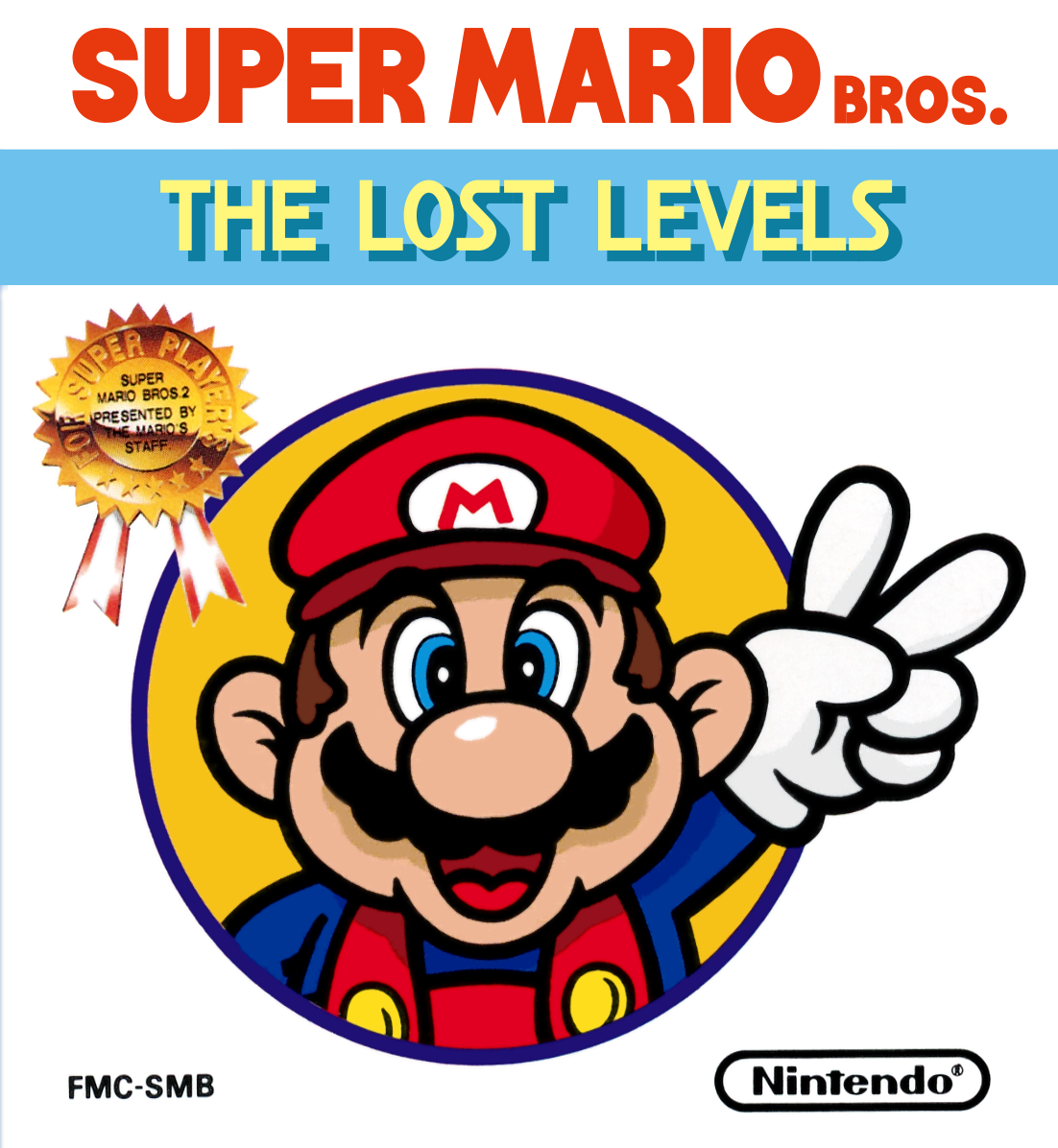
That left the original Super Mario Bros. 2 (Japan) or Super Mario Bros.: The Lost Levels (USA). I knew the game was famous (infamous?) for its difficulty, Therefore, I used all the resources I had at hand. I played the Super Mario All-Stars version on Switch Online so I could have restore points and rewind at my fingertips. Boy, did I need them, and I used them liberally. Thanks to them, however, I could fully complete the game. I played every level in every world (Worlds 1-9 & A-D), and again, I did not use warp pipes.I racked up a total of 13 lives and high score of 856,000. And I did it all in a matter of 3 1/2 hours game play hours in a span of the week of September 6-12.
2/3 the way through 2020, and I had already played and finished all 21 Super Mario games. With about a third of the year remaining, I figured I had enough time to go back and complete the near complete games. The first one was Super Mario Galaxy 1. For that game, I collected all 120 stars and beat Bowser a second time as Mario. So for Super Mario Galaxy 1, I completed the game as Mario, but I did not fully complete the game because that would involve completing it as Luigi, and this is the Year of Super Mario, not the Year of Luigi. From there I moved on to New Super Mario Bros. 1 on the Nintendo DS. This one I did 100% fully, earning those 3 beautiful stars on my profile. And I completed all these game by the end of October.

Also during October, Nintendo released Super Mario 35, a Super Mario battle royale to celebrate the 35th birthday of Mario. While there isn't a way to finish or complete Super Mario 35, with the help of my wife Carrie, we unlocked and cleared every level, collected over 100,000 coins, knocked out 150 other players and reached over level 150. I have finished in 1st place 13 times, and she finished in 1st place 2 times, for a total of 15 1st place finishes. This may be a hot take, but I feel like Super Mario Bros. 35 is what the original Super Mario Bros. 1 should have been. In Super Mario Bros. 1, there is no need to beat enemies, and many speedrunners have demonstrated this by avoiding enemies altogether. Super Mario Bros. 35 encourages defeating enemies in order to increase the time. While collecting 100 coins in Super Mario Bros. 1 can give the player an extra life, besides that, they have no need. In Super Mario Bros. 35, players can spend 20 coins to randomly get a helpful item in need. This encourages players to collect coins, which in the original games, players can do without collecting any coins. While I think that fan made Super Mario Battle Royale is better than Super Mario Bros. 35, I appreciate Nintendo made their own battle royale which does not favor speedrunners. Even speedrunners need to slow down to collect coins, collect items and beat enemies. I hope the popularity of the game will encourage Nintendo to keep the game active past its March expiration date.
And with Super Mario 35, thus concluded my Year of the Super Mario. In my Year of Super Mario, I played 19 of 21 Super Mario games (20 of 22, if you include Super Mario 35). I decided not play (or rather, replay) New Super Mario Bros. Wii and New Super Mario Bros. U because I played them in the recent past, and I came near completing them the first time playing them. In my Year of Super Mario, I spent a total of 243 hours 7 minutes on Super Mario games. That's averaging 11 hours 34 minutes per Super Mario game. While you can call me a Super Mario fanboy, I'm not sure you can call me a Mario fanboy just yet. I will have play some other Mario games to deserve that title, not just Super Mario platforming games ;)